
Clerkenwell Priory
Clerkenwell Priory was the English headquarters and the residence of the Grand Prior for the Monastic Order of the Knights Hospitallers of St John of Jerusalem. Founded in the reign of Henry II, it played a significant role throughout medieval England, hosting royal councils and notable figures, and was a base for crusades. Despite destruction by fire and the Peasants' Revolt, it was rebuilt and later dissolved under Henry VIII, with its remnants surviving today as St John's Gate and an underlying crypt.
Key Facts
- ›Served as the English headquarters for the Knights Hospitallers.
- ›Founded in the reign of Henry II, with its church consecrated in 1185.
- ›Hosted significant royal figures and aulic councils.
- ›Suffered destruction during the Peasants' Revolt but was rebuilt by 1504.
- ›Dissolved by Henry VIII in the 16th century.
- ›Remnants include St John's Gate and an Early English crypt.

Early English, Gothic
St John's Gate, Early English Crypt, Site of Royal Councils
- Priory of the Hospital of St John of Jerusalem
Jordan Briset, Heraclius, Thomas Malory, Theodoric, King John, Edward I, Eleanor of Castile, Henry Iv, Henry V, Richard Iii, Sir Thomas Docwra, William Camden, Henry Vii, Suleyman the Magnificent, L'Isle Adam, Henry Viii, William Weston, John Dudley, 1st Duke of Northumberland, Edward Vi, John Stow, Mary I, Cardinal Pole, Elizabeth I, Edmund Tylney, James Vi and I, Lord Aubigny, Sir William Cecil, Earl of Elgin, Joseph Hall, Charles I, Gilbert Burnet
- Consecration of the Church In 1185
- Aulic Council Held By Henry Ii
- Departure of Hospitallers For Crusade In 1237
- Royal Visits By King John, Edward I, Henry Iv, and Henry V
- Burning By the Mob of the Peasants' Revolt
- Royal Council Held In 1485
- Rebuilding Completed By 1504
- Dissolution By Henry Viii
- Destruction of the Church Body and Bell-Tower Under Edward Vi
- Revival and Restoration Under Mary I
- Reversal of Revival Under Elizabeth I
- Use As A Presbyterian Meeting-House
- Enlargement and Purchase For A New Parish Church In the 18th Century
About Clerkenwell Priory
Clerkenwell Priory, located in present-day Clerkenwell, London, was a significant monastic institution and the English headquarters of the Monastic Order of the Knights Hospitallers of St John of Jerusalem. Observing the Rule of Saint Augustine, the Priory served as the residence for the Order's Grand Prior in England and oversaw extensive landholdings that provided produce and income.
History
Founded by Norman baron Jordan Briset during the reign of Henry II, the Priory's church was consecrated in 1185 by Heraclius, the Patriarch of Jerusalem. It became a site of historical importance, hosting royal events such as an aulic council where Heraclius unsuccessfully urged Henry II to lead a crusade. The Priory was a departure point for knights heading to the Holy Land, as recounted by Matthew Paris in 1237. Despite its medieval heyday, which saw frequent royal visits and substantial expenditure to support the Grand Prior and numerous guests, the Priory was burned down by the mob during the Peasants' Revolt.
Reconstruction efforts led to its full rebuilding by 1504, with notable additions like the grand south gate erected by Sir Thomas Docwra. The rebuilt complex was described by William Camden as resembling a palace with a fine church and a tall tower-steeple. However, its fortunes changed during the Dissolution of the Monasteries under Henry VIII. The Order was dissolved for its adherence to the Pope, and the Priory's lands and buildings were subsequently granted to noblemen.
Under Edward VI, the Priory church was largely destroyed, with its stone used for other constructions. Mary I briefly revived the Order and restored its possessions, undertaking repairs to the church. Upon Elizabeth I's accession, the Order was again sent to Malta, and the Priory buildings were utilized by the Master of the Revels for court plays and masques. In later centuries, parts of the structure served as a private chapel and then a Presbyterian meeting-house before becoming the parish church of St John Clerkenwell in the 18th century. Today, only the reconstructed St John's Gate and an Early English crypt remain as tangible links to the former Clerkenwell Priory.
Source: Wikipedia ↗
Frequently Asked Questions
When was Clerkenwell Priory founded?
Clerkenwell Priory was founded in the reign of Henry II. Its church was consecrated in 1185 by the Patriarch of Jerusalem, Heraclius.
What was the significance of Clerkenwell Priory?
The Priory was the English headquarters for the Knights Hospitallers and the residence of their Grand Prior in England. It was a significant religious and political site throughout the medieval period.
What happened to Clerkenwell Priory during the Dissolution of the Monasteries?
Clerkenwell Priory was dissolved by Henry VIII as part of his wider Dissolution. The King granted the Priory church and complex to John Dudley, 1st Duke of Northumberland.
What remains of Clerkenwell Priory today?
Today, the most prominent remaining structure is Docwra's south gate, largely reconstructed and known as St John's Gate. An Early English crypt also survives beneath the neighbouring parish church of St John Clerkenwell.
Who was buried at Clerkenwell Priory?
Notable figures buried at Clerkenwell Priory include Thomas Malory and Sir Thomas Docwra, the penultimate Grand Prior. The church also served as a burial site for other officers of the order.
Related Monasteries

Ankerwycke Priory
Ankerwycke Priory was a small and relatively poor Benedictine nunnery established around 1160 in Buckinghamshire, England. Dedicated to St. Mary Magdalene, it held lands across several counties. Dissolved in 1536, its revenues were transferred to Bisham Abbey, and the priory site later saw the construction of a manor house. Today, only a small section of ruins remains, situated in Berkshire.
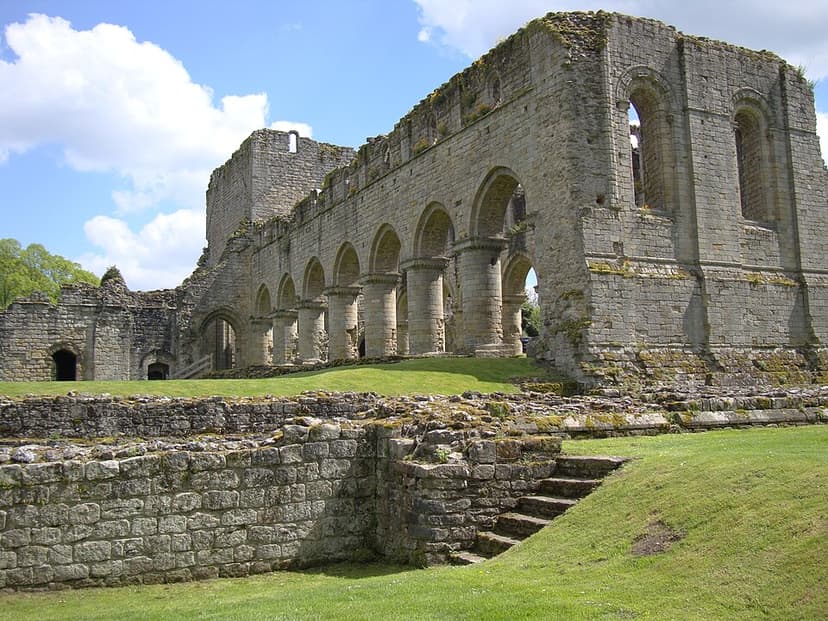
Buildwas Abbey
Buildwas Abbey was a significant Cistercian monastery in Shropshire, England, founded in 1135. It experienced periods of substantial growth and wealth, becoming a center of learning with a notable library. Despite facing challenges from economic crises and conflict, it played a role in royal administration, particularly concerning Ireland and Wales, before its suppression in 1536. Today, substantial remains of the abbey church and monastic buildings are maintained by English Heritage.

Byland Abbey
Byland Abbey was a Savigniac and later Cistercian monastic institution founded in 1135 in North Yorkshire, England. Despite an unstable early history with multiple relocations, it eventually settled at its final site near Coxwold. Once established, it became a significant religious and economic center, renowned for its sheep rearing and wool exports, and boasting a church described as one of the finest 12th-century structures in Europe. Though dissolved in 1538, extensive ruins remain, including the west front of the church with its notable rose window, and the site is maintained by English Heritage.