
Bgheno-Noravank
Bgheno-Noravank is an 11th-century Armenian monastery located in the Syunik province of Armenia, situated on a wooded promontory overlooking gorges. The monastery primarily consists of a small, ornately decorated church built in 1062, featuring biblical reliefs and intricate borders. Its ruins were rediscovered in the 1920s by prose writer Axel Bakunts.
Key Facts
- ›Founded in the 11th century, with the main church dating to 1062.
- ›Located in the Syunik province of Armenia.
- ›Situated on a triangular, wooded promontory surrounded by gorges.
- ›Features a small church with ornate decorations, including biblical reliefs.
- ›Rediscovered in the 1920s by prose writer Axel Bakunts.
- ›Associated with Armenian monastic architecture.

Armenian
Ornately Decorated Church, Biblical Reliefs, Wooded Promontory Location
Axel Bakunts
Rediscovery of Ruins In the 1920s
About Bgheno-Noravank
Bgheno-Noravank (Armenian: Բղենո-Նորավանք) is a historical Armenian monastery situated in the Syunik province of Armenia. Its origins trace back to the 11th century, with the primary surviving structure, a small church, dating to 1062. The monastery's unique setting is a triangular promontory, enveloped by wooded gorges, lending it a secluded and picturesque character.
Architectural Significance
The church at Bgheno-Noravank is notable for its ornate decorations, which include intricate borders and biblical reliefs. These artistic elements provide insight into the craftsmanship and religious iconography prevalent in Armenian architecture of the period. Although now in ruins, the surviving church stands as a testament to the region's rich ecclesiastical history.
Rediscovery and Modern Context
The ruins of Bgheno-Noravank were brought to public attention during the 1920s through the efforts of Axel Bakunts, a prominent Armenian prose writer who also worked as an agronomist. His rediscovery highlighted the historical and cultural importance of the site, which is now recognized for its architectural merit and its connection to Armenia's past. The monastery is considered an important historical monument within the Syunik region.
Source: Wikipedia ↗
Frequently Asked Questions
When was Bgheno-Noravank founded?
The monastery of Bgheno-Noravank dates back to the 11th century. The main church structure that remains was specifically built in 1062.
Where is Bgheno-Noravank located?
Bgheno-Noravank is situated in the Syunik province of Armenia. It is located about 3 km east of Bardzravan village, to the left of the road leading to Shurnukh.
What are the notable architectural features of Bgheno-Noravank?
The primary structure is a small church dating to 1062. It is ornately decorated with borders and biblical reliefs, showcasing the artistic traditions of the time.
Who rediscovered Bgheno-Noravank?
The ruins of Bgheno-Noravank were rediscovered in the 1920s. The individual credited with its rediscovery is Axel Bakunts, a well-known Armenian prose writer.
What is the natural setting of Bgheno-Noravank?
The monastery is uniquely positioned on a triangular promontory. This promontory is surrounded by wooded gorges, contributing to its picturesque and secluded location.
Related Monasteries
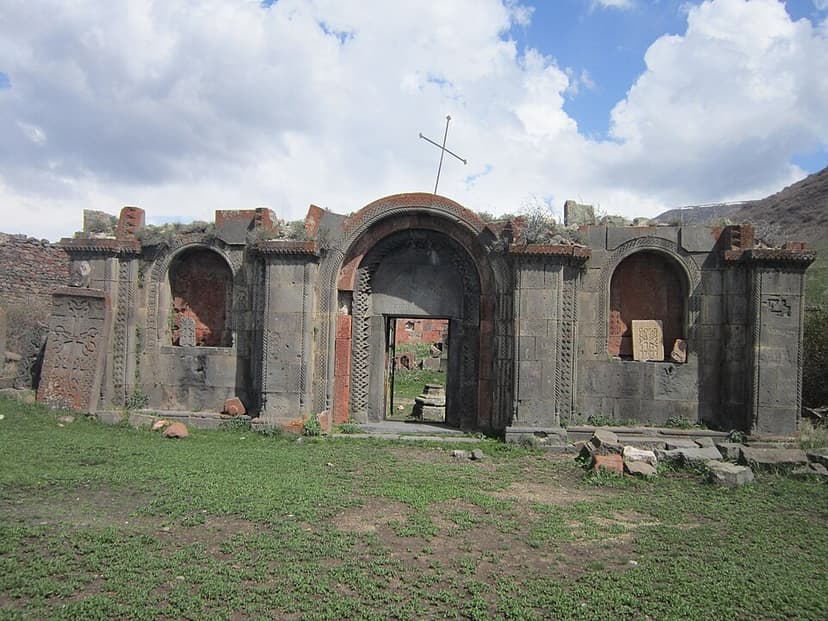
Havuts Tar
Havuts Tar is an 11th to 13th-century walled monastery in Armenia's Kotayk Province, situated on a promontory along the Azat River Valley. Originally constructed between the 12th and 14th centuries, it suffered significant damage from a 1679 earthquake and was later partially rebuilt in the early 18th century. Despite its current state of ruins, the complex features notable decorative reliefs, khachkars, and remnants of monastic buildings, including a church with a unique façade.

Kecharis Monastery
Kecharis Monastery is a significant medieval Armenian monastic complex located in the ski resort town of Tsaghkadzor, Armenia. Originally known as Kecharuk and founded in the 11th century by a Pahlavuni prince, it evolved into a major religious and educational center by the 12th and 13th centuries. The complex, which includes multiple churches, chapels, and a gavit, experienced damage from earthquakes and periods of halted restoration but has since been fully revitalized and is now a prominent landmark visible from the ski slopes.

Makravank Monastery
Makravank Monastery is an Armenian church complex located in Hrazdan, Armenia, within the Kotayk Province. The complex features a 13th-century church dedicated to Surb Astvatsatsin (Holy Mother of God) and a half-ruined 11th-century chapel, along with remnants of a gavit and a medieval cemetery. Its architecture showcases traditional Armenian elements like circular tambours, conical cupolas, and distinctive cross carvings.