
Havuts Tar
Havuts Tar is an 11th to 13th-century walled monastery in Armenia's Kotayk Province, situated on a promontory along the Azat River Valley. Originally constructed between the 12th and 14th centuries, it suffered significant damage from a 1679 earthquake and was later partially rebuilt in the early 18th century. Despite its current state of ruins, the complex features notable decorative reliefs, khachkars, and remnants of monastic buildings, including a church with a unique façade.
Key Facts
- ›The monastery's main construction period was between the 12th and 14th centuries.
- ›It was significantly damaged by an earthquake in 1679 and largely abandoned.
- ›Portions were rebuilt in the early 18th century by Catholicos Astvatsatur Hamadantsi.
- ›The site includes two churches, a gavit, monastic buildings, and an underground chamber likely used as a library.
- ›The main church is distinguished by decorative relief on its exterior and interior walls.
- ›Amenaprkich Church, located on a western outcrop, is believed to have been originally built in the 10th century and rebuilt in 1013.
Medieval Armenian
Fortified Walls, Khachkars, Decorative Reliefs, Churches, Gavit, Underground Chamber
Havuts Tar Vank, All Savior Monastery
Catholicos Astvatsatur Hamadantsi, Abraham Kretatsi, Catholicos Abraham Ii, Gevorg Marzpetuni, Grigor Magistros Pahlavuni, Vasak Pahlavuni
Damaged By An Earthquake In 1679, Partially Rebuilt In the Early 18th Century, Visited By Abraham Kretatsi In 1734
About Havuts Tar
Havuts Tar, also known as Havuts Tar Vank or the 'All Savior Monastery,' is a significant historical monastic complex located in the Kotayk Province of Armenia. Its origins trace back to the 11th century, with the majority of its structures constructed between the 12th and 14th centuries. Perched on a promontory overlooking the Azat River Valley, across from the villages of Goght and Garni, the monastery is nestled within the Khosrov State Reserve and is accessible via the dedicated Havuts Tar Trail.
History and Reconstruction
The monastery suffered severe damage from a major earthquake in 1679, leading to its abandonment in the subsequent years. Despite this devastation, efforts were made to preserve and restore parts of the complex. In the early 18th century, Catholicos Astvatsatur Hamadantsi undertook reconstruction efforts, and further restoration work occurred in the early 20th century. The site was visited in October 1734 by Abraham Kretatsi, who documented his two-day stay at the monastery during his pilgrimage.
Monastic Complex and Architecture
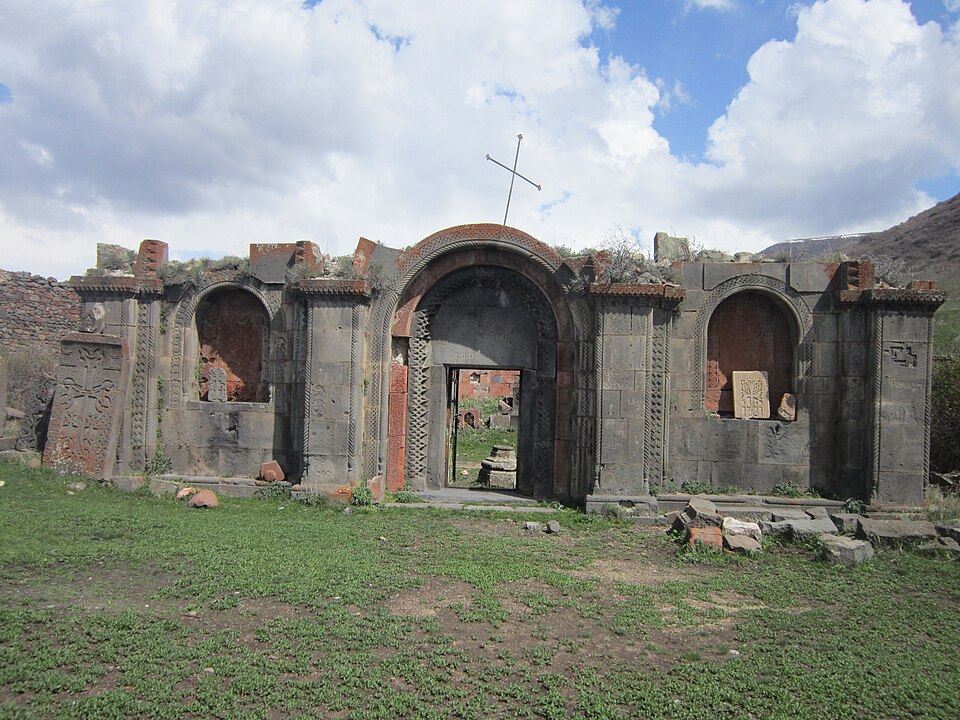
The Havuts Tar complex is enclosed by a fortified wall constructed of roughly hewn stones. Within its confines lie two churches, the ruins of a gavit (narthex) attached to the main church, monastic buildings, vaulted guest chambers, and a large underground chamber believed to have served as a manuscript library. The main church is particularly distinguished by its decorative relief work on both exterior and interior walls, with a highly decorated western façade that uses contrasting colored tuff stones. Adjacent to the north, construction of a new church began in 1772, but it remained unfinished.
Amenaprkich Church
On a western outcrop, overlooking the valley, stands the Amenaprkich Church. Historical accounts suggest it was originally built in the 10th century by Gevorg Marzpetuni and later rebuilt in 1013 by Grigor Magistros Pahlavuni. This church is cross-dome in plan, though its drum and dome have collapsed. Its exterior walls are characterized by an alternating checkerboard pattern of burnt orange and dark gray tuff, a construction technique designed to enhance stability. The church exhibits decorative relief, and numerous inscriptions are visible on its exterior walls. A later-built vaulted church, constructed of grey basalt, is attached to its southern exterior wall.
Source: Wikipedia ↗
Frequently Asked Questions
What is the historical significance of Havuts Tar?
Havuts Tar is an 11th to 13th-century monastic complex that played a role in Armenian religious history. Although heavily damaged by an earthquake in 1679, it was partially restored in the 18th century, indicating its continued importance.
What is the current condition of Havuts Tar?
The majority of the Havuts Tar monastic complex is now in ruins. However, significant portions of its fortified walls, churches, and decorative elements, such as khachkars and relief carvings, are still visible.
How can one visit Havuts Tar?
Havuts Tar is accessible via the Khosrov State Reserve in the Kotayk Province of Armenia. The Havuts Tar Trail leads directly from the east side of the reserve entrance to the monastic complex, taking about thirty minutes to traverse.
Are there any notable architectural features at Havuts Tar?
Yes, the main church is particularly noted for its decorative relief on both exterior and interior walls, utilizing colored tuff to highlight architectural details. The Amenaprkich Church also features a distinctive alternating checkerboard pattern of tuff on its exterior walls.
What does the name 'Havuts Tar' mean?
The name Havuts Tar translates from Armenian as the 'All Savior Monastery'.
Related Monasteries

Bgheno-Noravank
Bgheno-Noravank is an 11th-century Armenian monastery located in the Syunik province of Armenia, situated on a wooded promontory overlooking gorges. The monastery primarily consists of a small, ornately decorated church built in 1062, featuring biblical reliefs and intricate borders. Its ruins were rediscovered in the 1920s by prose writer Axel Bakunts.

Kecharis Monastery
Kecharis Monastery is a significant medieval Armenian monastic complex located in the ski resort town of Tsaghkadzor, Armenia. Originally known as Kecharuk and founded in the 11th century by a Pahlavuni prince, it evolved into a major religious and educational center by the 12th and 13th centuries. The complex, which includes multiple churches, chapels, and a gavit, experienced damage from earthquakes and periods of halted restoration but has since been fully revitalized and is now a prominent landmark visible from the ski slopes.

Makravank Monastery
Makravank Monastery is an Armenian church complex located in Hrazdan, Armenia, within the Kotayk Province. The complex features a 13th-century church dedicated to Surb Astvatsatsin (Holy Mother of God) and a half-ruined 11th-century chapel, along with remnants of a gavit and a medieval cemetery. Its architecture showcases traditional Armenian elements like circular tambours, conical cupolas, and distinctive cross carvings.