
Beeston Regis Priory
Beeston Regis Priory was an Augustinian priory founded in 1216 by Lady Isabel de Cressey. Dissolved in 1538, its remains, particularly the priory church nave and transept, are a Grade I listed ruin. The priory's suppression is believed to have influenced the founding of Gresham's School, and its cloister garden is now part of Priory Farm.
Key Facts
- ›Founded in 1216 by Lady Isabel de Cressey.
- ›Augustinian priory, dissolved in 1538.
- ›Remains are a Grade I listed ruin.
- ›Cloister area is now part of Priory Farm garden.
- ›Its dissolution may have prompted the founding of Gresham's School.
- ›The nave of the priory church is 75 feet long.

Priory Church Nave and Transept Remains, Chapter House Walls, Dormitory Traces, Cloister Garden
Beeston-Next-the-Sea
Lady Isabel De Cressey, Sir John Gresham
Dissolution of the Monasteries
About Beeston Regis Priory
Beeston Regis Priory was an Augustinian priory located in the village of Beeston Regis, Norfolk, England. Founded in 1216 by Lady Isabel de Cressey, it served as a religious institution for the Augustinian order.
History and Dissolution
The priory existed for over three centuries before its eventual dissolution in 1538 as part of the wider Dissolution of the Monasteries. This event marked the end of its monastic life and led to the demolition and repurposing of many of its structures. The suppression of the priory and its associated school is believed to have been a significant factor in Sir John Gresham's decision to found Gresham's School in nearby Holt in 1555.
Architectural Remains
Today, Beeston Regis Priory is primarily known for its substantial ruins, which are designated as a Grade I listed structure. The nave of the priory church, extending from the west wall to the transept, measures 75 feet in length. The north wall of the nave remains largely intact, though window divisions are absent. The west wall stands almost complete to gable height, with modern brickwork replacing the original door lining. The north transept, measuring 24 feet by 24 feet, has an east wall that is almost entirely gone, save for traces of its join with the north wall. A pillar opposite a west-facing door in the south part of the transept is well-preserved. Within the transept, a doorway leading to a presumed sacristy is the sole remaining doorway in its original form, with an almost complete architrave. A small chapel, 23 feet by 12 feet, lies west of the transept, retaining most of its window mouldings. The chancel at the eastern end of the ruin still stands to roof height on its north and south sides, though the original eastern wall has been demolished and replaced with a flint wall up to window-sill level.
Associated Features
The cloister, once situated to the south of the priory church nave, is now part of the Priory Farm garden. East of the cloister, remnants of the chapter house walls and traces of the dormitory persist. The refectory and other domestic buildings are likely located beneath or have been incorporated into the 18th-century Priory Farmhouse, which was likely constructed using materials salvaged from the demolition of the earlier monastic buildings. Near the priory ruins, the Priory maze operates as a popular tourist attraction, complete with a café-restaurant and garden centre.
Source: Wikipedia ↗
Frequently Asked Questions
When was Beeston Regis Priory founded?
Beeston Regis Priory was founded in the year 1216. The founder was Lady Isabel de Cressey.
What religious order was Beeston Regis Priory part of?
Beeston Regis Priory was an Augustinian priory. The Augustinian order follows a rule based on St. Augustine's writings.
What happened to Beeston Regis Priory?
The priory was dissolved in 1538 as part of the Dissolution of the Monasteries. Much of its structure was subsequently demolished or incorporated into other buildings.
What remains of Beeston Regis Priory today?
Significant remains of the priory church, including the nave and transept, are still standing. Parts of the chapter house walls and traces of the dormitory are also visible. The cloister area is now part of the Priory Farm garden.
Is Beeston Regis Priory open to the public?
While the priory itself is a ruin, the adjacent Priory Maze, a popular tourist attraction, includes a café-restaurant and garden centre, suggesting some public access to the associated grounds.
Related Monasteries

Dunkeswell Abbey
Dunkeswell Abbey was a Cistercian monastery founded in 1201 by William Briwere, granting it significant property in Devon. Following its dissolution in 1539, the abbey was largely demolished, with parts remaining in domestic use until the 19th century. A parish church was later built on a portion of the site, and surviving fragments of the abbey can still be found.
Hailes Abbey
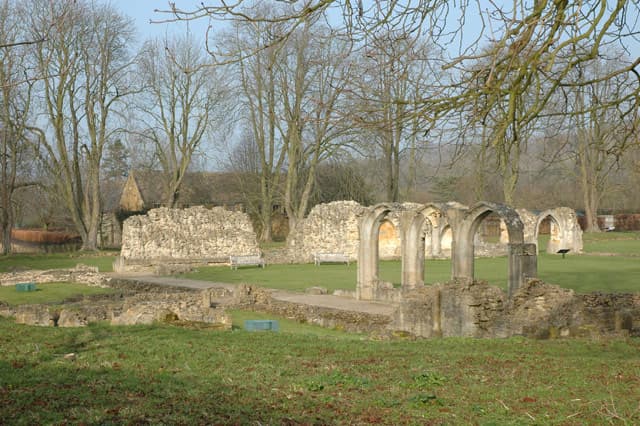
Hailes Abbey was a Cistercian monastery founded in 1246 by Richard of Cornwall. It rose to prominence as a major pilgrimage site after the donation of a phial believed to contain the Holy Blood. Despite attempts to save it by admitting the relic was fake, the abbey was dissolved by Henry VIII in 1539, and little of its structure now remains.
Ashridge Priory
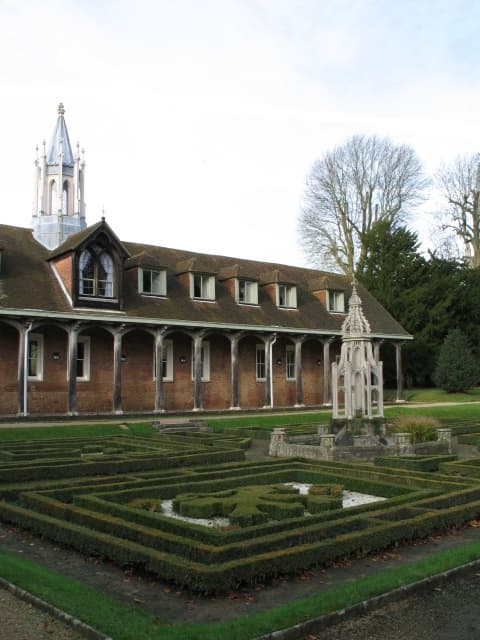
Ashridge Priory was a medieval college of Austin canons, established in 1283 by Edmund of Almain. It was known as the "Brothers of Penitence" or the "Boni Homines" and gained wealth through donations, particularly a phial of Christ's blood. After its dissolution, it served as a royal residence and later became a private estate before being demolished.