
Banjska Monastery
Serbian Orthodox·Kosovo·Partially rebuilt, protected monument·14th century
Banjska Monastery is a Serbian Orthodox monastery located in Kosovo, founded between 1313 and 1317 by King Stefan Milutin as his intended mausoleum. Despite its early grandeur and status as a royal endowment, it suffered significant damage and abandonment over centuries, including a fire that destroyed its library and eventual repurposing as a mosque. Significant conservation efforts have been undertaken, and it remains a protected Monument of Culture of Exceptional Importance.
Key Facts
- ›Founded by King Stefan Milutin between 1313 and 1317.
- ›Originally intended as the royal mausoleum for King Stefan Milutin.
- ›Received a large endowment of 75 villages and 8 pastures upon its founding.
- ›Was once a stavropegial (Imperial) monastery, ranking high in the state.
- ›Suffered destruction from fire and was later converted into a mosque.
- ›Declared a Monument of Culture of Exceptional Importance in 1990.

RašKa
Church of St Stephen, Library, Monks' Quarters, Imperial Palace
Manastir Banjska, Manastiri I BanjskëS
Stefan Milutin, Archpriest Danilo Domazetović, Archbishop Danilo Ii
- Banjska Monastery Founded
- King Stefan Milutin Buried and Later Relocated
- Library Destroyed By Fire
- Monastery Abandoned and Razed
- Church Converted To A Mosque
- Conservation Work In 1939 and 1990
- Banjska Attack
About Banjska Monastery
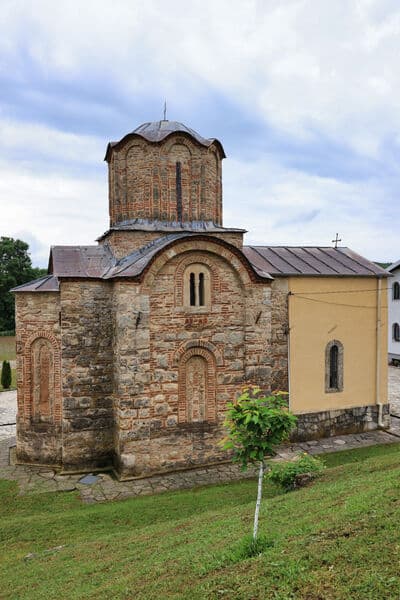
Banjska Monastery is a significant Serbian Orthodox monastic complex located in Banjska village near Zvečan, Kosovo. Its construction was initiated by King Stefan Milutin, a prominent ruler of the Nemanjić dynasty, between 1313 and 1317. The monastery was conceived as King Milutin's royal mausoleum, a purpose reflected in its grand architecture and initial endowment, which included 75 villages and 8 pastures. The building works were overseen by Archbishop Danilo II, who was a close confidant of the king.
History and Decline
From its inception, Banjska Monastery was designed to be a monumental structure, featuring not only the church but also a library, monks' quarters, and an "imperial palace." However, its grandeur was short-lived. A fire in the early 15th century destroyed the library, and by the latter half of that century, the monastery was likely abandoned. Historical accounts suggest it was razed to the ground in the 16th century by order of the Ottoman Sultan, as it had become a refuge for Christians fleeing Ottoman rule. The main church, St Stephen's, was severely damaged and later converted into a mosque in the 19th century, serving as such until World War I.
Restoration and Significance
Conservation efforts began in 1939, with further partial rebuilding of the church in 1990. The monastery is notable for possessing its original founding charter. Due to its royal connection, the bishopric was elevated to a stavropegial status, signifying its imperial importance within the state. Considered one of the most beautiful Serbian monasteries in its time, built in the Raška architectural style, Banjska Monastery was declared a Monument of Culture of Exceptional Importance in 1990 and is protected by the Republic of Serbia. Despite its historical tribulations, it continues to be an active religious site, with Archpriest Danilo Domazetović serving as its head since 2010.
Source: Wikipedia ↗
Frequently Asked Questions
Who founded Banjska Monastery?
Banjska Monastery was founded by King Stefan Milutin, one of the most powerful rulers of the Nemanjić dynasty, between 1313 and 1317.
What was the original purpose of Banjska Monastery?
The monastery was built by King Stefan Milutin as his personal mausoleum, and he was initially buried there in 1321.
What is the current status of Banjska Monastery?
While parts of the church have been rebuilt through conservation efforts, the monastery has a complex history of disrepair and abandonment. It is recognized as a Monument of Culture of Exceptional Importance and is under the spiritual leadership of Archpriest Danilo Domazetović.
Has Banjska Monastery always been a religious site?
The church of St Stephen within the monastery complex was turned into a mosque in the 19th century and served that purpose until World War I, indicating periods where it did not function solely as an Orthodox monastery.
What significant historical events are associated with Banjska Monastery?
The monastery was the site of the Banjska attack in September 2023, where armed Serbs confronted Kosovo Police. Historically, it also saw the relocation of King Milutin's remains after the Battle of Kosovo and was razed on the orders of an Ottoman Sultan.
Related Monasteries

Gračanica Monastery
Gračanica Monastery is a Serbian Orthodox monastery in Kosovo, built by King Stefan Milutin in 1321. Recognized as a Monument of Culture of Exceptional Importance and a UNESCO World Heritage site, it is celebrated for its Serbo-Byzantine architecture and well-preserved frescoes, particularly those within the narthex depicting the Nemanjić dynasty genealogy. The monastery has endured significant historical events, including damage during Ottoman rule and recent bombings, but continues to operate as an active convent and a vital spiritual and cultural center for the Serbian community in Kosovo.
Budisavci Monastery
Budisavci Monastery is a medieval Serbian Orthodox monastery located in the village of Budisavci, near Klina and Peja. Founded in the early 14th century, the church is dedicated to the Transfiguration of Jesus Christ and is considered an important religious and cultural monument of medieval Serbian heritage. While its original frescoes are lost, significant repainting occurred in the 16th century, and the monastery remains an active spiritual center.

Gorioč Monastery
Gorioč Monastery is a Serbian Orthodox monastery located in Kosovo, serving as a dependency of Visoki Dečani Monastery. Traditionally founded in the 14th century by Serbian King Stefan Dečanski as a gift to Saint Nicholas, the monastery complex includes a church dedicated to the saint, dormitories, a bell tower, and economic buildings. It is recognized as a cultural monument of exceptional importance in Serbia.