
Angermünde
Angermünde is a historic town in the Uckermark region of Brandenburg, Germany, with a population of around 14,000. Originally an abbreviation of Tangermünde, it developed into an administrative sub-center known for its Protestant churches, schools, and a recently revitalized historic marketplace. Once a hub for enamel production, the town now heavily relies on tourism, leveraging its location amidst game-filled forests and numerous lakes.
Key Facts
- ›Located in the Uckermark region, northeast of Berlin.
- ›Has a population of approximately 14,000, with a declining industrial base.
- ›Serves as an administrative sub-centre for its district.
- ›Features a recently refurbished historic marketplace with an old town hall.
- ›Declared a federally declared resort town since 2010.
- ›Was part of the Prussian Province of Brandenburg from 1815 to 1947.
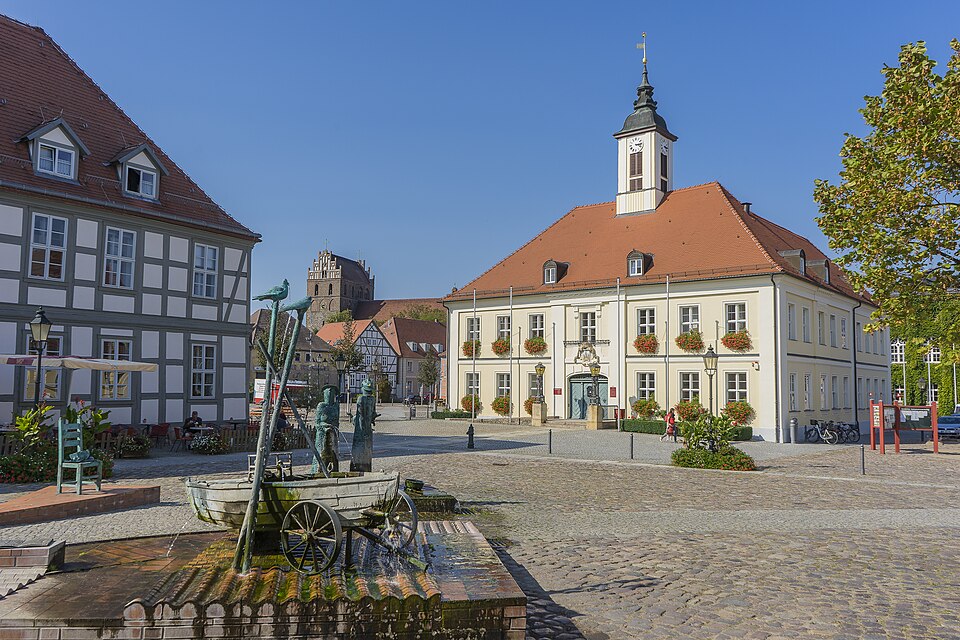
- Several Protestant Churches
- Former Franciscan Church
- Recently Refurbished Historic Marketplace
- Old Town Hall
- Location In the Game-Filled Forests of the Uckermark With Many Lakes
TangermüNde, New-TangermüNde, Neu-TangermüNde
Frederick I of Brandenburg, Wolf-Hugo Just, Wolfgang Krakow, Frederik Bewer, Friedrich Heinrich Von Der Hagen, Albert Manthe, Hermann Dietrich, Ehm Welk, Hans-Erich Voss, GüNter Reimann, Heinrich Borgmann, Hartmut Losch, Maik Heydeck, Julia JäGer
- 1420: Victory of Frederick I of Brandenburg Over the Pomeranians.
- Since 1687: Settlement of French Huguenots and Use of Holy Spirit Chapel As French Church.
- 1815-1947: Part of the Prussian Province of Brandenburg.
- 19th Century: Linked To Berlin By Railway To Stettin, Serving As A Junction For Branch Lines.
- World War Ii: Operation of Five Forced Labour Subcamps of Stalag Iii-C.
- 1947-1952: Part of the State of Brandenburg.
- 1952-1990: Part of the Bezirk Frankfurt of East Germany.
- Since 1990: Part of Brandenburg.
- Since 2010: Federally Declared Resort Town.
About Angermünde
Angermünde is a town situated in the Uckermark district of the state of Brandenburg, located in north-eastern Germany. It lies approximately 69 kilometers (43 miles) northeast of the German capital, Berlin. The town's name has historical roots, originating as an abbreviation of the older settlement of Tangermünde, and was for a time referred to as New-Tangermünde (Neu-Tangermünde).
Name Origins
The name Angermünde is derived from the German word 'Anger,' which signifies a central town square. This nomenclature reflects its historical layout and development.
Geography and Administration
Geographically, Angermünde is nestled within the Uckermark region. The municipality is comprised of its Inner City (Kernstadt) and 23 surrounding districts, along with numerous registered neighborhoods. With a total area of around 324 square kilometers, Angermünde ranks as one of Germany's larger municipalities.
Historical Context
Historically, Angermünde has witnessed significant events. In 1420, it was the site of a notable victory by Frederick I of Brandenburg against the Pomeranians. From 1687 onwards, the town became a settlement for French Huguenots, who utilized the Holy Spirit Chapel as their place of worship. Between 1815 and 1947, Angermünde was integrated into the Prussian Province of Brandenburg. During the 19th century, it was a key administrative center and a railway junction. The town also experienced hardship during World War II, hosting five forced labor subcamps.
Modern Significance
In contemporary times, Angermünde's traditional industrial base, particularly enamel working, has seen a decline. Consequently, the town now places a strong emphasis on tourism, capitalizing on its scenic location. It is characterized by several Protestant churches, a former Franciscan church, various educational institutions, and a recently renovated historic marketplace featuring an old town hall. Since 2010, Angermünde has been officially recognized as a federally declared resort town, further cementing its role as a tourist destination amidst the game-filled forests and numerous lakes of the Uckermark.
Source: Wikipedia ↗
Frequently Asked Questions
What is the origin of the name Angermünde?
The name Angermünde is an abbreviation of the older town of Tangermünde. For a period, the town was known as New-Tangermünde (Neu-Tangermünde) before being changed to Angermünde. The name 'Anger' refers to a central square in a town.
What is Angermünde known for today?
Angermünde is recognized as a federally declared resort town and relies heavily on tourism. Its attractions include its location in the game-filled forests of the Uckermark with many lakes, and its recently refurbished historic marketplace with an old town hall.
What historical events have taken place in Angermünde?
Angermünde was the site of a victory by Frederick I of Brandenburg over the Pomeranians in 1420. French Huguenots settled in the town from 1687, using the Holy Spirit Chapel as their church. During World War II, five forced labor subcamps of the Stalag III-C prisoner-of-war camp were operated in the town.
How is Angermünde geographically situated?
Angermünde is situated in the Uckermark region, approximately 69 km (43 miles) north of Berlin. The municipality is extensive, covering around 324 km², and comprises the Inner City along with 23 adjacent districts and 40 registered neighborhoods.
Related Monasteries

Itzehoe Abbey
Itzehoe Abbey was originally founded as a Cistercian monastery in the 1230s, later relocating to Itzehoe in 1263. Following the Reformation, it was transformed in 1541 into a noble Protestant ladies' convent, a status it maintains today. The convent continues to own significant land and forest properties, and its historical courtyard once formed an independent rural municipality within the city.

Elsey Abbey
Elsey Abbey, originally Elsey Priory, was a women's religious house established around 1220 near Hagen, Germany. Initially founded for Premonstratensian canonesses, it evolved into a secularstift for noble canonesses in the 15th century. During the Reformation, the abbey adopted Protestantism and was eventually dissolved in 1810.

Brilon
Brilon is a town in North Rhine-Westphalia, Germany, with a history dating back to at least 973 AD. Originally a significant settlement and later a fortified town under the Archbishops of Cologne, it developed into a thriving trading and mining center and a member of the Hanseatic League. Despite periods of conflict and economic decline, Brilon regained importance as a district center after the Napoleonic era and has since experienced further development, notably after the local government reforms of 1975 which expanded its administrative area.