
Alexander-Svirsky Monastery
Russian Orthodox·Russia·Partially active monastic community, part mental asylum, parts restored·15th century
The Alexander-Svirsky Monastery, founded in 1487, is a significant Russian Orthodox monastery located in the Leningrad Oblast. It gained prominence in the 17th century and is known for its unique architectural features, including a preserved three-tented belfry and medieval clock tower. Despite periods of destruction and secularization, the monastery has undergone restoration and continues to be a site of religious and historical importance.
Key Facts
- ›Founded in 1487 by a monk named Alexander, formerly of Valaam Monastery.
- ›Developed into twin cloisters: the Trinity and the Transfiguration.
- ›The founder, Alexander of the Svir, was canonized in 1547 and is venerated throughout Russia.
- ›Boasts one of the few preserved three-tented belfries and medieval clock towers in Russia.
- ›Experienced periods of prosperity due to royal privileges and trade through the Svir Fair, but also suffered during the Time of Troubles and after the Russian Revolution.
- ›Restoration efforts began in the 1970s.

Medieval, Baroque
Three-Tented Belfry, Medieval Clock Tower, Relics of St. Alexander of Svir
александро-свирский монастырь
Alexander of Svir
- Founded In 1487
- Canonization of Alexander of the Svir In 1547
- Sacked and Burnt By Swedes During the Time of Troubles
- Secularization of Lands In 1764
- Persecution of Monks and Desecration of Relics After the Russian Revolution
- Used As A Gulag Labor Camp
- Damaged During World War Ii
- Restoration Began In the 1970s
About Alexander-Svirsky Monastery
The Alexander-Svirsky Monastery is a historic Russian Orthodox monastic complex situated in the Leningrad Oblast, nestled within extensive woodlands near the Svir River. Its origins trace back to 1487 when a monk named Alexander, formerly of the Valaam Monastery, established a hermitage. Inspired by a vision of the Holy Trinity, he was directed to build two chapels, dedicated to the Trinity and the Saviour's Transfiguration. These foundations eventually grew into the twin Trinity and Transfiguration cloisters, which together form the Alexander Svirsky Monastery.
History and Significance
The monastery's founder, Alexander of the Svir, was canonized by the church synod in 1547, and his veneration spread throughout Russia, with even chapels in Saint Basil's Cathedral in Moscow consecrated to him. The monastery flourished over the centuries, receiving significant privileges from Russian tsars, including rights related to the annual Svir Fair, which boosted its economic importance. Despite suffering damage and destruction during the Time of Troubles from Swedish invasions, the monastery continued to prosper, particularly after the Russian-Swedish border was settled nearby, channeling trade through the fair.
Architectural Development and Later History
The 17th century marked a golden age for the monastery, with considerable rebuilding and expansion. Notable structures erected during this period include the five-domed Transfiguration Cathedral (completed in 1644), a three-tiered belfry crowned with three tents (1649), monastic cells from the 1670s, and the Trinity Cathedral (completed by 1695). The hospital chapel of St. John of Damascus was added in 1718. However, Catherine the Great's ecclesiastical reforms in 1764 led to the secularization of the monastery's vast lands. Following the Russian Revolution of 1917, the monks faced severe persecution; they were imprisoned and executed, and the relics of St. Alexander were desecrated. The monastery's buildings were repurposed as the Svirlag gulag labor camp and suffered further damage during World War II. Restoration efforts commenced in the 1970s, and as of the early 21st century, the Transfiguration Cloister houses an active monastic community, while the Trinity Cloister was occupied by a mental asylum. The monastery also maintains a subsidiary chapel in St. Petersburg.
Source: Wikipedia ↗
Frequently Asked Questions
When was the Alexander-Svirsky Monastery founded?
The Alexander-Svirsky Monastery was founded in 1487. It originated when a monk named Alexander settled in the woods and was inspired by a vision to build two oaken chapels.
What is the religious tradition of the Alexander-Svirsky Monastery?
The monastery is a Russian Orthodox monastery. It follows the traditions of the Orthodox Church and is dedicated to St. Alexander of Svir.
What are some notable architectural features of the monastery?
The monastery is distinguished by its preserved three-tented belfry and a medieval clock tower. These are rare examples of such structures remaining in Russia.
What happened to the monastery after the Russian Revolution?
Following the 1917 revolution, the monks were persecuted, and the relics of St. Alexander were desecrated. The monastery buildings were used as a gulag labor camp and were further damaged during World War II.
What is the current status of the twin cloisters?
As of 2005, the Transfiguration Cloister houses a local monastic community. The Trinity Cloister, however, was used to house a mental asylum established in 1953.
Related Monasteries
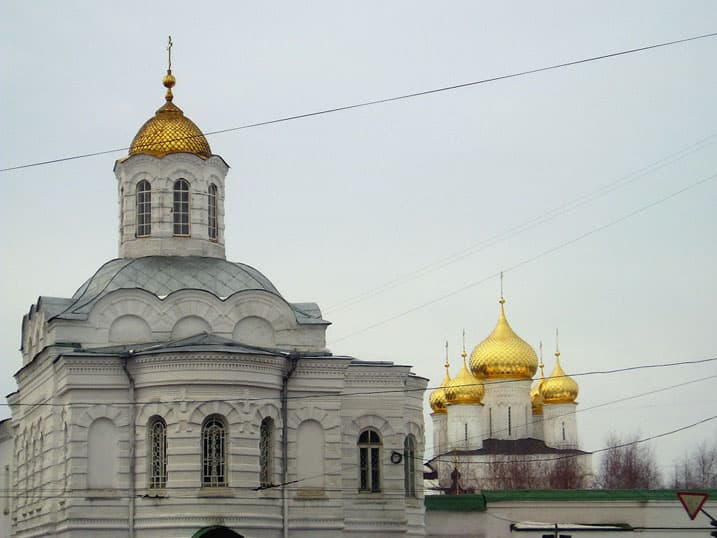
Bogoyavlensky Monastery (Kostroma)
Bogoyavlensky Convent, located in Kostroma, is a prominent Russian Orthodox convent renowned for housing the ancient Feodorovskaya Icon of the Mother of God. Originally founded as a monastery in the 15th century, it underwent significant construction and stylistic changes throughout its history, including a major rebuilding in the Russian Revival style in the late 19th century, after which it became a convent. Despite abolishment after the October Revolution, it was revived in the 1990s.

Krypetsky Monastery
Krypetsky Monastery is a Russian Orthodox monastery located near Pskov, founded in 1485 by Saint Savva Krypetsky. Initially established in a difficult marshland, it received support from the Pskov veche and later saw expansion and improvements. Despite periods of disrepair and closure by the Bolsheviks in 1918, the monastery was revived and restituted to the Russian Orthodox Church in 1991.

Makaryev Monastery
The Zheltovodsky Makaryev Convent, historically a men's monastery, is a significant Russian Orthodox site known for its legendary foundation by Saint Macarius in the early 15th century. It played a crucial role in the economy due to the famous Makaryev Fair held outside its walls for over two centuries. After facing destruction, relocation of the fair, and dissolution, it was resurrected as a women's convent in the late 19th century and continues to operate today.