
Abbeyfeale Abbey
Roman Catholic·Ireland·Ruins (largely disappeared, remnants incorporated into church)
Abbeyfeale Abbey was a historical monastic site in County Limerick, Ireland, whose remnants were incorporated into the Roman Catholic Church built on its former location in 1847. While the abbey itself has largely disappeared, its legacy is preserved in the town's continued association with religious and cultural life, including a local priest, Father William Casey, who is commemorated with a statue and a GAA club named in his honor.
Key Facts
- ›The abbey's remnants were used in the construction of the Roman Catholic Church in 1847.
- ›The current boys' national school is located on the site of the former abbey.
- ›The town of Abbeyfeale is situated on the banks of the River Feale.
- ›A statue of Father William Casey, a significant parish priest from 1883 to 1907, is a main feature in the town square.
- ›The town is known for its traditional music festival, 'Fleadh by the Feale'.

- Remnants Incorporated Into Roman Catholic Church
- Statue of Father William Casey
- River Feale
Mainistir Na FéIle
Father William Casey
- Remnants Used In Construction of Roman Catholic Church In 1847
About Abbeyfeale Abbey
Abbeyfeale Abbey was a historical monastic site located in the town of Abbeyfeale, County Limerick, Ireland. While the abbey itself has largely vanished, its presence is marked by the Roman Catholic Church built in 1847 on its former grounds, with some of its remnants incorporated into the new structure. The site of the former abbey is now occupied by the boys' national school.
Historical Context
The town of Abbeyfeale is situated on the River Feale and has a history that includes a notable event in 1418 concerning Thomas FitzGerald, 5th Earl of Desmond, who was dispossessed of his lands after marrying Catherine MacCormac of Abbeyfeale. This marriage, between a man of Norman blood and a woman of Gaelic ancestry, was in violation of the Statutes of Kilkenny.
Legacy and Town Features
Today, Abbeyfeale is a market town known for its cultural traditions. A prominent feature in the town square is a statue of Father William Casey, a significant parish priest who ministered from 1883 to 1907 and advocated for tenant farmers. His influence is remembered through the local Gaelic football club, Fr. Caseys GAA Club. The town also hosts the annual 'Fleadh by the Feale' traditional music festival, highlighting its rich musical heritage.
Source: Wikipedia ↗
Frequently Asked Questions
What remains of Abbeyfeale Abbey today?
The abbey itself has all but disappeared. The only identifiable remnants were used in the construction of the Roman Catholic Church in 1847, which is located on the site of the current boys' national school.
Where is Abbeyfeale Abbey located?
While the abbey no longer stands, the town of Abbeyfeale, where it was historically situated, is located in County Limerick, Ireland, near the border with County Kerry. It is on the banks of the River Feale.
Is there any notable structure associated with the abbey's former site?
Yes, the Roman Catholic Church, built in 1847, stands on the site where the abbey was once located. The boys' national school is also situated there.
What is the historical significance of Father William Casey in Abbeyfeale?
Father William Casey was the parish priest from 1883 to 1907 and was instrumental in helping tenant farmers fight against their landlords. He is commemorated with a statue in the town square and a local Gaelic football club is named in his honor.
Related Monasteries

Abbey of Lerha
The Abbey of Lerha was a significant Cistercian monastery founded in 1205 by Risteárd de Tiúit. Although dissolved in 1539, its ruins remain visible and give the nearby village of Abbeylara its name. The monastery's historical presence is a defining characteristic of the region.

Abbeydorney Abbey
Abbeydorney Abbey, also known as Kyrie Eleison Abbey or Odorney, was established in 1154 by the O Torna chieftains for the Cistercian order, serving as the sole medieval Cistercian foundation in County Kerry. The abbey church, dating from the 15th century, and parts of its claustral buildings remain visible today, with the grounds now functioning as a cemetery populated by gravestones.
Abbeyknockmoy
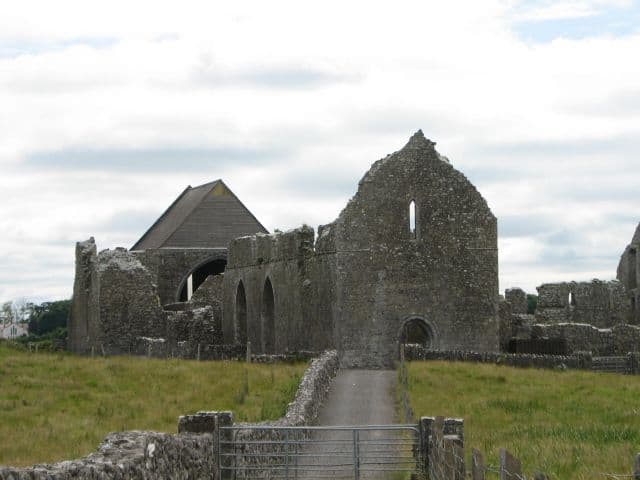
Abbeyknockmoy is a historic Cistercian abbey founded in 1190 in County Galway, Ireland, by the King of Connacht, Cathal Crobhdearg Ua Conchobair. The abbey served as the burial site for King Cathal and is renowned for its surviving medieval wall paintings and sculptures, which show connections to other Cistercian sites in western Ireland. Although now in ruins, it remains a significant historical and artistic monument.