
Vishvarupa
Vishvarupa is an iconographical form and theophany of the Hindu deity Vishnu, most famously depicted in the Bhagavad Gita. In this supreme form, the entire universe and all its creatures are contained within him, representing his infinite and cosmic nature. This awe-inspiring manifestation is primarily associated with Vishnu as Krishna, revealed to Arjuna on the battlefield of Kurukshetra.
Key Facts
- ›Vishvarupa literally translates to 'universal form' or 'all-formed'.
- ›The most celebrated depiction of Vishvarupa is in the Bhagavad Gita, where Krishna reveals this form to Arjuna.
- ›This form encompasses the entire universe, containing innumerable beings, deities, sages, and forms, both peaceful and wrathful.
- ›Vishvarupa is considered the supreme and cosmic form of Vishnu, displaying his omnipresence and infinitude.
- ›Early iconographical depictions often featured multiple heads (human, animal avatars) and arms, evolving over time.

Virāḍrūpa, Vishwaroopa
- Innumerable Forms, Eyes, Faces, Mouths, and Arms
- Contains Peaceful and Wrathful Forms
- the Entire Universe and All Creatures Within His Body
- Early Depictions: Three Heads and Four Arms; Ten Heads and Ten Arms; Six Arms and Three Visible Heads ; Three Visible Animal Heads and Eight Arms
- Later Depictions: Three Human Heads and Fourteen Arms; Four Faces and Twenty Arms Holding Various Attributes
- Modern Depictions: Many Heads, Some Breathing Fire, Many Hands Holding Weapons, Arjuna Often Depicted Bowing
Bhagavad Gita, Mahabharata, Harivamsa, Vishnudharmottara Purana, Bhagavata Purana, PañCaratra Texts
Jyotisar
Conch, Sudarshana Chakra, Gada, Bow, Sword Nandaka, Vajra, Ankusha, Arrow, Lime Fruit, Danda, Pasha, Sword, Lotus, Horn, Musala, Akshamala
Supreme Form, Cosmic Manifestation
About Vishvarupa
Vishvarupa, meaning 'universal form', is a significant iconographical manifestation and theophany of the Hindu deity Vishnu. This supreme form encapsulates the entirety of the cosmos, containing within itself all beings, divine entities, sages, and myriad forms, encompassing both tranquil and fierce aspects. It represents Vishnu's omnipresence and infinite nature, serving as a profound symbol of his cosmic dominion.
Revelation in the Bhagavad Gita
The most celebrated depiction of Vishvarupa occurs in the Bhagavad Gita, a pivotal scripture within the epic Mahabharata. Here, Krishna, an avatar of Vishnu, reveals this awe-inspiring cosmic form to the Pandava prince Arjuna on the battlefield of Kurukshetra. Arjuna, grappling with a moral crisis, is granted divine vision to witness this overwhelming manifestation, which serves to dispel his doubts and encourage him to fulfill his duty.
Literary and Artistic Depictions
Beyond the Bhagavad Gita, other passages in the Mahabharata describe similar cosmic theophanies. The Harivamsa and other Puranic texts also feature Vishvarupa, sometimes in relation to Vishnu's avatar Vamana. Early artistic interpretations, beginning around the 5th-6th centuries CE, grappled with portraying this infinitude. Iconography evolved from depicting multiple heads (human and animal avatars like Narasimha and Varaha) and arms to more elaborate representations incorporating a vast array of divine and worldly elements, often conveying a sense of 'sacred terror' as experienced by Arjuna. Modern depictions continue to illustrate this cosmic grandeur, frequently showing Arjuna in humble reverence before the divine display.
Source: Wikipedia ↗
Frequently Asked Questions
What is Vishvarupa?
Vishvarupa is an iconographical form and theophany of the Hindu deity Vishnu. It represents his supreme, cosmic form where the entire universe is contained within him. This manifestation is most famously described in the Bhagavad Gita.
Who revealed the Vishvarupa form?
The Vishvarupa form was revealed by Krishna, who is an avatar of Vishnu, to the Pandava prince Arjuna. This occurred on the battlefield of Kurukshetra during the Mahabharata war.
What is depicted in the Vishvarupa form?
The Vishvarupa form is described as having innumerable forms, eyes, faces, mouths, and arms. All creatures of the universe are seen as part of him, and he contains both peaceful and wrathful aspects. The entire infinite universe is encompassed within this form.
Why did Krishna reveal the Vishvarupa to Arjuna?
Krishna revealed the Vishvarupa form to Arjuna to alleviate his crisis of conscience and to discourse with him about life, death, dharma, and yoga. This profound vision encouraged Arjuna to continue with his duty in the Mahabharata War.
Are there other descriptions of Vishvarupa in the Mahabharata?
Yes, the Mahabharata contains other descriptions of Krishna or Vishnu-Narayana displaying a cosmic form. One of these was shown to Duryodhana, featuring many arms holding Vishnu's attributes, and another, called Vishvamurti, was revealed to the sage Narada.
How did early art depict Vishvarupa?
Early artistic depictions faced the challenge of portraying infiniteness. Sculptors often chose to represent Vishvarupa with multiple heads, such as human, lion (Narasimha), and boar (Varaha) heads, and several arms. Beings and avatars of Vishnu would emerge from the main figure.
Related Hindu deities

Perumal
Perumal, also known as Tirumal, is a major Hindu deity, primarily worshipped by Tamil Hindus in South India and the diaspora. He is widely considered a form of Vishnu, the preserver deity in the Hindu trinity. Perumal is celebrated for his grace and is the supreme deity in Vaishnavism, with numerous temples dedicated to him across India and beyond.
Junior wives of Krishna
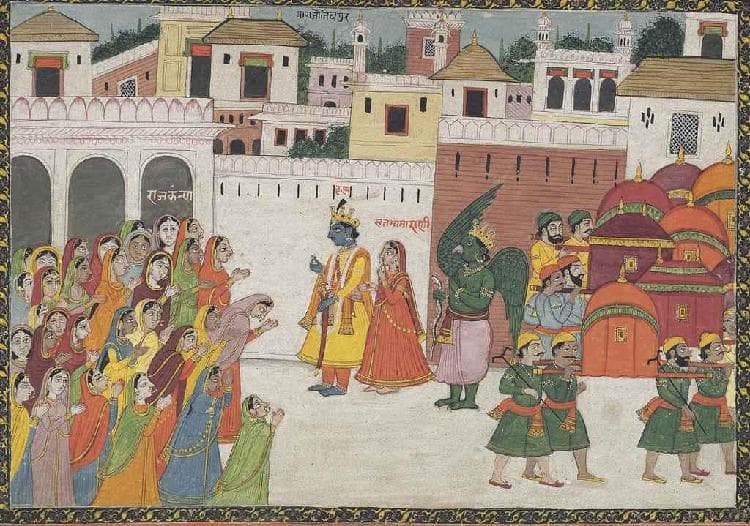
The junior wives of Krishna refer to the approximately 16,000 women Krishna married after rescuing them from the demon Narakasura. These women are often identified as manifestations of Lakshmi, Krishna's eternal consort. Their story highlights Krishna's divine power and compassion in saving and providing for them.

Buddha
In Hinduism, particularly within the Vaishnava tradition, the Buddha is revered as the ninth avatar of the god Vishnu. This integration into Hindu cosmology aimed to absorb and account for the rise of Buddhism, with some Hindu texts describing Vishnu taking the form of Buddha to delude demons and restore cosmic order. While many Hindus today still consider Buddhism a form of Hinduism and revere the Buddha, some scholars and religious figures reject this identification, asserting that Gautama Buddha and the Vishnu avatar are distinct individuals.