
Maheshwari
8th century·India·Vaishya varna
Maheshwari refers to a Hindu caste primarily found in Rajasthan, India, traditionally engaged in commerce. They are part of the wider Bania community and are often known as Marwaris. The Maheshwaris claim a unique origin story tied to their devotion to Shiva, from whom they derive their name.
Key Facts
- ›A Hindu caste originating from Rajasthan, India.
- ›Traditionally occupied in commerce, forming part of the Bania community.
- ›Often referred to as Marwaris, and prefer the term Mahajans.
- ›Claim a Rajput ancestry and an origin story involving devotion to Shiva.
- ›The community is structured around 72 distinct family lines (kaps).
- ›Some Maheshwari families, like the Birlas, became prominent industrialists in the 20th century.
Maheshvari, Marwaris, Mahajans
Merchant, Industrialist, Entrepreneur
Caste
About Maheshwari
What is the Maheshwari Caste?
The Maheshwari, also spelled Maheshvari, is a prominent Hindu caste originating from the state of Rajasthan in India. Traditionally, their primary occupation has been commerce, positioning them as a significant part of the broader Bania community, which also includes castes like the Khandelwals, Oswals, and Agrawals. The Banias of Rajasthan are frequently referred to as Marwaris, and many within the community prefer the term Mahajans, as 'Bania' can sometimes carry less favorable connotations.
Origin Myths and Community Structure
Maheshwaris hold a distinct claim to ancestry from the Rajput varna. A traditional account recounts that in the 8th century, 72 groups of Kshatriyas in Rajasthan chose to transition from their martial roles to embrace the Vaishya varna, inspired by their profound devotion to the deity Shiva, who is also known as Mahesh. This event is said to have established the 72 distinct family lines, known as 'kaps,' which characterize the close-knit Maheshwari community to this day. These kaps traditionally practice exogamy in marriages and largely adhere to Vaishnavism in their religious practices. A variant origin myth involves Shiva freeing 72 Rajputs from a curse cast by sages, which then inspired their devotion.
Economic and Social Influence
The advent of colonial trade with the British spurred the Marwari people, including the Maheshwaris, to expand their commercial reach. Maheshwaris were among those who migrated to the Deccan Plateau in the early 19th century, becoming active bankers in Hyderabad State by the mid-1800s and emerging as a significant force in Bombay's cotton trade by the late 19th century. In the 20th century, several Maheshwari families, such as the Birlas, utilized their accumulated wealth from trade to rise to prominence as major industrialists and entrepreneurs, demonstrating a significant evolution of their economic role.
Source: Wikipedia ↗
Frequently Asked Questions
What is the traditional occupation of the Maheshwari caste?
The traditional occupation of the Maheshwari caste is commerce. They are part of the broader Bania community, which is historically associated with trade and business.
What is the origin story of the Maheshwari caste?
Maheshwaris claim a Rajput ancestry and have a traditional origin story where 72 groups from the Kshatriya varna abandoned their traditional roles to become Vaishyas due to their devotion to Shiva, whose other name is Mahesh. Another variant myth states Shiva freed them from a curse, inspiring their devotion.
What is another common name for the Maheshwari community?
The Maheshwari community is often known as Marwaris, particularly in Rajasthan. They also prefer to be called Mahajans, as the term 'Bania' can sometimes carry negative connotations.
How is the Maheshwari community structured?
The Maheshwari community is structured around 72 distinct family lines, traditionally known as 'kaps'. These lines are said to have been established at the time of their origin story.
What role did Maheshwaris play in colonial and post-colonial India?
During colonial times, Maheshwaris were among the Marwari merchants who expanded their business interests, moving to regions like the Deccan Plateau for trade. In the 20th century, some families leveraged their accumulated wealth from traditional occupations to become major industrialists and entrepreneurs.
Related Hindu deities
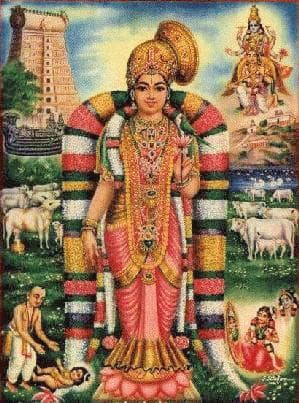
Andal
Andal, also known as Kotai and Nachiyar, is a revered Tamil saint and the only female Alvar among the 12 Alvars who championed Vaishnavism during the Bhakti movement. Considered an avatar of the earth goddess Bhumi, an aspect of Lakshmi, she is celebrated for her profound devotion to Lord Vishnu, particularly Krishna, and her poetic compositions, Tiruppavai and Nachiyar Tirumoli.
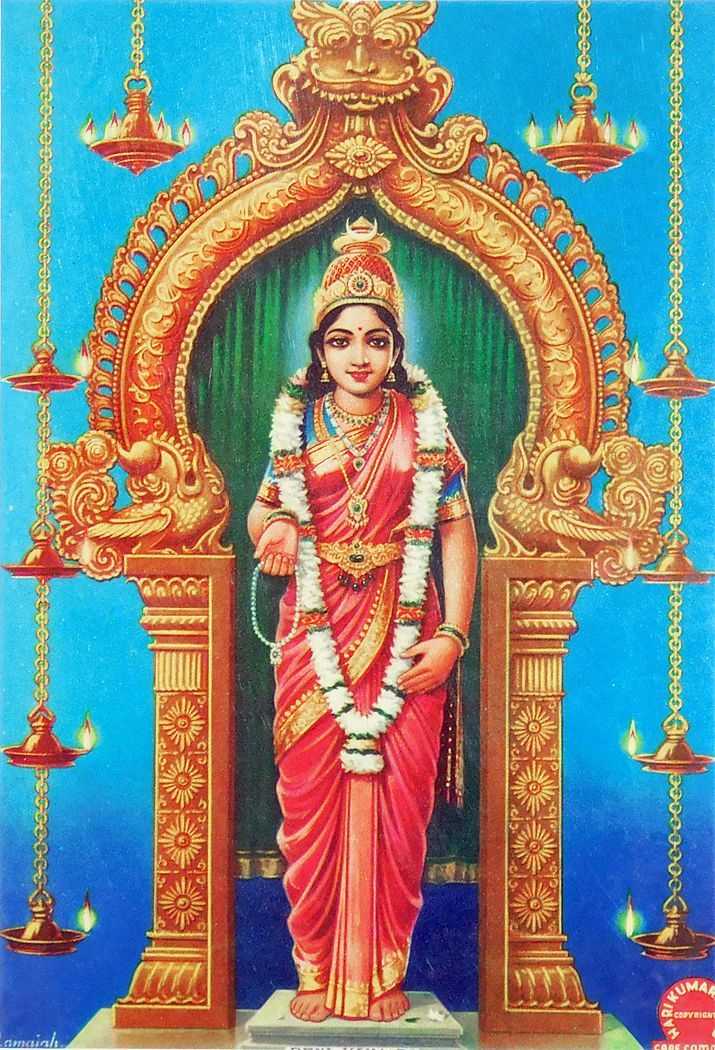
Devi Kanya Kumari
Devi Kanya Kumari is a prominent Hindu goddess, a manifestation of Mahadevi in the form of an adolescent girl. She is revered as a form of Parvati or Lakshmi, and is particularly known for her role in slaying the demon Banasura. Her worship is deeply tied to the town of Kanyakumari at the southernmost tip of India.

Chandraghanta
Chandraghanta is a powerful form of the Hindu goddess Mahadevi, revered as the destroyer of demons and the protector of her devotees. She is the third of the Navadurga and is prominently worshipped on the third day of Navaratri. Her name, meaning 'adorned with the moon as her bell,' refers to the crescent moon on her forehead, and she is depicted with ten arms holding various weapons and a bell.