
Aryaman
Aryaman is an early Vedic deity, considered one of the Adityas and the third son of Kashyapa and Aditi. His name signifies "Life-Partner" or "Close Friend," and he is depicted as the mid-morning sun. Aryaman presides over the customs and social order of Vedic tribes, and is invoked in marriage ceremonies as a witness.
Key Facts
Mid-Morning Sun Disc
Rigveda, Taittiriya Brahmanam
Son of Kashyapa and Aditi
Mares, Stallions
About Aryaman
Aryaman is an ancient deity originating from the Rigvedic period of Hinduism. His name carries significant meanings, including "Life-Partner," "Close Friend," "Sun," "Play-Fellow," and "Companion," reflecting his multifaceted role in Vedic society and cosmology.
Origins and Family
As one of the Adityas, Aryaman is recognized as the third son of the primordial parents Kashyapa and Aditi, who are considered the progenitors of the celestial beings. He is depicted in iconography as the sun disc observed in the mid-morning sky, embodying solar energy and presence.
Role and Significance
Aryaman's primary function in Vedic tradition is as the deity governing the customs and social order that structure various Vedic tribes and communities. He is the divine overseer of societal norms, particularly those related to hospitality. His importance is underscored by his invocation in Hindu marriage rites, where he is called upon to witness the sacred union, ensuring its adherence to established customs. The Rigveda also refers to the Milky Way as "Aryaman's path," associating him with celestial phenomena and cosmic order.
Position Among Deities
While not always considered the most prominent deity, Aryaman holds significant authority. The Rigveda suggests he is a supreme deity, often invoked alongside Mitra and Varuna. Notably, even Indra, traditionally the chief deity of the Rigveda, is depicted as seeking boons and gifts from Aryaman, highlighting Aryaman's considerable influence and power within the Vedic pantheon. His association extends to presiding over specific lunar mansions (nakshatras), with the Rig Veda linking him to Uttara Phalgunī and other texts to Purva Phalgunī.
Source: Wikipedia ↗
Frequently Asked Questions
Who is Aryaman?
Aryaman is an ancient Vedic deity, considered one of the Adityas. His name translates to "Life-Partner" or "Close Friend." He is depicted as the mid-morning sun and is the deity who governs the customs and social order of various Vedic tribes.
What is Aryaman known for?
Aryaman is known as the deity of customs, particularly those related to social order and hospitality. He is also invoked as a witness in Hindu marriage ceremonies. The Milky Way is referred to as his path, and he is seen as the protector of equines.
What is Aryaman's significance in the Rigveda?
In the Rigveda, Aryaman is invoked alongside other deities like Mitra-Varuna and Bhaga. He is sometimes suggested to be a supreme deity alongside Mitra and Varuna, and the Rigveda indicates that even Indra sought boons from him.
What does Aryaman's name mean?
The name Aryaman has multiple significant meanings, including "Life-Partner," "Close Friend," "Sun," "Play-Fellow," or "Companion." These meanings reflect his role in social relationships and his solar attributes.
What are Aryaman's associations with constellations?
Aryaman is sometimes associated with the Uttara Phalgunī Nakshatra (lunar mansion) based on the Rig Veda. However, other texts like the Taittiriya Brahmanam link him to the Purva Phalgunī Nakshatra.
Related Hindu deities

Padmanabha
Padmanabha is a form of the Hindu deity Vishnu, prominently featured in the Padmanabhaswamy Temple in Thiruvananthapuram, Kerala. He is depicted in a state of yogic sleep on his serpent mount, Shesha, and is the tutelary deity of the Travancore royal family. The deity is revered as one of the 108 Divya Desams, sacred sites in the Sri Vaishnava tradition.

Nataraja
Nataraja is a depiction of the Hindu deity Shiva as the divine cosmic dancer, known for his tandava dance. This iconic form symbolizes Shiva's cosmic functions of creation, preservation, and destruction, and is widely revered as one of the highest forms of Shiva, particularly in Tamil Nadu. The Nataraja sculpture is a significant symbol of Indian culture and Hindu art, representing the interconnectedness of religion and the arts.
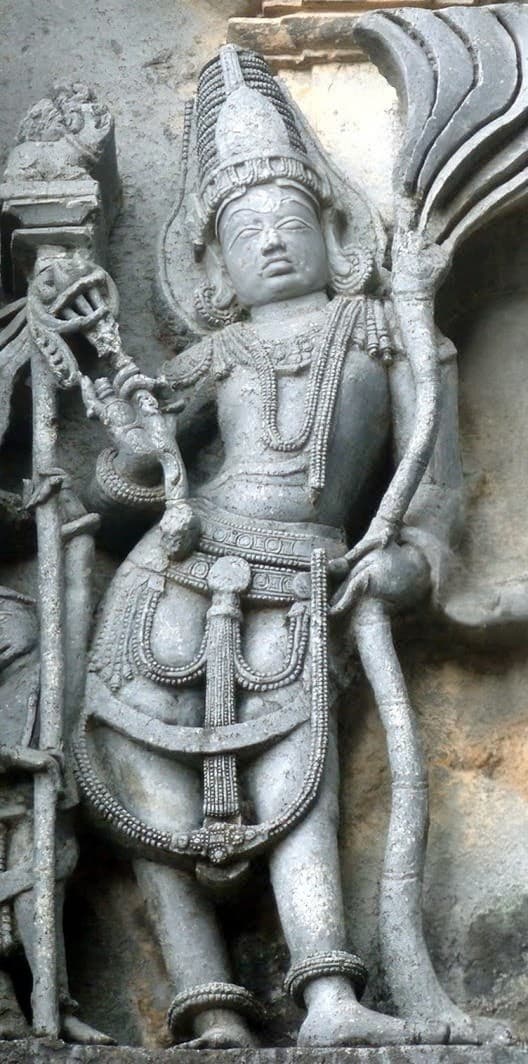
Kamadeva
Kamadeva is the Hindu god of love, attraction, pleasure, and beauty, as well as the personification of kāma (desire). He is depicted as a handsome youth armed with a bow of sugarcane and flower arrows, often accompanied by his consort Rati. Kamadeva's mythology is prominent in the Puranas, where he is known for being incinerated by Shiva's third eye and subsequently reborn as Pradyumna.