
Vanth
Etruscan mythology·Mythology·Etruscan·Chthonic figure
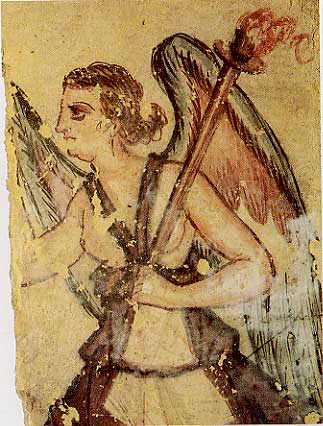
Vanth is a female chthonic figure in Etruscan mythology, primarily depicted in funerary art such as tomb paintings and sarcophagi from around 400 BC onwards. She is notable for her role as a benevolent psychopomp, guiding the deceased to the underworld, and is often depicted with attributes like a torch and a key.
Key Facts
- ›Vanth is an Etruscan underworld figure appearing in art from C. 400 BC.
- ›She is typically portrayed as a benevolent psychopomp, escorting the dead.
- ›Her attributes include a torch, key, and scroll, symbolizing guidance and destiny.
- ›Vanth is often depicted in scenes of slaughter, murder, and the journey of the deceased.
- ›She is sometimes shown protecting heroic figures, such as shielding Odysseus.
- ›Vanth is described as a young, vibrant female chthonic entity.
Underworld, Death, the Journey of the Deceased
Guiding the Deceased, Protecting Heroic Figures
Etruscan Funerary Art
Charun, Odysseus, Polyphemus
Benevolence, Guidance, Destiny
Vanth Herself
Torch, Key, Scroll
About Vanth
Vanth is a significant chthonic figure within Etruscan mythology, primarily known through her appearances in funerary art. Iconography featuring Vanth begins to emerge around 400 BC, during the middle period of Etruscan artistic development, though earlier inscriptions bearing her name also exist. She is consistently depicted as a female entity associated with the Etruscan underworld.
Role and Iconography
Vanth's most prominent role is that of a benevolent psychopomp, guiding and escorting the souls of the deceased to the underworld. Unlike some other underworld deities, she is not typically portrayed as an avenging spirit. Her attributes frequently include a torch, symbolizing the illumination of the path for travelers to the afterlife, and a key, representing the unlocking of the underworld's gates. Occasionally, she is depicted with a scroll, which some scholars interpret as containing the destiny of the deceased, suggesting Vanth may also be associated with fate.
Her visual depiction is that of a young, vibrant female, often winged. She is commonly shown wearing a rolled short chiton, fur boots, and sometimes unattached sleeves, with her dress sometimes noted as resembling that of a huntress. Vanth is frequently accompanied by other Vanth figures or by Charun, another Etruscan underworld entity.
Narrative Contexts
Vanth appears in a variety of scenes within Etruscan art. She is often present in depictions related to death and slaughter, including scenes from the Trojan cycle. She can be seen rising from the ground in these contexts or as a solitary figure adorning ash urns. Her psychopomp role is evident in scenes where she is escorting the dead, whether they are walking, or being transported by horse, wagon, or chariot. Notably, Vanth has also been depicted in a protective capacity, such as shielding the hero Odysseus from Polyphemus's hurled rocks in an urn painting, highlighting her capacity to safeguard individuals.
Vanth's presence underscores the Etruscan understanding of the underworld as a destination with complex transitions, where guidance and even protection could be offered to the departed.
Source: Wikipedia ↗
Frequently Asked Questions
Who is Vanth in Etruscan mythology?
Vanth is a female chthonic figure from Etruscan mythology associated with the underworld. She appears in funerary art, playing a role in the journey of the deceased.
What is Vanth's role in the Etruscan underworld?
Vanth's primary role is that of a benevolent psychopomp, guiding and escorting the dead to the underworld. She is also present in scenes depicting death and the afterlife.
What objects is Vanth often depicted with?
Vanth is frequently shown carrying a torch, which symbolizes lighting the way, a key, which unlocks the underworld's door, or a scroll, potentially containing the destiny of the deceased.
How is Vanth depicted visually?
She is typically depicted as a young, vibrant female, often winged, wearing a short chiton, fur boots, and sometimes unattached sleeves. Her attire has been likened to that of a huntress.
Is Vanth considered a malevolent or benevolent figure?
Vanth is generally depicted as a benevolent guide, contrasting with other underworld figures like Charun. She is known to protect heroic figures from harm.
Related Demons

Tuchulcha
Tuchulcha is a chthonic daemon from Etruscan mythology, primarily depicted in the Tomb of Orcus II. Notable for its hybrid appearance, including snake hair and a beak, Tuchulcha resides in the Etruscan underworld, Aita. Scholarly debate exists regarding its gender, with evidence suggesting it is likely female despite some masculine features.

Charun
Charun is an Etruscan underworld psychopomp, distinct from the god of the underworld, Aita. He is primarily depicted as a menacing figure tasked with escorting the dead, often portrayed with a hammer and apotropaic features to ward off evil. His name is derived from the Greek Charon, and his imagery has influenced later depictions of underworld figures.
Achlys
Achlys is a figure from ancient Greek literature, primarily known as the personification of sorrow or a deathly mist. While first appearing in Homer as a mist that clouds the eyes of the dying, she is later depicted in Hesiod's "Shield of Heracles" as a fearsome, gaunt entity. Her Roman equivalent, Caligo, is associated with the primordial origins of the cosmos.