
Tuchulcha
Tuchulcha is a chthonic daemon from Etruscan mythology, primarily depicted in the Tomb of Orcus II. Notable for its hybrid appearance, including snake hair and a beak, Tuchulcha resides in the Etruscan underworld, Aita. Scholarly debate exists regarding its gender, with evidence suggesting it is likely female despite some masculine features.
Key Facts
- ›Tuchulcha is an Etruscan chthonic daemon.
- ›It is depicted in a wall painting in the Tomb of Orcus II in Tarquinia, Italy.
- ›The daemon has a hybrid appearance with pointed ears, snake hair, and a beak.
- ›Tuchulcha inhabits the Etruscan underworld known as Aita.
- ›Scholars debate Tuchulcha's gender, with evidence suggesting it is likely female.
- ›The only known depiction shows Tuchulcha attending these and Peirithous playing a board game.

Underworld
Tomb of Orcus Ii Wall Painting
These, Peirithous
Snakes
About Tuchulcha
Tuchulcha is a chthonic daemon featured in Etruscan mythology. Unlike the later Christian concept of a 'demon,' the term 'daemon' in this context refers to a supernatural being within the Etruscan belief system. The primary and only known depiction of Tuchulcha is found in a wall painting within the Tomb of Orcus II, located in Tarquinia, Italy.
Appearance and Description
This daemon is characterized by a striking and hybrid appearance. It is described as possessing pointed ears, which may resemble those of a donkey, and its hair is composed of snakes. Additionally, Tuchulcha has a beak, possibly akin to that of a vulture. The serpents adorning its form are noted to have a diamond-marking, which scholars have identified as potentially signifying the poisonous adder. Tuchulcha wears a garment known as a chiton, a type of tunic worn by both men and women in classical antiquity, and its skin is described as pale pinkish.
Gender and Interpretation
Scholarly interpretation of Tuchulcha's gender has been a subject of discussion. While some masculine features have led to its reference as male, a closer examination of its iconography suggests otherwise. The presence of a woman's dress, pale skin, and what appear to be breasts have led many scholars, including Nancy de Grummond, Emeline Hill Richardson, and Graeme Barker, to conclude that Tuchulcha is very likely female, or potentially of indeterminate gender.
Role and Context
Tuchulcha is associated with the Etruscan underworld, known as Aita. In the sole surviving depiction, Tuchulcha appears in a scene depicting the Greek hero Theseus visiting the underworld. Alongside his companion Peirithous, Theseus is shown playing a board game, with Tuchulcha attending them. This imagery places Tuchulcha within the context of the underworld's inhabitants and their interactions with figures from the mortal or heroic realms.
Modern Relevance
Beyond its mythological context, Tuchulcha gained a measure of modern recognition through its appearance in the 1972 film, The Dead Are Alive. The fresco depicting Tuchulcha served as the inspiration for the narrative of serial murders within the film, highlighting its enduring visual impact and capacity to evoke themes of dread and the supernatural.
Source: Wikipedia ↗
Frequently Asked Questions
What is Tuchulcha?
Tuchulcha is a chthonic daemon from Etruscan mythology. It is not to be confused with the Christian concept of a 'demon'.
Where is Tuchulcha depicted?
The only known depiction of Tuchulcha is a wall painting in the Tomb of Orcus II, located in Tarquinia, Italy.
What does Tuchulcha look like?
Tuchulcha is described as having pointed ears, hair made of snakes, and a beak, possibly that of a vulture. It also wears a garment known as a chiton.
What is Tuchulcha's role in Etruscan mythology?
Tuchulcha resides in the Etruscan underworld, called Aita. In its sole depiction, it attends the heroes These and Peirithous as they play a board game.
Is Tuchulcha male or female?
Scholars debate Tuchulcha's gender. While some masculine features are noted, evidence such as wearing a woman's dress and having pale skin suggests it is likely female, or possibly neither gender.
Related Demons
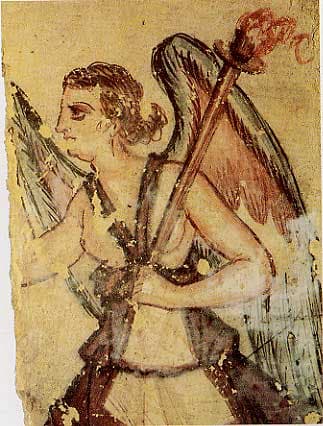
Vanth
Vanth is a female chthonic figure in Etruscan mythology, primarily depicted in funerary art such as tomb paintings and sarcophagi from around 400 BC onwards. She is notable for her role as a benevolent psychopomp, guiding the deceased to the underworld, and is often depicted with attributes like a torch and a key.

Charun
Charun is an Etruscan underworld psychopomp, distinct from the god of the underworld, Aita. He is primarily depicted as a menacing figure tasked with escorting the dead, often portrayed with a hammer and apotropaic features to ward off evil. His name is derived from the Greek Charon, and his imagery has influenced later depictions of underworld figures.

Allu
The Alû is a vengeful spirit originating from Akkadian and Sumerian mythology, described as a type of Utukku that descends to the underworld. Notable for its lack of mouth, lips, and ears, it roams at night to terrify and torment humans, sometimes causing unconsciousness or coma, similar to the effects of sleep paralysis. It is associated with other demonic entities and is recognized for its disruptive and harmful nature.