
Shedim
Shedim are spirits or demons in Jewish mythology and the Tanakh, distinct from the Christian concept of purely evil entities. They were often viewed not as inherently malevolent, but as the gods of foreign peoples, or as beings with a more morally ambiguous nature, sometimes even capable of living according to the Torah. Their origins are varied, with legends attributing them to serpents, Lilith, unfinished divine creations, or the builders of the Tower of Babel.
Key Facts
- ›Shedim appear in the Tanakh at Psalm 106:37 and Deuteronomy 32:17, associated with child or animal sacrifice.
- ›Their name is possibly derived from an Akkadian word for a spirit, or from the Hebrew root for 'laying waste'.
- ›Legends suggest their origins include descendants of serpents, offspring of Lilith, unfinished creations of God, builders of the Tower of Babel, or the offspring of Azazel and Naamah.
- ›The Talmud describes them as having wings, the ability to fly great distances, and knowledge of future events, similar to ministering angels, but also possessing human-like traits such as eating, drinking, and the potential to cause sickness.
- ›They are described as corporeal beings, sometimes appearing as men without shadows, black goat-like figures, or seven-headed dragons, and can shapeshift, with Asmodeus famously assuming King Solomon's form.
- ›In later Judaism, they evolved into more abstract beings, and in Judeo-Islamic culture, the term 'shedim' became synonymous with 'jinn'.

šēḏIm, šēḏ, Daimonia
Maladies, Misfortune, Foreign Gods
Possess Wings, Fly From End of the World To the Other, Know What Will Be In the Future, Eat and Drink, Cause Sickness and Misfortune, Follow the Dead, Shapeshift, Assume Human Form
Tanakh, Talmud, Zohar, Genesis, Midrashim
Lilith, Adam, Azazel, Naamah, Asmodeus, King Solomon
Gods of Foreigners, Not the Hebrew God, Violence, Laying Waste
- Admonition Not To Whistle Or Say the Word 'Shedim' To Avoid Invoking Them.
- A Belief That Sealing Up Windows Completely Traps Shedim In A House.
- Consulting Shedim Conjured By A Non-Jew Was Considered Permissible Even If Summoning Them Was An Act of Sorcery.
- Translated Into Greek As 'Daimonia' With Implicit Connotations of Negativity Under Zoroastrian Dualism.
- In Judeo-Islamic Culture, Became the Hebrew Word For Jinn, Conveying A Morally Ambivalent Attitude.
Wings, Rooster Footprints
About Shedim
Shedim (Hebrew: שֵׁדִים, romanized: šēḏim; singular: שֵׁד šēḏ) are spirits or demons that appear in Jewish mythology and the Tanakh. Unlike the modern Christian conception of demons as purely evil entities, Shedim were often understood differently. They were sometimes viewed as the gods of foreign peoples, or as beings whose nature was not inherently malevolent but rather opposed to the Hebrew God. However, they were also associated with causing maladies and were sometimes linked to sacrificial practices.
Origins and Nature
Multiple legends attempt to explain the origins of the Shedim. One tradition suggests they are descendants of serpents, referencing the serpent in the Garden of Eden. Another popular belief posits they are the offspring of Lilith, either from her union with Adam or other men. A third view, found in rabbinic texts, states that God created them on the sixth day but left their bodies unfinished to observe the Sabbath, resulting in beings with souls but incomplete forms. A further conception links them to the builders of the Tower of Babel, specifically those who actively sought to wage war against God. The Kabbalistic text the Zohar identifies them as the offspring of the demons Azazel and Naamah.
Biblical and Rabbinic Attestations
The Shedim are explicitly mentioned twice in the Tanakh, in Psalm 106:37 and Deuteronomy 32:17. Both instances relate to sacrificial practices, including the sacrifice of children or animals to these entities. While the exact extent and nature of such practices in ancient Israel remain debated among scholars, some interpretations suggest their existence, particularly in archaic periods.
Traits and Appearance
The Talmud describes Shedim as possessing a dual nature, with traits akin to both ministering angels and humans. Like angels, they are said to have wings, can traverse vast distances, and possess knowledge of future events. Like humans, they eat, drink, and can cause sickness and misfortune. They are also believed to follow the dead and fly around graves. Early descriptions in Midrashim depict them as corporeal beings that can appear in human form but without a shadow. They have also been described as black goat-like beings or even seven-headed dragons. Shedim are known for their ability to shapeshift, with a notable example being Asmodeus assuming the form of King Solomon to rule in his stead.
Cultural Significance and Evolution
The term 'shedim' itself may be derived from the Hebrew root 'šwd' meaning 'laying waste' or 'acting with violence,' or it could be a loanword from Akkadian, where 'shedu' referred to a spirit that could be either protective or malevolent. During the translation of Hebrew texts into Greek, influenced by Zoroastrian dualism, 'shedim' was often rendered as 'daimonia,' acquiring implicit negative connotations. Later, in Judeo-Islamic culture, the term 'shedim' came to be used interchangeably with 'jinn,' reflecting the morally ambiguous nature attributed to these beings. While often associated with negative influences, some traditions acknowledge that Shedim are not always malicious and can even be helpful, with some believed to be capable of adhering to the Torah.
Source: Wikipedia ↗
Frequently Asked Questions
What are Shedim in Jewish tradition?
Shedim are spirits or demons found in Jewish mythology and the Tanakh. They are not always considered purely evil entities, differing from the Christian concept of demons.
Where do Shedim appear in the Bible?
Shedim are mentioned in the Tanakh in Psalm 106:37 and Deuteronomy 32:17. These passages associate them with sacrificial practices, including child sacrifice.
What are the origins of Shedim?
Various legends attribute the origin of Shedim to different sources, including the serpent from Eden, the offspring of Lilith, unfinished creations of God from the sixth day, builders of the Tower of Babel, or the demonic beings Azazel and Naamah.
What are the characteristics of Shedim?
According to the Talmud, Shedim possess traits similar to ministering angels, such as wings and knowledge of the future, alongside human-like characteristics like eating and drinking. They can cause sickness and misfortune.
How are Shedim depicted in appearance?
Early descriptions depict Shedim as corporeal beings that can appear as men without shadows, black goat-like figures, or even seven-headed dragons. They are also capable of shapeshifting.
Are Shedim always considered evil?
No, Shedim are not always seen as purely malicious creatures. They are sometimes viewed as the gods of foreigners or as morally ambivalent beings, with some legends even suggesting they can live according to the Torah.
Related Demons
Lilith
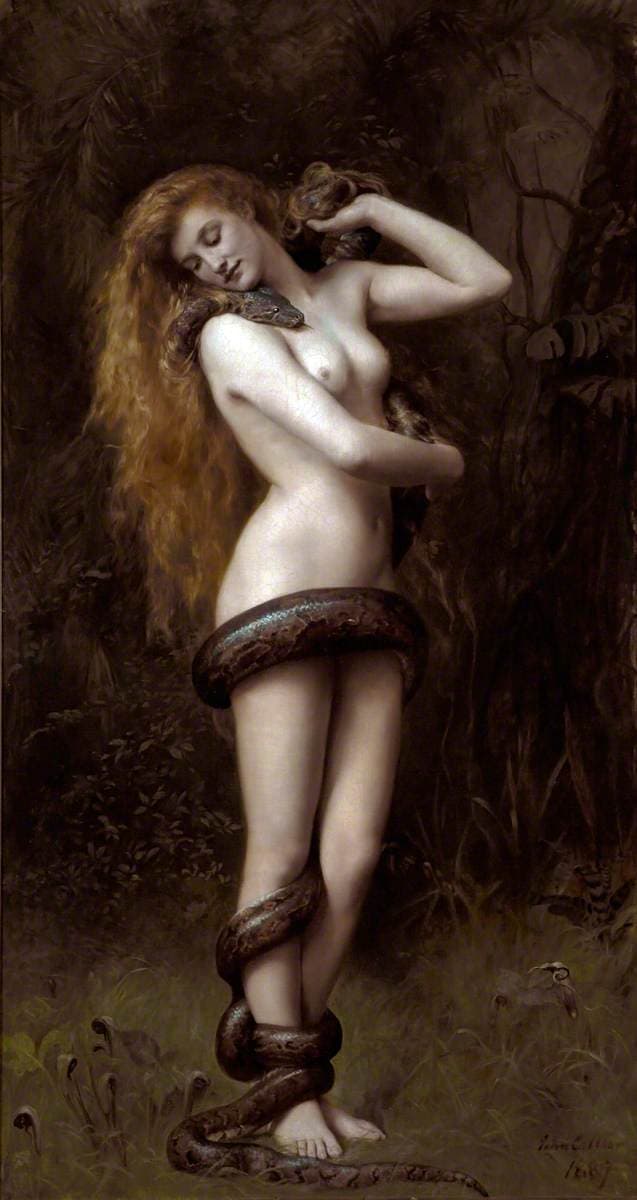
Lilith is a prominent figure in Jewish mythology, primarily known as Adam's first wife who refused to be subservient and fled the Garden of Eden. Her legend developed significantly in medieval Jewish folklore, mysticism, and texts like the Zohar, where she is often depicted as a dangerous night demon. Lilith is notable for her origins as a potentially composite figure drawing from Mesopotamian demonology and her enduring presence in folklore and theological discussions.
Agrat bat Mahlat
Agrat bat Mahlat is a demon from Jewish mythology, often referred to as "Agrat, daughter of Mahlat." She is notable as one of the four wives of the archdemon Samael, and is associated with magic, prostitution, and the "angels of destruction." Her most prominent appearances are in Talmudic literature and Kabbalistic texts, where she is depicted as a powerful and dangerous demonic figure.
Lili/Lilin/Lilim
Lilin are plural night spirits in Jewish mythology, serving as the male equivalent of Lilith and often conceived as her children with Adam or other mortal men. They are notable for their appearances in early rabbinic literature, such as the Babylonian Talmud and Midrash, and in Aramaic incantation bowls, where they are invoked or bound. Their origins are linked to ancient Akkadian wind demons, and they are depicted as having human form with wings or distinctive hair patterns.