
Onoskelis
Christian Demonology (within pseudepigraphical text)·Demonology·Ancient Near East / Greco-Roman·demon
Onoskelis is a demon encountered by King Solomon in the pseudepigraphical text, The Testament of Solomon. This demon is notable for its unique appearance and its association with specific ailments, as detailed in the text where Solomon commands various demons to aid in the construction of his temple.
Key Facts
- ›Onoskelis is listed among the demons Solomon encounters and commands in the Testament of Solomon.
- ›The demon is described as having a donkey's leg.
- ›Onoskelis is associated with causing ailments, though specific details are not elaborated in the text.
- ›It is one of many demons Solomon subjugates using a magical ring bestowed by the archangel Michael.
- ›The Testament of Solomon is a composite text, not considered canonical by Jewish or Christian groups.
Ailments
Causing Ailments
the Testament of Solomon
King Solomon, Archangel Michael, Beelzebul
Archangel Michael
Donkey's Leg
About Onoskelis
Onoskelis is a demon encountered and commanded by King Solomon in the pseudepigraphical text known as The Testament of Solomon. This text, believed to have been composed in Greek with roots reaching back to the early 1st millennium AD and likely finalized in the Middle Ages, describes how Solomon built his temple with the aid of demons subjugated by a magical ring provided by the archangel Michael.
Appearance and Role
Within The Testament of Solomon, Onoskelis is notable for its unique physical description: it possesses a donkey's leg. The demon is listed among the various supernatural beings that Solomon interviews and compels to perform tasks. While the text associates Onoskelis with causing ailments, the specific nature of these afflictions is not elaborated upon in detail. Onoskelis is part of a larger cast of demons from diverse traditions, including Greek, Egyptian, Jewish, Christian, and Arabic influences, all brought under Solomon's control through the magical ring.
Context in The Testament of Solomon
The Testament of Solomon is a significant text in the study of demonology, though it is not considered canonical scripture by major Jewish or Christian denominations. The text's dating and authorship are subjects of scholarly debate, with proposed composition dates ranging widely. The narrative of Solomon commanding demons is a central theme, allowing for the exploration of various cosmological, theological, and magical concepts, often incorporating elements from different cultural and religious mythologies. Onoskelis, therefore, represents one of many demonic entities whose power is acknowledged and harnessed within this unique pseudepigraphical work.
Source: Wikipedia ↗
Frequently Asked Questions
Who is Onoskelis?
Onoskelis is a demon featured in the pseudepigraphical text, The Testament of Solomon. It is one of many supernatural beings that King Solomon commands to assist in building his temple.
What is Onoskelis known for?
Onoskelis is primarily known for its distinctive physical characteristic: a donkey's leg. The text also associates the demon with causing various ailments, though specific details about these afflictions are not extensively described.
Where does Onoskelis appear?
Onoskelis appears in The Testament of Solomon, a text attributed to King Solomon but not accepted as canonical scripture. This text details Solomon's interactions with numerous demons.
How is Onoskelis controlled?
Like other demons in The Testament of Solomon, Onoskelis is controlled by King Solomon through a magical ring given to him by the archangel Michael. This ring allows him to command and subjugate these beings.
Related Demons
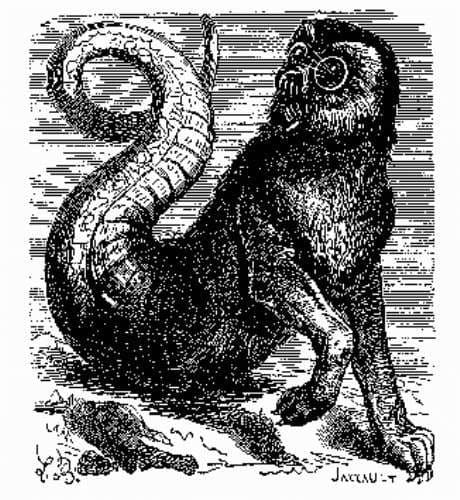
Aamon/Amon
Aamon, also known as Amon, is a Grand Marquis of Hell in demonology, commanding 40 infernal legions according to the Ars Goetia. He is notable for his knowledge of the past and future, his ability to reconcile friends and foes, and his association with life and reproduction. His origins are linked to ancient Libyan and Punic deities.
Abezethibou
Abezethibou is a demon and fallen angel prominently featured in the pseudepigraphal Testament of Solomon. He is notable for his role as a strategist and advisor to Beelzebub, his opposition to Moses and the Israelites during the Exodus, and his eventual imprisonment in the Red Sea. His story contributes to the demonological understanding of fallen angels and their influence.
Aeshma
Aeshma is the demon of "wrath" in Zoroastrianism, known by the epithet "of the bloody mace." As a hypostatic entity, he represents fury and rage, and is a significant adversary within the Zoroastrian cosmology. He is notably opposed by Sraosha, the principle of religious obedience, and is considered a messenger of Angra Mainyu, the destructive spirit.