
Asura
Indian Religions (Hinduism, Buddhism)·Mythology, Demonology, Theology·Indian subcontinent·Demigod, Titan, Antigod, Spirit
Asura are a class of powerful, often adversarial, beings in Indian religions, primarily Hinduism and Buddhism. Initially described in Vedic texts as divine lords with good or bad intentions, their role evolved to represent malevolent forces opposing the benevolent Deva (gods). They are notable for their complex dualistic symbolism, representing inner struggles and the forces of darkness or ego.
Key Facts
- ›Asura are a class of beings in Indian religions, related to the benevolent Deva.
- ›In early Vedic literature, the term 'Asura' could refer to divine beings with good or bad intentions, including gods like Agni and Indra.
- ›Later Vedic and post-Vedic texts depict Asura as malevolent beings and 'enemies of the gods,' in opposition to the Deva.
- ›In Buddhism, Asura are often translated as 'titans' or 'antigods' and are characterized by pride, envy, and bellicosity.
- ›The concept of Asura is symbolically interpreted as representing inner human tendencies towards ego, anger, and negative desires.
- ›The term 'Asura' is etymologically linked to the Old Iranian 'Ahura,' suggesting a shared Indo-Iranian origin.

Ahura
Ego, Anger, Envy, Pride, Bellicosity, Chaos, Destruction
- Possess Innate Potential, Knowledge, and Special Powers
- Magical Powers
- Specialized Knowledge
- Ability To Seduce
Rig Veda, Samaveda, Mahabharata, Brahmanda Purana, Vishnu Purana, Shiva Purana, Upanishads, Jatakas, Lotus Sutra
Deva, Varuna, Vritra, Agni, Indra, śAkra, Prajapati, RāHu, Vepacitti, PahāRāDa, Sambara, Bali, Sucitti, Namucī, Ravana, Rama, Hiranyakashipu, Vishnu, Virocana
Ego, Anger, Greed, Hate, Arrogance, Conceit, Harshness, Hypocrisy, Cruelty, Destructive Tendencies, Powers of Darkness
- Asuri Kalpa Contains Rites Derived From Special Knowledge and Magic.
Deva, Indra, Vishnu
- In Hinduism, They Are Often Depicted As Enemies of the Gods .
- In Buddhism, They Are Referred To As 'Titans' Or 'Antigods' and Are Part of the Cosmology.
- the Term 'Asura' Is Cognate With the Iranian 'Ahura,' Highlighting Shared Indo-Iranian Roots.
About Asura
The Asura (Sanskrit: असुर) are a class of powerful beings central to the mythology and cosmology of Indian religions, particularly Hinduism and Buddhism. Their nature and role have evolved significantly throughout ancient texts, moving from divine lords to adversaries of the gods.
Origins and Early Descriptions
In the earliest Vedic literature, the term 'Asura' was applied to divine beings, encompassing both those with benevolent and malevolent intentions. Gods like Agni and Indra were sometimes referred to as Asura, denoting their status as 'lords' of their respective domains. Benevolent Asura were identified with the Aditya, led by Varuna, while malevolent ones were known as Danava, led by Vritra.
Evolution in Later Texts
By the later Vedic and post-Vedic periods, the distinction between Asura and Deva became more pronounced, with Asura increasingly depicted as powerful, superhuman demigods who were in constant conflict with the Deva. These Asura were characterized by their pride, envy, and lust for power, often seeking to challenge or overthrow the gods. Texts like the Shiva Purana describe them as having become vain, abandoning sacred duties, and acting torturously towards other beings.
Buddhist Context
In Buddhist cosmology, the Asura are commonly translated as 'titans' or 'antigods.' They are said to inhabit realms beneath Mount Sumeru, driven by intense passions, particularly wrath, pride, and envy. While their lives are generally more pleasurable than humans', they are plagued by jealousy towards the Deva and are engaged in perpetual warfare against them.
Symbolism and Interpretation
The dichotomy between Asura and Deva is often interpreted symbolically within Hindu philosophy. They can represent the opposing forces within the human psyche: the Asura embodying ego, anger, and destructive desires, and the Deva symbolizing divine qualities and the path to inner happiness achieved through self-awareness and effort. This symbolism suggests that one's actions and motivations, rather than birth or lineage, determine whether one is Asura-like or Deva-like.
Etymology and Indo-Aryan Connections
The etymology of 'Asura' is linked to the Proto-Indo-Iranian word *háSura, meaning 'lord.' This term is cognate with the Old Iranian 'Ahura,' used for benevolent supernatural beings in pre-Zoroastrianism. The contrasting roles of 'Asura' and 'Ahura,' and 'Deva' and 'Daeva' (the malevolent Iranian counterparts), suggest a possible historical conflict between Indo-Iranian communities that influenced their respective mythologies.
Source: Wikipedia ↗
Frequently Asked Questions
What is the origin of the term Asura?
The word Asura originates from Sanskrit and is traditionally understood as 'not-sura,' with 'sura' being another name for the Deva (gods). Modern scholarship suggests it derives from the Proto-Indo-Iranian word *háSura, meaning 'lord,' and is cognate with the Old Iranian 'Ahura.'
How are Asura described in Hindu texts?
In Hindu texts, Asura are depicted as powerful superhuman demigods with both good and bad qualities. Early Vedic literature referred to benevolent Asura as Aditya, led by Varuna, and malevolent ones as Danava, led by Vritra. Later texts increasingly portray them as malevolent beings in conflict with the Deva.
What is the role of Asura in Buddhist cosmology?
In Buddhist cosmology, Asura are a type of supernatural being, often translated as 'titans' or 'antigods.' They are described as living in a realm below the Deva, characterized by their obsession with sensuous aspects of existence, jealousy, pride, and constant warfare against the gods.
What is the symbolic meaning of the Asura-Deva dichotomy?
The dichotomy between Asura and Deva is often seen as a symbolic representation of opposing forces within the human psyche. The Asura can symbolize tendencies towards ego, anger, and destructive desires, while the Deva represent divine qualities and inner happiness achieved through effort and introspection.
Are there feminine forms of Asura?
Yes, 'Asuri' is the feminine form. In later texts, it refers to beings associated with demons and spirits. Asuri are described as powerful female beings with special knowledge, particularly of herbs, and in some instances, their powers are projected into plants for remedies or charms.
Related Demons

Mara
Mara is a significant figure in Buddhism, representing any force that hinders enlightenment, including both demonic and celestial beings. Associated with death, desire, and the cycle of rebirth, Mara is often depicted as a powerful deva who tempted Prince Siddhartha, the future Buddha, with his army and beautiful maidens. His name etymologically signifies 'causing death' or 'killing,' and he is seen as the personification of forces antagonistic to spiritual liberation.

Rakshasa
Rakshasas are a race of powerful, often malevolent beings prominent in Hindu, Buddhist, and Jain traditions, known for their supernatural abilities, shape-shifting, and illusionary powers. While frequently depicted as antagonists and man-eaters, some Rakshasas are portrayed as morally upright or even heroic figures, and they retain a significant presence in various mythologies and modern fiction.
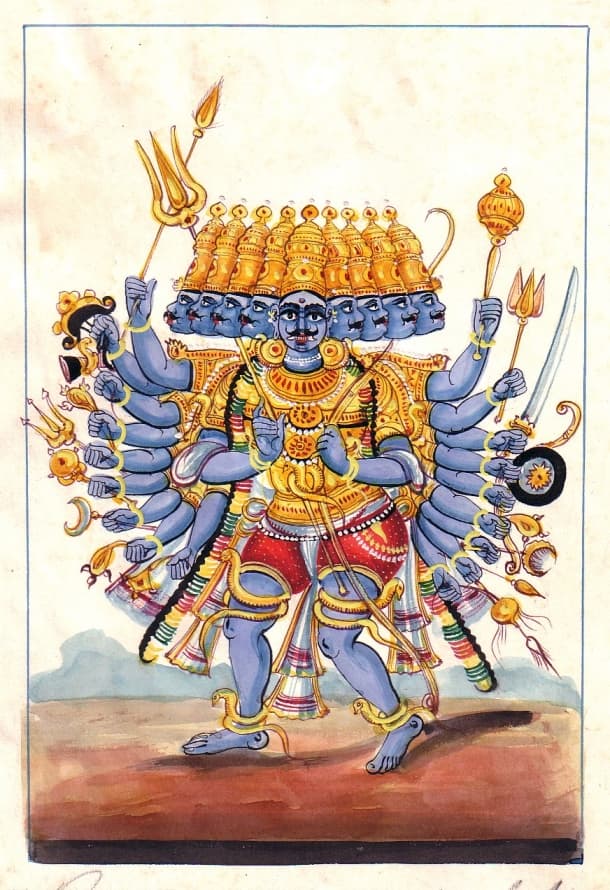
Ravana
Ravana is the primary antagonist in the ancient Hindu epic Ramayana, depicted as a ten-headed rakshasa (demon) king of Lanka. He is known for abducting Sita, the wife of Rama, and for his scholarly prowess in Vedic texts and devotion to Shiva. Ravana's defeat by Rama is a central theme in the Ramayana and is commemorated annually during the Hindu festival of Dussehra.