
Arunasura
Bhramari, also known as the goddess of bees, is a Hindu deity and an incarnation of Mahadevi within Shaktism. She is notable for her legend in the Devi Bhagavata Purana, where she appears as a massive, bee-emanating form to defeat the powerful asura Arunasura, who had gained near-invincibility through a boon. Her name directly translates to 'like a bee' or 'the goddess of bees'.
Key Facts
- ›Bhramari is a Hindu goddess, an incarnation of Mahadevi in Shaktism.
- ›Her name means 'like a bee' or 'the goddess of bees'.
- ›She is depicted as emanating bees and hornets from her four hands.
- ›The Devi Bhagavata Purana details her legend where she defeats the asura Arunasura.
- ›She is invoked as a form of Lakshmi in the Devi Bhagavata Purana and Lakshmi Tantra.
- ›The Bhramari Pranayama breathing technique is named after her.
BhrāMarī
Bees, Hornets, Wasps, Insects
- Emanating Bees, Hornets, Wasps, Flies, Termites, Mosquitos, and Spiders
- Assuming Massive Size
- Defeating Powerful Asuras With Insect Swarms
Devi Bhagavata Purana, Markandeya Purana, Devi Mahatmya, Lakshmi Tantra
Mahadevi, Lakshmi, Shiva, Arunasura, Brahma, Indra, Vishnu
Divine Retribution, Protection of the Cosmos
- Bhramari Pranayama Is A Yogic Breathing Technique Named After Her, Involving A Humming Sound Like A Bee.
- the Devas Invoked Her Protection Against Arunasura.
Bees, Hornets, Wasps, Insects
About Arunasura
Bhramari
Bhramari is a significant Hindu goddess within the Shaktism tradition, venerated as the "goddess of bees." Her name, derived from Sanskrit, directly translates to "like a bee" or "the goddess of black bees." She is recognized as an incarnation of Mahadevi, the supreme goddess, and is particularly celebrated for her role in vanquishing a formidable asura.
Legend of Arunasura
The tenth book and thirteenth chapter of the Devi Bhagavata Purana prominently feature Bhramari's legend. In this narrative, a powerful asura named Aruna gains a boon from Brahma, making him virtually invincible to any conventional form of death. Arunasura subsequently launches an invasion of the celestial realms, conquering various deities. The desperate gods, after seeking aid from Brahma and Vishnu, ultimately turn to Adi Parashakti. Realizing the limitations of ordinary combat against Arunasura's boon, the goddess devises a unique strategy. She manifests as Bhramari, a colossal divine form from which she emanates countless bees, hornets, wasps, flies, termites, mosquitos, and spiders. These insects, merging with her and then released in a wave, overwhelm Arunasura and his army, ultimately tearing the asura apart and restoring order to the cosmos.
Associations and Worship
Bhramari is also associated with the goddess Lakshmi, with salutations in the Devi Bhagavata Purana identifying her as a form of the goddess of prosperity. The Lakshmi Tantra corroborates this, with Lakshmi herself declaring she will appear as Bhramari to slay a demon named Aruna. Beyond her mythological exploits, Bhramari lends her name to a yogic breathing technique, Bhramari Pranayama, which involves producing a humming sound akin to a bee's buzz. The goddess is worshipped in various temples, often as Bhramaramba, in conjunction with Shiva, with notable sites in Andhra Pradesh and Karnataka.
Iconography
Iconographically, Bhramari is depicted with bees and hornets clinging to her body, and she is often shown emanating these insects from her four hands. Her divine radiance is further emphasized by her three eyes, said to shine like the sun, the moon, and the eternal fire Agni.
Source: Wikipedia ↗
Frequently Asked Questions
Who is Bhramari in Hinduism?
Bhramari is a Hindu goddess, an incarnation of Mahadevi, and is known as the goddess of bees. She is a significant figure in Shaktism, the tradition that worships the supreme goddess.
What is the significance of Bhramari's association with bees?
Her name directly translates to 'like a bee' or 'the goddess of bees'. She is iconographically depicted as emanating bees and hornets, and in her most famous legend, she summons swarms of insects to defeat a powerful demon.
What is the legend of Bhramari and Arunasura?
The Devi Bhagavata Purana recounts how the asura Arunasura, blessed with near invincibility, conquered the Devas. In response, the Adi Parashakti manifested as Bhramari, a colossal form emanating countless insects, who then tore Arunasura apart.
Is Bhramari associated with other goddesses?
Yes, salutations in the Devi Bhagavata Purana suggest she is a form of the goddess Lakshmi. Lakshmi herself declares in the Lakshmi Tantra that she will appear as Bhramari to slay a demon named Aruna.
Are there temples dedicated to Bhramari?
Yes, the goddess is worshipped as Bhramaramba, often alongside Shiva. Notable temples include the Mallikarjuna Temple at Srisailam and the Bhramari Sri Durga Parameshwari temple at Kateel.
Related Demons
Mahishasur
Mahishasur is a prominent bovine asura from Hindu mythology, primarily known as the "buffalo demon" whose defeat by the goddess Durga is a central theme in the Navaratri festival. He is depicted as a deceitful shape-shifter who waged war against the devas, ultimately being slain by Durga, earning her the epithet Mahishasuramardini. His story symbolizes the triumph of good over evil and is widely depicted in art and celebrated in religious festivals.
Andhaka
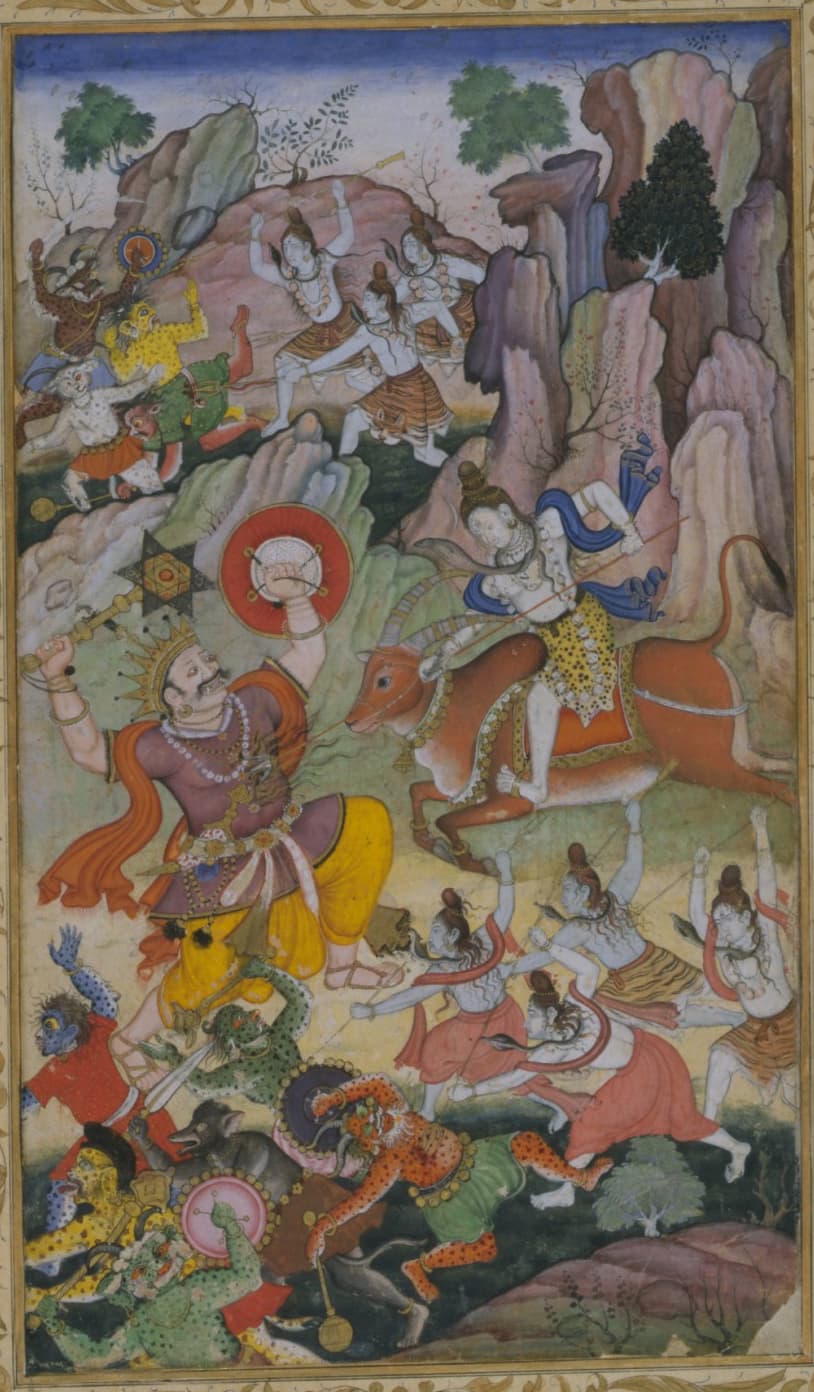
Andhaka is a malevolent asura from Hindu mythology, primarily featured in the Puranic scriptures, whose pride and malevolence are ultimately vanquished by Shiva and Parvati. His origin stories vary, but he is often depicted as a son of Shiva and Parvati, born from their union or Shiva's sweat, and notable for his immense power, numerous forms, and his eventual devotion to Shiva.
Kabandha/Kabhanda
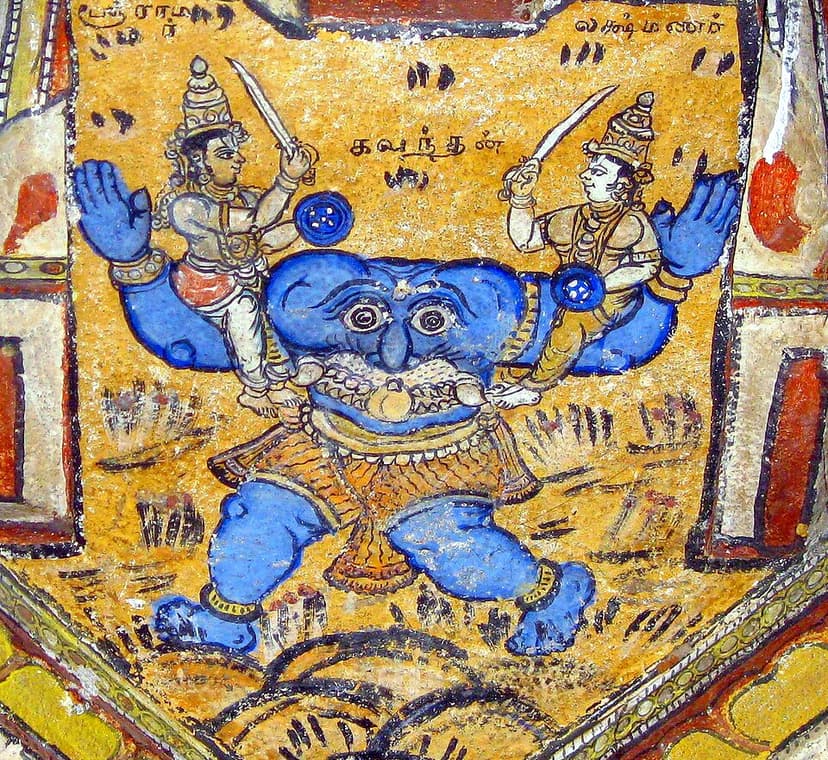
Kabandha, meaning "headless torso," is a Rakshasa (demon) in Hindu epics like the Ramayana and Mahabharata. Originally a celestial musician named Vishvavasu, he was cursed into a monstrous form, only to be freed by the god Rama. Kabandha's notable role is guiding Rama to Sugriva, a monkey-king crucial for rescuing Rama's wife, Sita.