
Toulouse Cathedral
Toulouse Cathedral, officially the Cathedral of Saint Stephen of Toulouse, is a Roman Catholic church and the seat of the Archbishop of Toulouse in France. It is a significant national monument, notable for its unique architectural blend resulting from centuries of construction and stylistic evolution, particularly the juxtaposition of southern French Gothic and northern French Gothic elements.
Key Facts
- ›The cathedral's origins are traced to a chapel built in the 3rd century and later reconstructed, with the first documented cathedral appearing in the 5th century.
- ›A Romanesque cathedral was constructed starting around 1078, with remnants of its structure incorporated into the current building.
- ›The 13th century saw the nave rebuilt in the southern French Gothic "Raymondine" style, while the choir was later constructed in the northern French Gothic style.
- ›The building exhibits a striking architectural disconnect between the nave and choir due to differing construction periods and axes.
- ›The cathedral is constructed primarily of brick, a common material in southern France due to the scarcity of suitable stone.
- ›It has been a listed monument historique by the French Ministry of Culture since 1862.

Southern French Gothic, Northern French Gothic, High Gothic, Rayonnant, Flamboyant Gothic, Baroque
- Juxtaposition of Southern and Northern French Gothic Styles
- Brick Construction
- Irregular West Front
- the 'D'OrléAns Pillar'
- Tapestries of Saint Stephen
- 17th-Century Choir Stalls With Pagan and Mythological Subjects
- Baroque Choir Retable Depicting the Stoning of Saint Stephen
- Rose Window On the West Front
Jean Deschamps, Auguste Virebent, Jacques Jean Esquié, Auguste Saint-Anne De Louzier, Pierre Mercier, Gervais Drouet
About Toulouse Cathedral
Toulouse Cathedral, known officially as the Cathédrale Saint-Étienne de Toulouse, stands as a significant Roman Catholic church and the metropolitan seat of the Archbishop of Toulouse in France. Designated as a national monument, its architectural history is marked by a prolonged and complex construction process, resulting in a unique blend of distinct Gothic styles. The building's significance lies not only in its religious function but also as a testament to centuries of architectural evolution and stylistic dialogue within southern France.
History and Construction
The site of Toulouse Cathedral is believed to have foundations dating back to a 3rd-century chapel attributed to Saint Saturnin. The first documented cathedral appeared in the 5th century, though no trace of this early structure remains. A Romanesque cathedral was constructed beginning around 1078. The early 13th century saw a major rebuilding of the nave in the southern French Gothic style, often termed "Raymondine," characterized by large, single vaults and massive wall buttresses designed for preaching to large congregations. This style was pioneered by Raymond VI, Count of Toulouse.
In contrast, the choir was begun around 1272 in the High Gothic and Rayonnant style prevalent in northern France, commissioned by Bishop Bertrand de L'Isle-Jourdain. This new section was wider and set on a different axis, intended to eventually replace the older nave. However, financial and political difficulties led to construction slowing and stopping, leaving the two parts of the cathedral disconnected. Further modifications and additions, including chapels and decorative elements in the Flamboyant Gothic style, continued through the 15th and 16th centuries.
The 17th century brought further developments, including a fire in 1609 that destroyed the temporary choir roof. The subsequent rebuilding, though lower than originally planned, completed the vaulting. The choir was then extensively redecorated in the Baroque style, with elaborate sculptures and marble retables added in the latter half of the century.
Architectural Features
Toulouse Cathedral is predominantly constructed of brick, a common building material in southern France. Its exterior presents an irregular appearance due to the juxtaposition of the 13th-century nave and the later choir, which are not aligned. This architectural disconnect is most strikingly evident internally with the presence of a massive round pillar, the "d'Orléans pillar," erected in the early 16th century to support proposed extensions, which now stands incongruously between the two main sections.
The nave, built in the southern Gothic style, features wide bays with single rib vaults and columns decorated with carved capitals. The choir, in contrast, exhibits features of northern Gothic architecture. The building is reinforced by massive brick buttresses, a characteristic of southern Gothic design.
Art and Decoration
The cathedral houses significant artistic and decorative elements. Four large tapestries from the 16th century depict scenes from the life of its patron saint, Saint Stephen, by Jean Pechaud. The choir stalls, crafted between 1610 and 1613 in the style of Louis XIII, are made of finely carved walnut and oak and feature decorative elements including pagan and mythological subjects. The grand Baroque retable in the choir, created between 1667 and 1680 by Pierre Mercier and Gervais Drouet, depicts the stoning of Saint Stephen.
Stained glass has been a recurring feature, though frequently damaged and replaced throughout history. The windows in the Saint Vincent de Paul chapel contain the oldest glass, dating from the end of the 13th century. The rose window on the west front, originally installed in 1230, was modeled after that of Notre-Dame de Paris. The cathedral also contains a collection of 17th-century Baroque paintings by artists such as Hilaire Pader and Jacques François Courtin, as well as works by Jean-Baptiste Despax.
Legacy
Toulouse Cathedral is a monument historique, recognized for its historical and architectural importance. Its complex layering of styles and periods, particularly the visual tension between the nave and choir, makes it a unique and compelling example of Gothic architecture in southern France. Despite periods of damage and debate over its completion, the cathedral stands today as a testament to its layered history and enduring religious and cultural significance.
Source: Wikipedia ↗
Frequently Asked Questions
What is the architectural style of Toulouse Cathedral?
Toulouse Cathedral is characterized by a unique blend of architectural styles due to its long and complex construction history. It primarily showcases southern French Gothic, often referred to as 'Raymondine,' and northern French Gothic, specifically the High Gothic and Rayonnant styles. This results in a disconcerting juxtaposition of two distinct Gothic approaches.
When was Toulouse Cathedral built?
The construction of Toulouse Cathedral spans several centuries. A Romanesque cathedral was begun around 1078. The nave was largely rebuilt in the early 13th century (1210–1220), and the choir was initiated around 1272. Significant additions and modifications continued into the 16th century, with final vaulting completed in the 17th century.
What are the notable features of Toulouse Cathedral?
Notable features include its irregular west front, a consequence of its construction from two distinct parts. Internally, a massive round pillar, the 'd'Orléans pillar,' stands incongruously between the nave and choir. The cathedral also boasts significant tapestries depicting the life of Saint Stephen, 17th-century choir stalls, and the grand Baroque retable in the choir.
Why is Toulouse Cathedral architecturally unusual?
The cathedral's unusual nature stems from the nave and choir being built on different axes and in contrasting Gothic styles. This lack of unity, combined with the massive 'd'Orléans pillar' placed between them, creates a visually striking and historically layered interior and exterior.
What is the history of the stained glass in Toulouse Cathedral?
The stained glass windows have a troubled history, having been damaged and replaced numerous times. They suffered destruction during the French Revolution, a hurricane in 1808, and an explosion in 1816. Much of the glass present today dates from the 19th and 20th centuries, often incorporating pieces from earlier windows. The oldest surviving glass fragments are from the 14th to 16th centuries.
Related Cathedrals
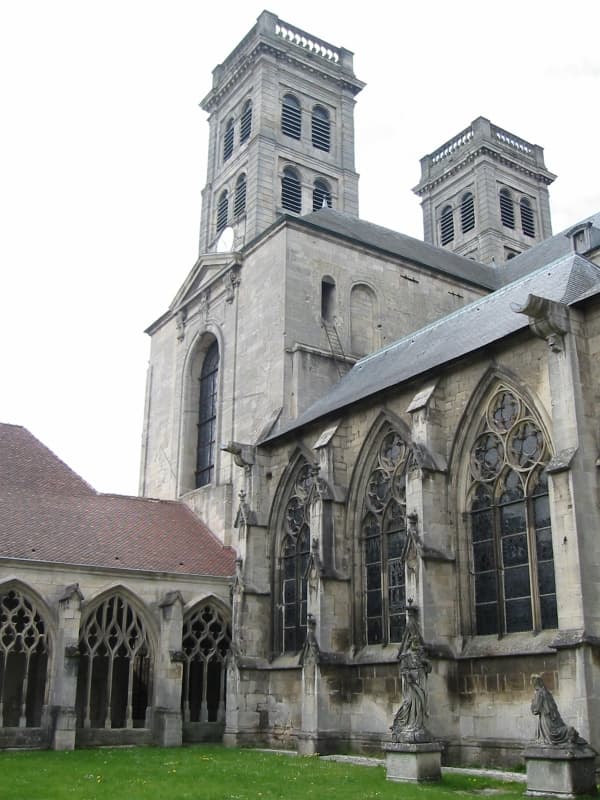
Verdun Cathedral
Verdun Cathedral, officially Cathédrale Notre-Dame de Verdun, is a Roman Catholic cathedral in Verdun, France. It is notable for its historical depth, tracing its origins to the 3rd century, and for its architectural blend of Romanesque, Gothic, and Neo-Classical styles. The cathedral holds significant historical importance, having been a focal point during World War I.

Sens Cathedral
Sens Cathedral, officially Cathédrale Saint-Étienne de Sens, is a Roman Catholic cathedral in Sens, Burgundy, France, dedicated to Saint Stephen and serving as the seat of the Archbishop of Sens. It is historically significant as the first cathedral built in the Gothic architectural style, with its choir construction beginning between 1135 and 1140, predating Notre Dame de Paris. Its revolutionary use of six-part rib vaults and influence on later Gothic structures, such as Canterbury Cathedral, mark its architectural importance.

Reims Cathedral
Reims Cathedral, officially Notre-Dame de Reims, is a preeminent example of Gothic architecture and held immense historical significance as the traditional site for the coronation of French kings. Dedicated to the Virgin Mary, it has been a focal point of French monarchy and religious life for over a millennium, attracting a million visitors annually and recognized as a UNESCO World Heritage Site.