
St Paul's Cathedral
St Paul's Cathedral, formally the Cathedral Church of St Paul in London, is an Anglican cathedral and the seat of the Bishop of London, serving as the mother church of the Diocese of London. Its iconic dome, designed by Sir Christopher Wren in the English Baroque style, has dominated the London skyline since its completion in 1710, following the Great Fire of London. The cathedral is a significant national landmark, having hosted numerous state funerals, royal events, and services of national importance.
Key Facts
- ›The current St Paul's Cathedral was designed by Sir Christopher Wren in the English Baroque style and completed in 1710.
- ›It was constructed as part of London's rebuilding program after the Great Fire of 1666 destroyed the previous Gothic cathedral.
- ›The cathedral's dome, standing at 111 meters (365 ft), was the tallest building in London from 1710 to 1963.
- ›St Paul's has been the site of significant national events, including the funerals of Lord Nelson, the Duke of Wellington, Winston Churchill, and Margaret Thatcher, as well as the wedding of Prince Charles and Lady Diana Spencer.
- ›It is the second-largest church building by area in the United Kingdom.
- ›The cathedral is a working church with hourly prayer and daily services, and charges an entry fee for tourists but not for worshippers.

Dome, Wren's City Churches Spires, Site of St Paul's Cross, National Event Venue
Christopher Wren
About St Paul's Cathedral
St Paul's Cathedral, officially the Cathedral Church of St Paul in London, stands as a significant Anglican cathedral and the seat of the Bishop of London, functioning as the mother church for the Diocese of London within the Church of England. Located on Ludgate Hill, at the highest point of the City of London, its origins trace back to AD 604 with the dedication of the original church in honor of Paul the Apostle. The current, imposing structure, a masterpiece of English Baroque architecture designed by Sir Christopher Wren, was completed in 1710. Its reconstruction was a pivotal element of London's extensive rebuilding program following the devastating Great Fire of 1666, which had largely destroyed the preceding Gothic cathedral, known as Old St Paul's.
Architectural Significance and Dominance
The cathedral is instantly recognizable and has been a prominent feature of the London skyline for over three centuries. Its magnificent dome, encircled by the spires of Wren's other City churches, measures 111 meters (365 ft) in height, making it the tallest building in London from its completion in 1710 until 1963. The dome itself remains one of the highest globally. St Paul's is the second-largest church building by area in the United Kingdom, surpassed only by Liverpool Cathedral.
Historical and National Importance
St Paul's Cathedral has been the venue for a multitude of pivotal national events. Its hallowed walls have witnessed the funerals of distinguished figures such as Admiral Lord Nelson, the Duke of Wellington, Winston Churchill, and Margaret Thatcher. It has also hosted significant royal occasions, including a royal thanksgiving service for the union of Great Britain, the wedding of Prince Charles and Lady Diana Spencer, and peace services marking the end of both World Wars. The cathedral has also held thanksgiving services for royal jubilees and birthdays of monarchs like George III, Victoria, George V, and Elizabeth II.
A Working Cathedral
Beyond its historical and architectural grandeur, St Paul's Cathedral remains an active place of worship. Hourly prayer and daily services are held, welcoming both visitors and worshippers. While tourists are charged an entrance fee, those attending services or seeking private prayer are admitted without charge. The cathedral's resilience was notably demonstrated during World War II, when it survived the Blitz despite being struck by bombs, becoming a symbol of endurance, famously captured in iconic photographs of its dome rising above the smoke and destruction.
Source: Wikipedia ↗
Frequently Asked Questions
When was St Paul's Cathedral built?
The current St Paul's Cathedral was completed in 1710. Construction began after the Great Fire of London in 1666, and the building was declared officially complete by Parliament on Christmas Day 1711, though work continued into the 1720s with the addition of roof statues.
Who designed St Paul's Cathedral?
The present St Paul's Cathedral was designed by Sir Christopher Wren in the English Baroque style. Wren was tasked with designing a replacement structure after the Great Fire of London.
What is the significance of St Paul's Cathedral's dome?
The dome of St Paul's Cathedral is one of its most famous features, having dominated the London skyline for over 300 years. At 111 meters (365 ft) high, it was the tallest building in London from 1710 to 1963 and remains one of the highest domes in the world.
What major events have taken place at St Paul's Cathedral?
St Paul's Cathedral has hosted numerous significant national events, including state funerals for figures like Admiral Lord Nelson, the Duke of Wellington, Winston Churchill, and Margaret Thatcher. It also hosted the wedding of Prince Charles and Lady Diana Spencer and various royal thanksgiving services.
Is St Paul's Cathedral an active place of worship?
Yes, St Paul's Cathedral is a working church with hourly prayer and daily services. While tourists pay an entrance fee, worshippers are not charged for attending services or for private prayer.
What happened to the previous St Paul's Cathedral?
The previous cathedral, known as Old St Paul's, was a Gothic structure largely destroyed in the Great Fire of London in September 1666. While parts could have been salvaged, a decision was made to build a new cathedral in a modern style.
Related Cathedrals
Brentwood Cathedral
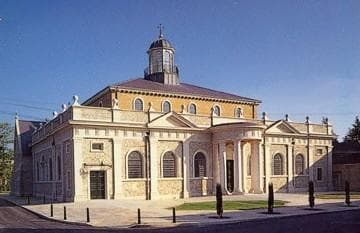
Brentwood Cathedral, officially the Cathedral of St Mary and St Helen, is the seat of the Roman Catholic Diocese of Brentwood in England. Originally a parish church built in 1861, it was elevated to cathedral status in 1917 and significantly enlarged and redesigned in an Italianate classical style between 1989 and 1991. Its architecture draws inspiration from the Italian Renaissance and English Baroque, creating a space focused on liturgy and flooded with light.

Birmingham Cathedral
The Birmingham Cathedral, officially the Cathedral Church of Saint Philip, is the principal Anglican cathedral in Birmingham, England. Originally built as a Baroque parish church designed by Thomas Archer and consecrated in 1715, it was elevated to cathedral status in 1905, becoming the seat of the Bishop of Birmingham. It is recognized as a Grade I listed building and is a significant example of English Baroque architecture.

Holy Name Cathedral
Holy Name Cathedral was a grand, but ultimately unbuilt, Roman Catholic cathedral planned for Brisbane, Australia. Designed to be the largest church in the Southern Hemisphere, its construction began in 1927 but stalled due to financial difficulties, with only the crypt chapel being completed. The project lost momentum after the death of its main proponent, Archbishop James Duhig, and was formally abandoned in the 1970s.