
Birmingham Cathedral
The Birmingham Cathedral, officially the Cathedral Church of Saint Philip, is the principal Anglican cathedral in Birmingham, England. Originally built as a Baroque parish church designed by Thomas Archer and consecrated in 1715, it was elevated to cathedral status in 1905, becoming the seat of the Bishop of Birmingham. It is recognized as a Grade I listed building and is a significant example of English Baroque architecture.
Key Facts
- ›Founded as a parish church in 1715, designed by Thomas Archer in the Baroque style.
- ›Became the Cathedral of Birmingham in 1905, coinciding with the formation of the Diocese of Birmingham.
- ›Suffered severe damage from bombing in World War II but was restored, retaining its Edward Burne-Jones windows.
- ›Features a distinctive tower surmounted by a lead-covered dome and lantern.
- ›The cathedral houses notable monuments, including one commemorating victims of the 1974 Birmingham pub bombings.
- ›Its organ, originally built by Thomas Swarbrick, dates in part from 1715.

Baroque, English Baroque, Italianate
- Stained-Glass Windows By Edward Burne-Jones
- Baroque Tower With A Lead-Covered Dome and Lantern
- St. Philip's Parish Library
- Monuments Including One For Victims of the 1974 Birmingham Pub Bombings
- Statue of Charles Gore By Thomas Stirling Lee
- Organ By Thomas Swarbrick
18th Century, 19th Century, 20th Century
Thomas Archer, J. A. Chatwin
About Birmingham Cathedral
The Cathedral Church of Saint Philip, commonly known as Birmingham Cathedral, stands as a significant religious and architectural landmark in the heart of Birmingham, England. Originally established as the parish church of St. Philip in 1715, it was designed by the renowned architect Thomas Archer in the English Baroque style. Its elevation to cathedral status in 1905 marked a new chapter, making it the seat of the Bishop of Birmingham and the central church of the Diocese of Birmingham.
History and Development
The need for a new church arose from Birmingham's rapid population growth in the early 18th century. Land for the church was donated by Robert Philips in 1710, and construction commenced in 1711, concluding in time for consecration in 1715. The church was dedicated to St. Philip in tribute to its benefactor. For nearly two centuries, St. Philip's served as a parish church, housing its own library, before becoming a cathedral. This transition was facilitated by the growing importance of Birmingham as an industrial city and the efforts of figures like Joseph Chamberlain and Bishop Charles Gore.
Architectural Significance
Thomas Archer's design for St. Philip's is a notable example of the Baroque style, with Italianate influences evident in its relatively restrained yet elegant form. The interior features a rectangular hall with aisles separated by classical pillars supporting an arcade. A striking western tower, stages rising to a lead-covered dome and lantern, characterizes the exterior. The building is constructed of brick and faced with stone. Later additions and alterations, particularly the extension of the chancel by J. A. Chatwin in the late 19th century, enriched its appearance with Corinthian columns and marbled surfaces. The cathedral is recognized as a Grade I listed building, underscoring its architectural importance.
World War II and Restoration
Birmingham Cathedral suffered a direct hit during World War II on November 7, 1940, resulting in extensive damage. However, its most treasured artistic possessions, several stained-glass windows by the Pre-Raphaelite artist Edward Burne-Jones, were safely removed before the bombing by the Birmingham Civic Society. These windows were returned and reinstalled after the building's restoration in 1948, allowing the cathedral to retain its significant artistic heritage.
Art and Monuments
Beyond the Burne-Jones windows, the cathedral houses several other notable artworks and monuments. A statue of Charles Gore, the first Bishop of Birmingham, by Thomas Stirling Lee is positioned at the west entrance. The cathedral also holds heritage-listed monuments, including one that commemorates victims of the 1974 Birmingham pub bombings, highlighting its connection to the city's modern history. The grounds, colloquially known as "Pigeon Park," feature an obelisk commemorating Frederick Gustavus Burnaby.
Music and Bells
The cathedral boasts a historic organ, originally built by Thomas Swarbrick and dating in part from 1715, which has undergone numerous restorations and modernizations. The tower houses a ring of twelve bells, with a history of recasting and refurbishment by prominent bell founders such as Thomas Lester and Gillett & Johnston, reflecting a long tradition of campanology.
Source: Wikipedia ↗
Frequently Asked Questions
When was Birmingham Cathedral built?
Birmingham Cathedral, originally St Philip's Church, was constructed between 1711 and 1715. The tower was completed by 1725.
What is the architectural style of Birmingham Cathedral?
The cathedral is primarily built in the Baroque style, influenced by Italianate churches. It features a rectangular hall church interior with classical columns and wooden galleries.
What is the significance of Edward Burne-Jones to Birmingham Cathedral?
Edward Burne-Jones, who was born in Birmingham and baptized in the church, donated several stained-glass windows to St Philip's. Three of these are located at the eastern end, and another significant window is at the west end.
Was Birmingham Cathedral damaged in World War II?
Yes, the cathedral was bombed and gutted on November 7, 1940. Fortunately, its most valuable stained-glass windows by Edward Burne-Jones had been removed for safekeeping and were reinstalled after restoration in 1948.
What is the history of the bells at Birmingham Cathedral?
The original eight bells were recast by Thomas Lester in 1751. The ring was augmented to twelve bells over time, with significant restoration and recasting by Gillett & Johnston in 1937 and further refurbishment in 2004.
Related Cathedrals

Canterbury Cathedral
Canterbury Cathedral is the seat of the Archbishop of Canterbury, the spiritual leader of the Church of England and the Anglican Communion. Founded in 597 on the site of earlier Christian structures, it has undergone numerous rebuildings and extensions, most notably after fires and to accommodate pilgrims. It is a UNESCO World Heritage Site and remains an active place of worship.
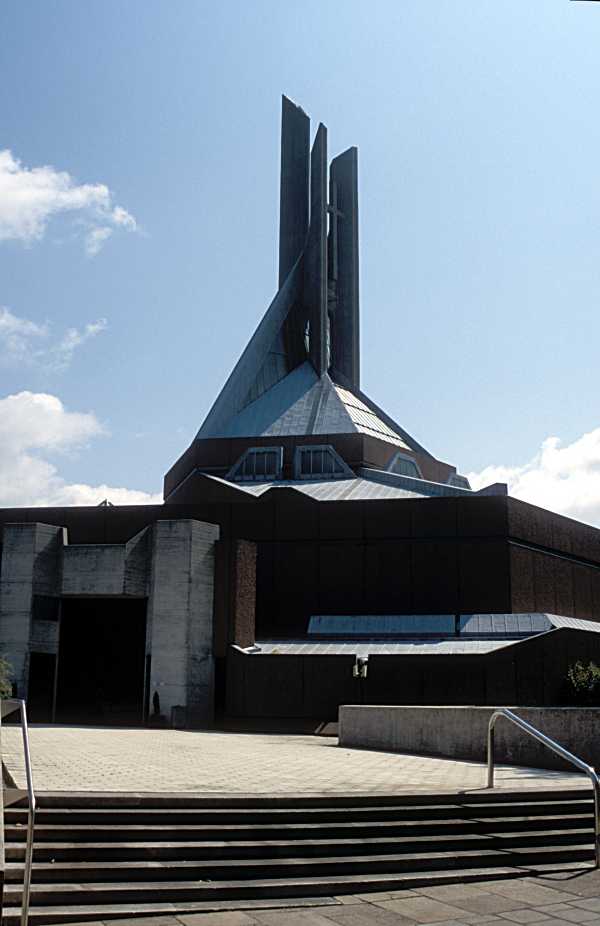
Clifton Cathedral
Clifton Cathedral, officially the Cathedral Church of SS. Peter and Paul, is the Roman Catholic cathedral for Bristol, England. It serves as the mother church for the Diocese of Clifton and is notable for being the first cathedral built under new guidelines following the Second Vatican Council, emphasizing congregational participation in worship.

Exeter Cathedral
Exeter Cathedral, officially the Cathedral Church of Saint Peter in Exeter, is a significant Anglican cathedral located in Exeter, Devon, England. The present building, completed around 1400, is renowned for its architectural achievements, including the longest uninterrupted medieval stone vaulted ceiling in the world, and houses historical artifacts like the Exeter Book.