
Clifton Cathedral
Diocese of Clifton·Roman Catholic·United Kingdom
Clifton Cathedral, officially the Cathedral Church of SS. Peter and Paul, is the Roman Catholic cathedral for Bristol, England. It serves as the mother church for the Diocese of Clifton and is notable for being the first cathedral built under new guidelines following the Second Vatican Council, emphasizing congregational participation in worship.
Key Facts
- ›Clifton Cathedral was the first Catholic church built in the 1970s to receive Grade II* listing.
- ›Its design was heavily influenced by the Second Vatican Council's decree on liturgical worship, focusing on congregational involvement.
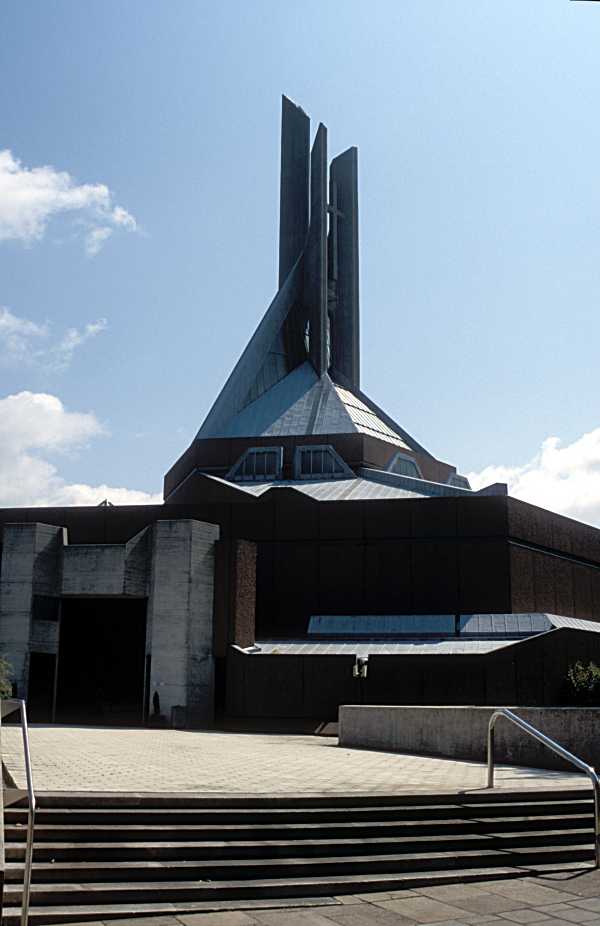
- ›The cathedral's architecture is a prime example of Brutalism, characterized by its use of raw concrete and functionalist design.
- ›Construction began in March 1970 and the cathedral was consecrated on June 29, 1973, the Feast of Saints Peter and Paul.
- ›The design prioritizes bringing the congregation close to the High Altar, with a maximum distance of 15 meters and no intervening pillars.
- ›The interior features distinctive dalle de verre glass windows by Henry Haig and a font carved from Portland stone by Simon Verity, incorporating fossilized sea creatures.
Brutalism, Functionalist
- Dalle De Verre Windows By Henry Haig
- Font With Fossilized Sea Creatures By Simon Verity
- Katyn Memorial
- Hexagonal Spire
- Concrete Structure With Visible Timber Formwork Imprints
20th Century
Ronald J. Weeks, Frederick S. Jennett, Antoni Poremba
About Clifton Cathedral
The Cathedral Church of SS. Peter and Paul, commonly known as Clifton Cathedral, stands as the Roman Catholic cathedral for the city of Bristol in the United Kingdom. It is the principal church and seat of the Diocese of Clifton. Its construction marked a significant moment in post-war ecclesiastical architecture, being the first cathedral built under new guidelines that emerged from the Second Vatican Council, emphasizing a more participatory form of worship.
History and Context
Before the construction of the current cathedral, Roman Catholics in Bristol worshipped in various locations, with a pro-cathedral church dedicated to the Holy Apostles serving the diocese from 1850. However, by the 1960s, this site was deemed unsuitable for a new cathedral. The impetus for a modern design came from the Second Vatican Council (1962-1965), which called for a renewal of the Church's relationship with the world and a focus on the liturgical role of the laity. In 1965, architects were commissioned to design a new cathedral on a different site in Clifton.
Design and Architecture
The design brief for Clifton Cathedral was to create a 1,000-seat church where the congregation could be grouped closely around the High Altar, fostering a sense of unity and participation in the Mass. The primary architect, Ronald J. Weeks, collaborated closely with the Church, aiming for a design that was both functionally appropriate for liturgy and aesthetically significant. The resulting architecture is a prominent example of Brutalism, a style characterized by its honest use of materials, particularly raw concrete, and its functionalist approach. The form of the building is largely dictated by its internal liturgical requirements, with spaces flowing progressively towards the High Altar. The cathedral's structure features a soaring hexagonal spire, and the interior is designed to maximize daylight in areas of greater liturgical importance, while minimizing distractions in the nave.
Construction and Key Features
Construction of Clifton Cathedral began in March 1970 and was completed in May 1973. The building is constructed from in-situ cast reinforced Portland concrete, with its exterior walls clad in red Aberdeen Granite composite panels. The interior showcases innovative artistic elements, including dalle de verre glass windows by Henry Haig, depicting themes relevant to Catholic theology and creation care. The baptistery features a font carved from Portland stone by Simon Verity, notable for its inclusion of fossilized sea creatures, and the sanctuary contains an altar holding relics of Pope Pius X and Oliver Plunkett. The cathedral's design sought to create an open interior, allowing for fluid movement between areas and emphasizing the centrality of the liturgy. The cathedral was consecrated on June 29, 1973, and remains an active place of worship and a significant example of 20th-century ecclesiastical architecture.
Source: Wikipedia ↗
Frequently Asked Questions
When was Clifton Cathedral built?
Construction for Clifton Cathedral began in March 1970 and was completed in May 1973. It was consecrated and opened on June 29, 1973.
What is the architectural style of Clifton Cathedral?
Clifton Cathedral is primarily an example of Brutalist architecture. This style is characterized by simple, block-like structures, the extensive use of raw concrete, and a design driven by its intended function.
What is the significance of the design of Clifton Cathedral?
The design of Clifton Cathedral was groundbreaking as it was the first to be built following new guidelines from the Second Vatican Council. These guidelines emphasized the role of the congregation and aimed to create a space where people felt closely involved in the celebration of Mass.
Who designed Clifton Cathedral?
The design of Clifton Cathedral was primarily by Ronald J. Weeks, working with Frederick S. Jennett and Antoni Poremba of the Percy Thomas Partnership. Ronald Weeks collaborated closely with the Church team to develop the cathedral's unique functionalist and liturgical design.
What are some notable features inside Clifton Cathedral?
Inside, notable features include the dalle de verre windows by Henry Haig, depicting themes like 'Jubilation' and 'Pentecost.' The baptistery contains a font carved by Simon Verity, which includes fossilized sea creatures, and the sanctuary houses an altar containing relics of Pope Pius X and Oliver Plunkett.
Related Cathedrals

Leeds Cathedral
Leeds Cathedral, officially the Cathedral Church of St Anne, is the principal Roman Catholic cathedral in Leeds, West Yorkshire, United Kingdom. It serves as the seat of the Roman Catholic Bishop of Leeds. While the city lacks a Church of England cathedral, Leeds Cathedral stands as a significant religious and architectural landmark for the Catholic community.

Birmingham Cathedral
The Birmingham Cathedral, officially the Cathedral Church of Saint Philip, is the principal Anglican cathedral in Birmingham, England. Originally built as a Baroque parish church designed by Thomas Archer and consecrated in 1715, it was elevated to cathedral status in 1905, becoming the seat of the Bishop of Birmingham. It is recognized as a Grade I listed building and is a significant example of English Baroque architecture.

Canterbury Cathedral
Canterbury Cathedral is the seat of the Archbishop of Canterbury, the spiritual leader of the Church of England and the Anglican Communion. Founded in 597 on the site of earlier Christian structures, it has undergone numerous rebuildings and extensions, most notably after fires and to accommodate pilgrims. It is a UNESCO World Heritage Site and remains an active place of worship.