
Leeds Cathedral
Roman Catholic Diocese of Leeds·Roman Catholic·United Kingdom
Leeds Cathedral, officially the Cathedral Church of St Anne, is the principal Roman Catholic cathedral in Leeds, West Yorkshire, United Kingdom. It serves as the seat of the Roman Catholic Bishop of Leeds. While the city lacks a Church of England cathedral, Leeds Cathedral stands as a significant religious and architectural landmark for the Catholic community.
Key Facts
- ›The current Leeds Cathedral building on Cookridge Street was completed in 1904, replacing an earlier cathedral on the same site granted status in 1878.
- ›The original St Anne's Roman Catholic Church, which served as the first cathedral, was demolished around 1900 due to city development plans.
- ›The current cathedral was designed in the Arts and Crafts Gothic Revival style by John Henry Eastwood, with significant contributions from his assistant, Sydney Kyffin Greenslade.
- ›Due to its restricted site, the cathedral is relatively small, featuring an aisled nave and chancel under a continuous roof.
- ›Relics of English Catholic martyrs, Blessed Peter Snow and Ralph Grimston, were placed in the altar following renovations in 2005–2006.
- ›The cathedral houses a 1904 Norman and Beard organ, restored and enlarged in 2010, as well as a portable chamber organ built in 1992.

Arts and Crafts, Gothic Revival
- Relics of Blessed Peter Snow and Ralph Grimston
- 1904 Norman and Beard Organ
- 1992 Peter Collins Chamber Organ
- Ornate Crucifix Sculpture On the West Front
20th Century
John Henry Eastwood, Sydney Kyffin Greenslade
About Leeds Cathedral
Leeds Cathedral, formally known as the Cathedral Church of St Anne, is the principal cathedral of the Roman Catholic Diocese of Leeds and serves as the seat for the Roman Catholic Bishop of Leeds. Located in the city of Leeds, West Yorkshire, United Kingdom, it is a significant religious edifice for the Catholic community. While the city does not host a Church of England cathedral, Leeds Cathedral stands as a prominent landmark.
History and Development
The history of Leeds Cathedral involves a transition from an earlier site. The first post-Reformation Catholic place of worship in Leeds was Lady Lane Chapel, built in 1786, which was succeeded by St Anne's Church in 1838. This church was granted cathedral status in 1878 with the establishment of the Diocese of Leeds. However, this original cathedral faced demolition around 1900 due to extensive city development plans aimed at widening The Headrow. The current cathedral building, situated on Cookridge Street on land adjacent to the previous site, was constructed between 1901 and 1904.
Architectural Features
The current Leeds Cathedral was designed in the Arts and Crafts Gothic Revival style by John Henry Eastwood, with significant input from his assistant, Sydney Kyffin Greenslade. The design was influenced by the limited size of the site, resulting in a structure that is relatively small. The cathedral features an aisled nave and chancel under a continuous roof, with narrow transepts and chapels. The building is constructed of Weldon stone with Ketton stone details. The west front is characterized by a tall gable flanked by large buttresses that terminate in Gothic turrets, and it displays a large ornate crucifix sculpture. The interior follows a conventional layout with rows of pews facing the altar, supported by two rows of stone pillars, and features a barrel-shaped ceiling.
Notable Elements and Restoration
Leeds Cathedral is a Grade II* listed building. In 2005–2006, renovations were undertaken, during which relics of English Catholic martyrs, Blessed Peter Snow and Ralph Grimston, were placed within the altar. The cathedral is equipped with a notable organ by Norman and Beard, originally installed in 1904 and restored and enlarged by Klais Orgelbau in 2010, featuring 55 ranks. Additionally, a portable chamber organ, built by Peter Collins in 1992, is used daily to accompany Gregorian chant. The Cathedral's Pastoral and Conference Centre, known as Cathedral Hall, is located adjacent to the main building.
Source: Wikipedia ↗
Frequently Asked Questions
When was Leeds Cathedral built?
The current Leeds Cathedral building was completed in 1904. Building work began in the autumn of 1901.
What is notable about Leeds Cathedral's architecture?
Leeds Cathedral is designed in the Arts and Crafts Gothic Revival style. Its small size is a consequence of the restricted site, and it features a tall gable between large buttresses on its west front, along with a large ornate crucifix sculpture.
What is the history of Leeds Cathedral?
The first Catholic place of worship in Leeds post-Reformation was Lady Lane Chapel in 1786, replaced by St Anne's Church in 1838. This church was granted cathedral status in 1878 but was demolished around 1900. The current cathedral was constructed on an adjacent site and opened in 1904.
Is Leeds Cathedral an active place of worship?
Yes, Leeds Cathedral is the cathedral of the Roman Catholic Diocese of Leeds and serves as the seat of the Roman Catholic Bishop of Leeds, indicating it is an active place of worship.
What is the significance of the relics in Leeds Cathedral?
Following renovations in 2005–2006, relics of English Catholic martyrs, Blessed Peter Snow and Ralph Grimston, were placed in the altar of Leeds Cathedral.
Related Cathedrals
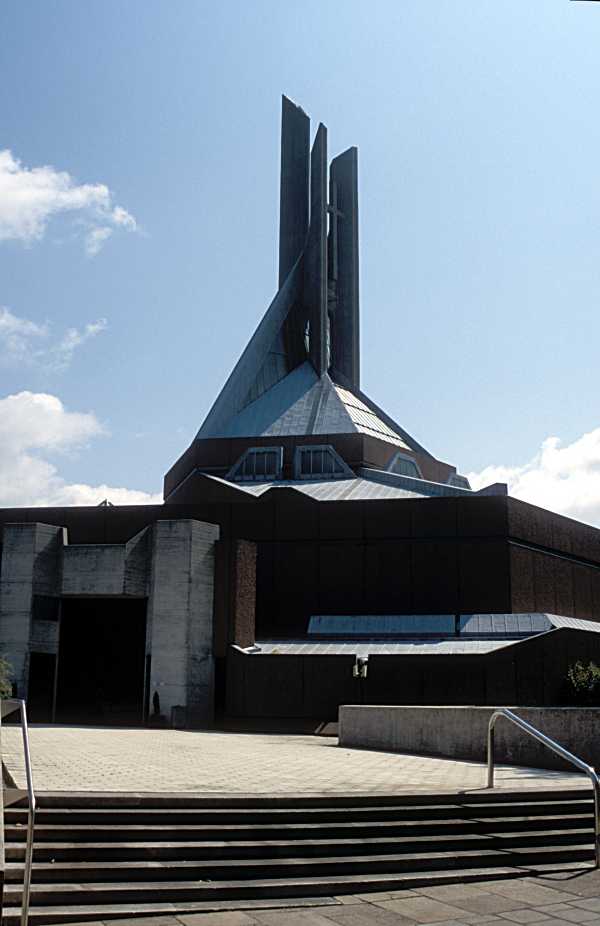
Clifton Cathedral
Clifton Cathedral, officially the Cathedral Church of SS. Peter and Paul, is the Roman Catholic cathedral for Bristol, England. It serves as the mother church for the Diocese of Clifton and is notable for being the first cathedral built under new guidelines following the Second Vatican Council, emphasizing congregational participation in worship.

Birmingham Cathedral
The Birmingham Cathedral, officially the Cathedral Church of Saint Philip, is the principal Anglican cathedral in Birmingham, England. Originally built as a Baroque parish church designed by Thomas Archer and consecrated in 1715, it was elevated to cathedral status in 1905, becoming the seat of the Bishop of Birmingham. It is recognized as a Grade I listed building and is a significant example of English Baroque architecture.

Canterbury Cathedral
Canterbury Cathedral is the seat of the Archbishop of Canterbury, the spiritual leader of the Church of England and the Anglican Communion. Founded in 597 on the site of earlier Christian structures, it has undergone numerous rebuildings and extensions, most notably after fires and to accommodate pilgrims. It is a UNESCO World Heritage Site and remains an active place of worship.