
Exeter Cathedral
Exeter Cathedral, officially the Cathedral Church of Saint Peter in Exeter, is a significant Anglican cathedral located in Exeter, Devon, England. The present building, completed around 1400, is renowned for its architectural achievements, including the longest uninterrupted medieval stone vaulted ceiling in the world, and houses historical artifacts like the Exeter Book.
Key Facts
- ›The site of Exeter Cathedral has Roman origins, with a legionary fortress established between 50-75 AD.
- ›The founding of the cathedral in 1050 was a strategic move to relocate the bishop's seat from Crediton due to fears of sea-raids.
- ›The current Gothic structure, largely completed by 1400, incorporates elements of the earlier Norman cathedral, such as its two massive square towers.
- ›It boasts the longest uninterrupted medieval stone vaulted ceiling globally, measuring approximately 96 meters.
- ›Notable features include an early set of misericords, the earliest complete set in the UK, and a unique Minstrels' Gallery with carved angels.
- ›The cathedral was damaged during the CIVIL War, with its cloisters destroyed, and again during the Baedeker Blitz in World War II.

Norman, Decorated Gothic
- Longest Uninterrupted Medieval Stone Vaulted Ceiling In the World
- Earliest Complete Set of Misericords In the Uk
- Minstrels' Gallery
- Astronomical Clock
- Exeter Book
- Norman Transept Towers
- Great East Window
11th Century, 12th Century, 13th Century, 14th Century, 15th Century
Master Roger, Master Thomas of Witney, William Joy, Robert Lesyngham, John Loughborough Pearson, George Gilbert Scott
About Exeter Cathedral
Exeter Cathedral, officially the Cathedral Church of Saint Peter in Exeter, is a prominent Anglican cathedral situated in the city of Exeter, Devon, in South West England. The present structure, largely completed by approximately 1400, stands as a significant example of medieval ecclesiastical architecture and houses numerous historical treasures.
History and Foundation
The site of Exeter Cathedral has a long history, with evidence of Roman presence including a legionary fortress established between 50–75 AD. The formal establishment of the cathedral in Exeter dates to 1050, when the seat of the bishop was moved from Crediton due to the threat of sea-raids. Bishop Leofric utilized an existing Saxon minster as his seat. The impetus for building a new cathedral in the Norman style came with the appointment of William Warelwast in 1107, with its official foundation occurring in 1133. However, by the time Walter Bronescombe became bishop in 1258, the building was considered outdated. A subsequent rebuilding in the Decorated Gothic style, inspired by Salisbury Cathedral, commenced, integrating much of the Norman structure, including its distinctive square towers and parts of the walls, all constructed from local stone.
Architectural Significance
The architecture of Exeter Cathedral is characterized by a remarkable sense of harmony, particularly evident in the continuous run of tierceron vaults extending from the west to the east. Despite irregular bay sizes, the plan is based on a division into ninths. A notable aspect is the three-storey facade with a triforium, a design shift from the earlier two-storey approach. The cathedral features the longest uninterrupted medieval stone vaulted ceiling in the world, measuring about 96 meters. This architectural feat is partly due to the absence of a central tower.
Notable Features
Exeter Cathedral is distinguished by several significant interior and exterior features. The fifty misericords are the earliest complete set found in the United Kingdom, dating from the 13th century and depicting various scenes, including the earliest known wooden representation of an elephant in the UK. The Minstrels' Gallery, dating to around 1360, is unique among English cathedrals, adorned with 12 carved and painted angels playing medieval instruments. The Astronomical Clock is another remarkable feature, with its main dial dating from 1484, displaying the hour, the sun's position, and the moon's phase. The cathedral also houses the Exeter Book, a precious manuscript of Anglo-Saxon poetry, and its library holds a significant collection of Anglo-Saxon charters.
Resilience Through Time
Throughout its history, Exeter Cathedral has faced challenges. It experienced damage during the Dissolution of the Monasteries and further destruction during the Civil War, when the cloisters were demolished. In more recent times, it sustained damage during the "Baedeker Blitz" of World War II, with a high-explosive bomb hitting the chapel of St James. Despite these events, the cathedral has undergone reconstruction and restoration, preserving its historical and architectural integrity for continued worship and public admiration.
Source: Wikipedia ↗
Frequently Asked Questions
When was Exeter Cathedral founded?
The founding of the cathedral at Exeter, dedicated to Saint Peter, dates from 1050. Its official foundation as a new building in the Norman style was in 1133.
What is the architectural style of Exeter Cathedral?
The cathedral showcases a blend of architectural styles. It began with Norman construction and was later rebuilt in the Decorated Gothic style, following the example of Salisbury. Much of the Norman building, including its towers, was retained.
What are the most notable features inside Exeter Cathedral?
Key interior features include an early set of misericords, the Minstrels' Gallery with carved angels, an astronomical clock, and the longest uninterrupted medieval vaulted ceiling in the world. The bishop's throne, made from Devon oak, is also a significant element.
Has Exeter Cathedral been damaged by conflict?
Yes, Exeter Cathedral suffered damage during the English Civil War when its cloisters were destroyed. It also sustained a direct hit during the Baedeker Blitz in World War II, which destroyed the chapel of St James and other parts of the building.
What is significant about the Exeter Book held at the cathedral?
The Exeter Book is a manuscript of Anglo-Saxon poetry, and it is the only one of the 66 books originally presented to the cathedral by Bishop Leofric that remains in the library. It is a highly significant cultural and literary artifact.
Related Cathedrals
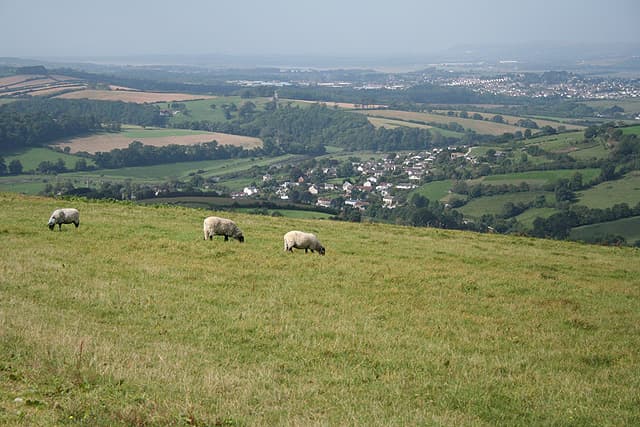
Bishop's Tawton
Bishop's Tawton is a village and civil parish in North Devon, England, situated in the valley of the River Taw. Its historical significance is linked to a potential early bishopric in the 10th century, though this is conjectural, with the extant Church of St John the Baptist featuring a 14th-century spire and Norman font.

Canterbury Cathedral
Canterbury Cathedral is the seat of the Archbishop of Canterbury, the spiritual leader of the Church of England and the Anglican Communion. Founded in 597 on the site of earlier Christian structures, it has undergone numerous rebuildings and extensions, most notably after fires and to accommodate pilgrims. It is a UNESCO World Heritage Site and remains an active place of worship.

Peterborough Cathedral
Peterborough Cathedral, officially the Cathedral Church of St Peter, St Paul and St Andrew, is a significant example of Norman and Early English Gothic architecture located in Peterborough, Cambridgeshire, United Kingdom. Originally founded as an Anglo-Saxon minster and later a Benedictine abbey, it became a cathedral in 1542 and is notable for its remarkably intact medieval structure, particularly its unique West Front.