
St Machar, Aberdeen
St Machar's Cathedral in Aberdeen, Scotland, is a historic Church of Scotland building that, while no longer a cathedral in the ecclesiastical sense, serves as a high kirk. Its origins are traced to a 6th-century foundation by St Machar, with the current structure evolving significantly from a Norman cathedral established in 1131 through medieval rebuilding and later modifications.
Key Facts
- ›Founded around 580 AD by St Machar, reportedly guided by a divine sign.
- ›The current building incorporates elements from a Norman cathedral consecrated in 1131, though little of that original structure remains.
- ›Significant rebuilding occurred from the late 13th century through the 15th century, shaping the nave, western towers, and spires.
- ›The chancel was demolished in 1560 during the Scottish Reformation, and parts of the central tower collapsed in 1688.
- ›The cathedral is renowned for its unique 16th-century heraldic ceiling, featuring the coats of arms of European royalty and Scottish nobility.
- ›Primarily constructed from outlayer granite, it exhibits features of a fortified kirk with robust twin western towers.

Gothic, Fortified Kirk
- Heraldic Ceiling With Coats of Arms of European Royalty and Scottish Nobility
- Twin Western Towers and Spires
- Granite Construction
- Remains of Norman Cathedral Arches
- Late Medieval Bishops' Tombs In the Ruined Transepts and Crossing
About St Machar, Aberdeen
St Machar's Cathedral, Aberdeen
St Machar's Cathedral, located in the historic area of Old Aberdeen, Scotland, is a significant edifice of the Church of Scotland. While it no longer functions as the seat of a bishop and is thus technically a 'high kirk,' its history spans over a millennium, tracing its origins to a foundation by Saint Machar around 580 AD. The present structure is the culmination of centuries of development, incorporating remnants of a Norman cathedral established in 1131 and extensive rebuilding and modifications that occurred from the late 13th century through the 16th century.
History and Development
The legend of St Machar's founding involves a divine instruction to establish a church at a specific bend of the River Don. The Norman cathedral, built after the see was transferred from Mortlach to Aberdeen, saw little of its original fabric survive. Significant architectural contributions were made by a series of bishops, including Henry Cheyne, Alexander Kininmund II, Henry Lichtoun, and Gavin Dunbar. These efforts resulted in the construction of the nave, western towers, and spires, with much of the building primarily constructed from outlayer granite.
The Scottish Reformation in 1560 led to the demolition of the chancel, and a severe storm in 1688 caused the collapse of the central tower, destroying the choir and transepts. Consequently, the current church comprises only the nave and aisles of the earlier building. The ruined transepts and crossing are now maintained by Historic Environment Scotland and contain important medieval bishops' tombs.
Architectural Significance and Features
St Machar's is noted for its unique 16th-century heraldic ceiling, a flat panelled expanse adorned with the coats of arms of contemporary European monarchs, Scottish archbishops, bishops, and prominent families. The western facade is characterized by twin towers, believed to have been inspired by the fortified tower houses of the 14th century, and the spires crowning these towers were added in the 15th century. The cathedral also features significant stone carvings, including capitals from the Norman period and late medieval effigies.
Ministry and Conservation
The cathedral has a rich history of ministry, with notable figures serving as ministers throughout its Presbyterian period. Recent decades have seen considerable investment in conservation and restoration work, including the renewal of battlements on the western towers and the careful display of historic artefacts. In 1987, bells from another church were restored and installed, making it one of the few churches in Scotland equipped for change ringing. A substantial project in 2020 addressed the re-slating of the roof, cleaning of the heraldic ceiling, and repair of stained glass windows.
Source: Wikipedia ↗
Frequently Asked Questions
Is St Machar's Cathedral still a functioning cathedral?
Technically, St Machar's is no longer a cathedral as it has not been the seat of a bishop since 1690. It is now referred to as a high kirk within the Church of Scotland.
What is the legend behind the founding of St Machar's?
According to a 14th-century legend, St Machar was instructed by God or St Columba to establish a church where the River Don bends like a bishop's crosier before meeting the sea, a geographical feature present near the cathedral's location.
What is the significance of the heraldic ceiling?
The unique flat panelled ceiling of the nave, dating from the first half of the 16th century, displays the heraldic shields of contemporary kings of Europe, as well as the chief earls and bishops of Scotland. It also features a frieze listing bishops and Scottish monarchs.
What architectural styles are present at St Machar's?
The cathedral exhibits a mix of styles due to its long construction history, with Gothic elements prominent in the nave and western towers. It also incorporates features of a fortified kirk.
Are there any notable burials at St Machar's?
Yes, the cathedral cemetery includes burials of notable figures such as author J.J. Bell and Robert Brough. Within the cathedral itself, various bishops of Aberdeen and other historical figures are interred.
What was the impact of the Reformation on St Machar's?
During the Scottish Reformation in 1560, the chancel was demolished. Additionally, the bells and lead from the roof were sent to be sold in Holland, though the ship carrying them sank.
Related Cathedrals
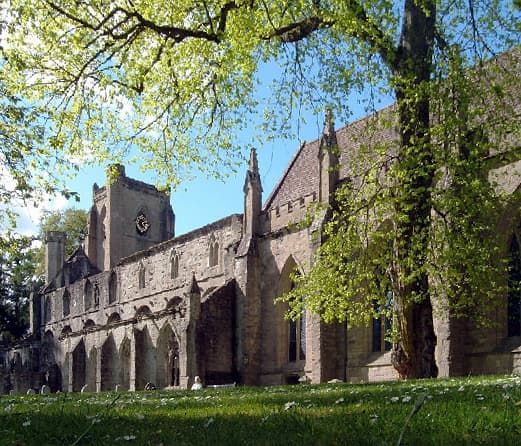
Dunkeld Cathedral
Dunkeld Cathedral is a historic Church of Scotland place of worship situated on the north bank of the River Tay in Dunkeld, Scotland. While no longer formally a cathedral with bishops, it retains the name and stands on the site of a former Culdee monastery, showcasing a blend of Gothic and Norman architectural elements. The cathedral is a significant historical site, believed to have once housed relics of Saint Columba, and is still an active parish church.

Glasgow Cathedral
Glasgow Cathedral is a historic parish church of the Church of Scotland, serving as the mother church of the Archdiocese of Glasgow and the province of Glasgow from the 12th century until the Scottish Reformation. It is the oldest cathedral in mainland Scotland and the oldest building in Glasgow, notable for surviving the Reformation largely intact. The cathedral is dedicated to Saint Mungo, the city's patron saint, whose tomb is located within the Lower Church.

St Magnus, Kirkwall
St Magnus Cathedral in Kirkwall, Orkney, is Scotland's oldest and the United Kingdom's most northerly cathedral. Originally a Roman Catholic cathedral founded in 1137, it is a significant example of Romanesque architecture with subsequent Gothic additions. It is now a parish church of the Church of Scotland and is owned by Orkney Islands Council.