
Salerno Cathedral
Archdiocese of Salerno-Campagna-Acerno·Roman Catholic·Italy
Salerno Cathedral, also known as the Duomo, is the principal church of Salerno, Italy, and a significant tourist destination. Dedicated to Saint Matthew, whose relics are housed in its crypt, the cathedral was founded in the late 11th century and has undergone various renovations, most notably in the Baroque period and a restoration in the 1930s to recall its original appearance. It holds historical importance as the burial site of Pope Gregory VII and is a symbol of the Italian Renaissance.
Key Facts
- ›Founded in 1076 and consecrated in 1084 by Pope Gregory VII.
- ›Houses the relics of Saint Matthew in its crypt.
- ›Features a 12th-century bell tower in Arab-Norman style, standing 56 meters high.
- ›The main entrance, Porta dei Leoni, is a 12th-century Romanesque portal with 11th-century bronze doors from Constantinople.
- ›The interior was significantly remodelled in the Neapolitan Baroque style in 1688 but retains traces of the original Romanesque and early Christian elements.
- ›It is the burial site for Pope Gregory VII and Queen Margaret of Durazzo.

- Crypt of Saint Matthew
- Porta Dei Leoni
- 11th-Century Bronze Doors From Constantinople
- 12th-Century Arab-Norman Bell Tower
- Two 13th-Century Pulpits With Mosaic Decorations
- Tomb of Pope Gregory Vii
- Cappella Delle Crociate
Ferdinando Sanfelice, Domenico Fontana, Giulio Fontana
About Salerno Cathedral
Salerno Cathedral, also commonly referred to as the Duomo of Salerno, stands as the principal ecclesiastical edifice in the southern Italian city of Salerno. It is a significant religious site and a major tourist attraction, primarily due to its dedication to Saint Matthew the Apostle, whose relics are enshrined within its crypt. The cathedral's origins trace back to the period when Salerno served as the capital of the Principality of Salerno, with its construction initiated over the foundations of an even older church likely dating from the late Roman centuries.
History and Construction
The foundation of Salerno Cathedral was laid in 1076 under the Norman ruler Robert Guiscard, during the episcopate of Alfano I. The consecration ceremony was performed by Pope Gregory VII in 1084. The cathedral's architectural history is marked by significant transformations. In 1688, architect Ferdinando Sanfelice undertook a substantial remodelling of the interior, imbuing it with Neapolitan Baroque and Rococo styles. A subsequent restoration in the 1930s aimed to restore the cathedral to an appearance closer to its original Romanesque form. The building suffered damage during World War II as a consequence of the Allied landings in Salerno in September 1943.
Architectural Significance and Features
The cathedral presents a multifaceted architectural character. Its most distinctive external feature is the mid-12th century bell tower, standing 56 meters tall and exhibiting an Arab-Norman style with small arcades and mullioned windows. The façade is graced by a Romanesque portal, the Porta dei Leoni, which leads to a harmonious courtyard surrounded by graceful arches and overlooked by the bell tower. The entrance is further enhanced by imposing bronze doors, cast in Constantinople in the 11th century, featuring 56 panels depicting figures, crosses, and scenes from the life of Jesus. The portico leading into the interior, supported by 28 antique columns with pointed arches and lava rock intarsia, showcases Arab artistic influences. The interior, though largely Baroque, retains elements of the original church, including parts of the transept and choir floor, as well as two raised pulpits adorned with intricate 13th-century mosaic work, reminiscent of the early Christian mosaics found in Ravenna.
The Crypt and Relics
Central to the cathedral's spiritual significance is its crypt, which houses the sacred relics of Saint Matthew the Apostle. These remains were transferred to Salerno in 954 AD. The crypt itself is a groin-vaulted hall with a basilica-like plan, divided by columns. It underwent restoration between 1606 and 1608 under the direction of Domenico and Giulio Fontana, with marble decorations added in the 18th century. The ceiling frescoes, executed by Belisario Corenzio, illustrate scenes from the Gospel of Matthew and historical episodes of Salerno. Within the crypt also lie the tombs of the martyred saints Caius, Ante, and Fortunato, Saint Felice, and the virgin saints Marina and Costanza. The original remains of Saint Matthew are visible within the main altar, and until the 19th century, a special liquid known as Manna San Matteo was said to emanate from this spot.
Artistic Treasures and Burials
Beyond its architectural grandeur and relics, Salerno Cathedral is home to a wealth of artistic treasures. These include two pulpits with detailed mosaic decorations, paintings by Francesco Solimena, and a 14th-century Gothic fresco of the Madonna with Child. The cathedral also serves as the final resting place for several important historical figures, including Queen Margaret of Durazzo, Roger Borsa, Archbishop Bartolomeo d'Arpano, and notably, Pope Gregory VII, whose tomb is a significant memorial to his resistance against imperial domination of the Church and marks the cathedral as a symbol of the Italian Renaissance. The Duomo Museum, an adjacent section, preserves artworks from various periods, such as 13th-century silver statues of the Salernitane Martyrs, and historical documents connected to the renowned Schola Medica Salernitana, considered by some scholars to be the first university in Europe.
Source: Wikipedia ↗
Frequently Asked Questions
When was Salerno Cathedral built?
The foundation of Salerno Cathedral was initiated in 1076 under Robert Guiscard, and it was consecrated by Pope Gregory VII in 1084. The building has undergone several renovations and restorations throughout its history.
What is Salerno Cathedral famous for?
Salerno Cathedral is most famous for housing the relics of Saint Matthew the Apostle in its crypt. It is also notable for its 12th-century Arab-Norman bell tower, its 11th-century Byzantine-style bronze doors, and the tomb of Pope Gregory VII.
Where are Saint Matthew's relics kept?
The relics of Saint Matthew the Apostle are kept in the cathedral's crypt. These remains were brought to Salerno in 954 AD and are a major draw for visitors.
What architectural styles can be found at Salerno Cathedral?
Salerno Cathedral exhibits a blend of styles, including Romanesque elements in its facade and portal, Arab-Norman influences in its bell tower, and significant Baroque and Rococo additions from the 1688 remodelling. Traces of early Christian mosaics are also present.
Who is buried in Salerno Cathedral?
Notable figures buried within Salerno Cathedral include Pope Gregory VII, Queen Margaret of Durazzo, Roger Borsa, and Archbishop Bartolomeo d'Arpano. The crypt also contains the tombs of several martyrs and virgin saints.
Has Salerno Cathedral been damaged historically?
Yes, Salerno Cathedral was damaged during World War II when Allied forces landed in Salerno in September 1943 as part of Operation Avalanche. It has also undergone extensive remodelling and restoration throughout its history.
Related Cathedrals

Amalfi Cathedral
Amalfi Cathedral, officially the Cathedral of Saint Andrew, is a medieval Roman Catholic cathedral located in Amalfi, Italy. It is renowned for its elaborate architecture, a blend of various historical styles, and for housing the relics of the Apostle Saint Andrew. The cathedral has been an important religious center and a significant landmark of the Amalfi Coast for centuries.
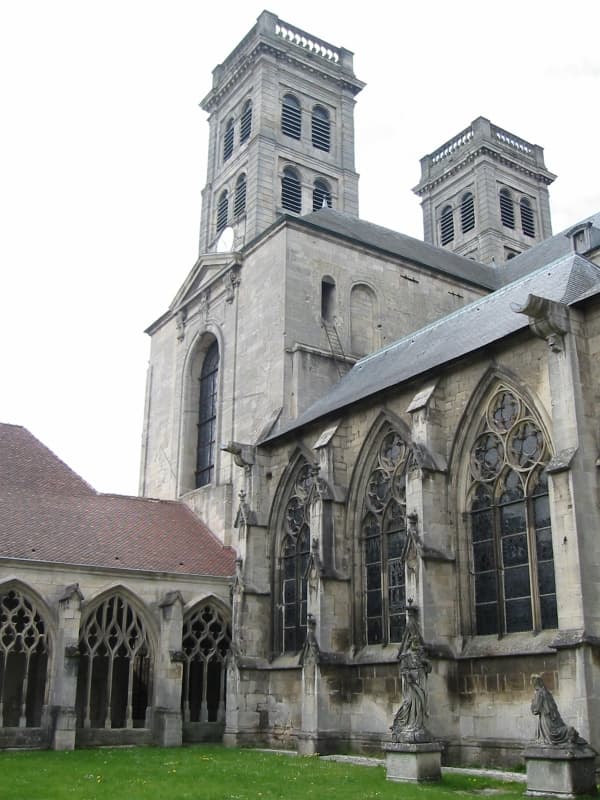
Verdun Cathedral
Verdun Cathedral, officially Cathédrale Notre-Dame de Verdun, is a Roman Catholic cathedral in Verdun, France. It is notable for its historical depth, tracing its origins to the 3rd century, and for its architectural blend of Romanesque, Gothic, and Neo-Classical styles. The cathedral holds significant historical importance, having been a focal point during World War I.

Caltanissetta Cathedral
Caltanissetta Cathedral, also known as the Church of Santa Maria la Nova, serves as the principal church of the Diocese of Caltanissetta. Its construction began in 1570 and concluded in 1622, with significant expansions and decorations carried out in subsequent centuries. The cathedral is a significant religious and architectural landmark in the city, showcasing Baroque and Rococo influences.