
Saint-Papoul Cathedral
Saint-Papoul·Roman Catholic·France
Saint-Papoul Cathedral, located in the village of Saint-Papoul in Languedoc, was a Roman Catholic church dedicated to Saint Papulus, an early Christian bishop and martyr. Established as a cathedral in 1317 when the existing abbey church was elevated to this status and its abbot became a bishop, it served as the seat of the Bishop of Saint-Papoul until its suppression during the French Revolution. Today, the former cathedral functions as the parish church for the village.
Key Facts
- ›Founded as an abbey in the 8th century, it became a cathedral in 1317.
- ›Dedicated to Saint Papulus, an early Christian bishop and martyr.
- ›Served as the seat of the Bishop of Saint-Papoul for 34 bishops until the French Revolution.
- ›Suffered plunderings in 1361 by the Routiers and in 1595 by Protestants.
- ›Underwent significant restorations in the 17th and 18th centuries.
- ›Became a parish church after the suppression of the bishopric during the French Revolution.

- Tomb of Saint Berenger, A Pilgrimage Site In the 11th Century.
About Saint-Papoul Cathedral
Saint-Papoul Cathedral, situated in the village of Saint-Papoul in Languedoc, France, is a historical Roman Catholic church with roots tracing back to the 8th century. Originally an abbey, it was transformed into a cathedral in 1317 when Pope John XXII established the bishopric of Saint-Papoul, elevating the abbot to episcopal status. The cathedral served as the episcopal seat for 34 bishops until its suppression during the French Revolution.
History and Significance
The abbey was founded in the 8th century, named after Saint Papoul, a hermit and martyr from the 5th or 6th century. A significant figure in the abbey's history was Saint Berenger, who lived there in the 11th century, and whose tomb later became a pilgrimage destination. The creation of the bishopric in 1317 marked a new era for the religious institution, although its existence was tumultuous.
The cathedral faced periods of destruction and restoration. In 1361, it was plundered by the Routiers, and again in 1595 by Protestants. The 17th and 18th centuries saw considerable restoration work, including the rebuilding of the episcopal palace. During the Revolution, the bishopric was abolished, and the cathedral reverted to its role as a parish church for the village, a function it continues to fulfill today. The diocese's territory was largely absorbed into the Diocese of Carcassonne under the Concordat of 1801.
Source: Wikipedia ↗
Frequently Asked Questions
When was Saint-Papoul Cathedral founded?
The site of Saint-Papoul Cathedral was originally an abbey founded in the 8th century. The abbey church was elevated to the status of a cathedral in 1317 when the bishopric of Saint-Papoul was created.
To whom is Saint-Papoul Cathedral dedicated?
The cathedral is dedicated to Saint Papulus, an early Christian bishop and martyr. The village of Saint-Papoul also takes its name from this saint.
What happened to the Diocese of Saint-Papoul?
The Diocese of Saint-Papoul was created in 1317 and suppressed during the French Revolution. Under the Concordat of 1801, its territory was largely transferred to the Diocese of Carcassonne.
What is the current status of Saint-Papoul Cathedral?
Following the suppression of the bishopric during the French Revolution, Saint-Papoul Cathedral became the parish church for the village of Saint-Papoul. The abbey buildings remain in use today.
What historical events affected the cathedral?
The cathedral was plundered in 1361 by the Routiers and again in 1595 by Protestants. It also underwent significant restorations in the 17th and 18th centuries.
Related Cathedrals
Nevers Cathedral
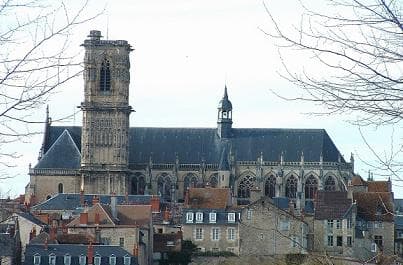
Nevers Cathedral, officially Cathédrale Saint-Cyr-et-Sainte-Julitte de Nevers, is a Roman Catholic cathedral in Nevers, France, serving as the seat of the Bishop of Nevers. It is a significant national monument with origins dating back to the Roman period, and its history showcases a blend of Romanesque and Gothic architectural styles shaped by numerous reconstructions and restorations.

Rouen Cathedral
Rouen Cathedral, officially Cathédrale primatiale Notre-Dame de l'Assomption de Rouen, is a significant Catholic church in Rouen, Normandy, France, serving as the seat of the Archbishop of Rouen. Renowned for its three distinct towers, the cathedral showcases a rich architectural history, evolving from Early Gothic to Flamboyant and Renaissance styles over more than eight centuries. It holds notable importance in art history as the subject of Claude Monet's impressionist series and in architectural history, having been the world's tallest building from 1876 to 1880.

Glastonbury Abbey
Glastonbury Abbey was a prominent Benedictine monastery in Glastonbury, Somerset, England, with ruins that are now a visitor attraction. Founded in the 8th century and significantly rebuilt after a fire in 1184, it became one of England's wealthiest and most powerful abbeys by the 14th century, playing a key role in land management and drainage projects. The abbey was dissolved by King Henry VIII in 1539, with its last abbot executed.