
Glastonbury Abbey
Glastonbury Abbey was a prominent Benedictine monastery in Glastonbury, Somerset, England, with ruins that are now a visitor attraction. Founded in the 8th century and significantly rebuilt after a fire in 1184, it became one of England's wealthiest and most powerful abbeys by the 14th century, playing a key role in land management and drainage projects. The abbey was dissolved by King Henry VIII in 1539, with its last abbot executed.
Key Facts
- ›Founded in the 8th century and enlarged in the 10th century, with significant rebuilding after a fire in 1184.
- ›Became one of the richest and most powerful monasteries in England by the 14th century.
- ›Instrumental in major drainage projects on the Somerset Levels.
- ›Associated with legends of King Arthur and Avalon from at least the 12th century.
- ›Suppressed during the Dissolution of the Monasteries under King Henry VIII, with the last abbot executed in 1539.
- ›Its ruins are a Grade I listed building and scheduled monument, managed as a visitor attraction.

- Abbot's Kitchen
- Lady Chapel
- Alleged Tomb of King Arthur and Queen Guinevere
- Glastonbury Canal
- the George Hotel and Pilgrims' Inn
About Glastonbury Abbey
Glastonbury Abbey, located in Glastonbury, Somerset, England, is a ruin of a once-powerful Benedictine monastery, now a significant visitor attraction. Archaeological evidence points to Roman and Saxon occupation, with the abbey itself dating at least to the early 7th century. It was founded by Britons and later enriched by King Ine of Wessex, who is credited with directing the construction of a stone church in 712. The abbey was further developed in the 10th century by Abbot Dunstan, a key figure in English monastic revival, who instituted the Benedictine Rule and built cloisters.
History and Significance
The abbey experienced periods of growth and destruction, notably a great fire in 1184 that necessitated extensive rebuilding. By the 14th century, Glastonbury was among the wealthiest and most influential monasteries in England, controlling vast lands and undertaking major drainage projects on the Somerset Levels. This period also saw the construction of impressive structures like the Abbot's Kitchen, a remarkably preserved medieval building.
The abbey's history is deeply intertwined with legend. From the 12th century, it became associated with King Arthur, with monks promoting the idea that Glastonbury was the mythical Isle of Avalon. In 1191, the monks claimed to have discovered the tomb of Arthur and Queen Guinevere, a find widely believed by historians to be a fabrication intended to boost the abbey's prestige and attract pilgrims. Despite this, the abbey's connection to Arthurian legend has endured.
Dissolution and Legacy
Glastonbury Abbey met its end during the Dissolution of the Monasteries under King Henry VIII. In 1539, the abbey was suppressed, and its last abbot, Richard Whiting, was executed as a traitor on Glastonbury Tor. Following the Dissolution, the abbey was stripped of its valuables and much of its stone was repurposed for other buildings. The site eventually fell into ruin, serving as a quarry in the 19th century before its preservation began with the Ancient Monuments Protection Act in 1882.
In the 20th century, the ruins were purchased by the Bath and Wells Diocesan Trust and are now managed by the Glastonbury Abbey Trust. The site, set in 36 acres of parkland, continues to attract over 100,000 visitors annually. Pilgrimages, both Anglican and Catholic, are still held, and services are conducted in various Christian traditions, maintaining the abbey's spiritual relevance. The ruins are a Grade I listed building and a scheduled monument, with the Abbot's Kitchen standing as a testament to the abbey's medieval architectural prowess.
Source: Wikipedia ↗
Frequently Asked Questions
When was Glastonbury Abbey founded?
Glastonbury Abbey was founded at least by the early 7th century, with suggestions of even earlier religious importance. King Ine of Wessex is reputed to have directed that a stone church be built in 712.
What is the connection between Glastonbury Abbey and King Arthur?
From at least the 12th century, the Glastonbury area has been associated with the legend of King Arthur. In 1191, the alleged discovery of King Arthur and Queen Guinevere's tomb in the abbey's cemetery was promoted by the monks, though historians largely dismiss its authenticity.
Why was Glastonbury Abbey suppressed?
Glastonbury Abbey was suppressed during the Dissolution of the Monasteries under King Henry VIII. The abbey was stripped of its valuables, and the last abbot, Richard Whiting, was executed in 1539.
What is the architectural significance of the ruins?
The ruins of the great church and the Lady Chapel are Grade I listed buildings. The Abbot's Kitchen, a 14th-century octagonal building, is considered one of the best-preserved medieval kitchens in Europe and is the only substantial monastic building surviving.
Is Glastonbury Abbey still an active religious site?
While the abbey is now primarily a visitor attraction, pilgrimages continue to be held, attracting visitors from across Western Europe. Services are celebrated in Anglican, Roman Catholic, and Eastern Orthodox traditions on the site.
Related Cathedrals
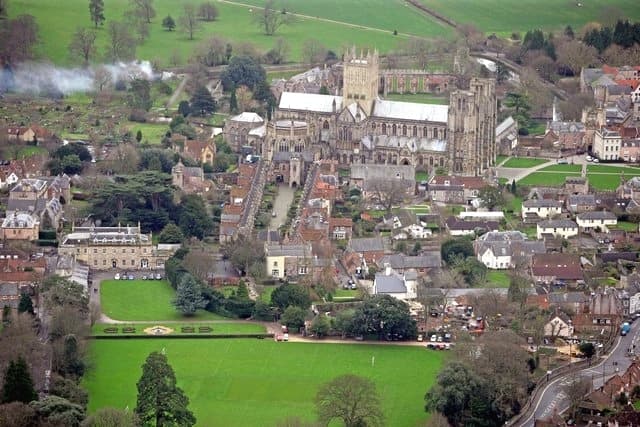
Wells, Somerset
Wells, Somerset, is a historic cathedral city in England, renowned for its magnificent cathedral and its status as one of the country's smallest cities. It holds significant historical importance, tracing its origins to a Roman settlement and later becoming a key center under the Anglo-Saxons, with its growth deeply intertwined with the presence of its cathedral and bishopric.

Bath Abbey
Bath Abbey, officially the Abbey Church of Saint Peter and Saint Paul, is a significant parish church and former Benedictine monastery in Bath, Somerset, England. Originally founded in the 7th century, it has undergone numerous rebuildings and restorations, most notably in the 12th and 16th centuries, with major renovations by Sir George Gilbert Scott in the 1860s. It stands as a prime example of Perpendicular Gothic architecture and once served as a cathedral for the Diocese of Bath and Wells before its consolidation at Wells.

Wells Cathedral
Wells Cathedral, formally the Cathedral Church of St Andrew, is a Church of England cathedral in Wells, Somerset, England, and the seat of the Bishop of Bath and Wells. It is renowned for its status as potentially the world's first truly Gothic structure, largely constructed between the late 12th and mid-14th centuries, and features a significant collection of medieval stained glass and sculpted figures on its west front.