
Wells Cathedral
Wells Cathedral, formally the Cathedral Church of St Andrew, is a Church of England cathedral in Wells, Somerset, England, and the seat of the Bishop of Bath and Wells. It is renowned for its status as potentially the world's first truly Gothic structure, largely constructed between the late 12th and mid-14th centuries, and features a significant collection of medieval stained glass and sculpted figures on its west front.
Key Facts
- ›Earliest recorded church on site dates to 766 AD.
- ›Construction of the present Gothic cathedral began around 1175.
- ›The west front features 300 sculpted figures.
- ›It is considered by some historians to be the world's first truly Gothic cathedral.
- ›The cathedral precinct includes the medieval Vicars' Close.
- ›Receives over 300,000 visitors annually.

West Front With 300 Sculpted Figures, Octagonal Chapter House, Vicars' Close, Medieval Stained Glass, Strainer Arches, Cloisters
Adam Lock, Thomas Norreys, William Wynford, Thomas Witney, William Joy, Benjamin Ferrey, Anthony Salvin
About Wells Cathedral
Wells Cathedral, formally known as the Cathedral Church of St Andrew, stands as a prominent Church of England cathedral in the city of Wells, Somerset, England. It serves as the seat of the Bishop of Bath and Wells and is the mother church for the diocese of the same name. The cathedral is celebrated for its architectural significance, with some historians positing it as the world's first truly Gothic structure, marking a departure from Romanesque styles. It attracts over 300,000 visitors annually and hosts daily services.
History and Development
The earliest recorded church on the present site dates back to 766 AD. A bishopric was established in 909, though the cathedral seat was later moved to Bath in 1090. Wells became a co-cathedral in 1218, and the title "Bishop of Bath and Wells" was officially established in 1245, with Wells as its principal seat. The construction of the present cathedral is largely attributed to two major building campaigns: one from approximately 1180 to 1260, focusing on the western half, and another from 1285 to 1345, which completed the eastern end, chapter house, and central tower. Significant later additions include the Perpendicular Gothic towers on the west front, built between 1385 and 1410.
Architectural Significance
Wells Cathedral is distinguished by its harmonious blend of Gothic styles. The western sections are predominantly in the Early English style, characterized by simple lancet arches, while the eastern end showcases the more ornate Decorated Gothic style. The west front, a notable feature, is 100 feet high and 147 feet wide, and is adorned with approximately 300 sculpted figures, described by architectural historian John Harvey as a "supreme triumph of the combined plastic arts in England". Later modifications, such as the western towers and remodelled cloisters, were executed in the Perpendicular Gothic style. Internally, the nave, with its horizontal emphasis and unique triforium, stands at 67 feet in height. The cathedral's plan features two transepts, a nave, choir, retrochoir, and an octagonal chapter house.
Notable Features and Ministry
Beyond its architectural grandeur, Wells Cathedral boasts several notable features, including the Vicars' Close, a well-preserved medieval residential street for the cathedral's vicars choral, and a significant collection of medieval stained glass, particularly the 14th-century Jesse Tree window. The cathedral precinct also includes the Bishop's Palace. As an active center of worship, Wells Cathedral holds over a thousand services each year and plays a vital role in the community, hosting events and educational outreach programs. It is also a venue for musical performances and serves as a significant tourist attraction while remaining freely accessible for prayer and worship.
Source: Wikipedia ↗
Frequently Asked Questions
What is the history of Wells Cathedral?
The earliest evidence of a church on the site dates to 766 AD. The present Gothic cathedral's construction began around 1175, with significant building campaigns occurring between c. 1180-1260 and c. 1285-1345. Its status as a cathedral seat has shifted over centuries before settling as the principal seat of the Bishop of Bath and Wells.
What architectural styles are present at Wells Cathedral?
Wells Cathedral primarily exhibits the Early English Gothic style in its western half and the Decorated Gothic style in its eastern parts, including the chapter house and Lady Chapel. Later additions, such as the western towers and cloisters, feature the Perpendicular Gothic style.
What are the notable features of Wells Cathedral?
Key features include its impressive west front adorned with 300 sculpted figures, the octagonal chapter house, the Vicars' Close, and a significant amount of medieval stained glass. The cathedral also contains strainer arches, a unique architectural solution to structural issues.
When was Wells Cathedral built?
The main construction phases of Wells Cathedral took place between approximately 1180 to 1260 for the western parts and 1285 to 1345 for the eastern sections, including the chapter house and central tower. Additions like the west front towers were completed by the early 15th century.
Is Wells Cathedral an active place of worship?
Yes, Wells Cathedral is an active Church of England cathedral with daily services, including Matins, Holy Communion, and Choral Evensong. It also hosts major Christian festivals and ceremonies such as baptisms, weddings, and funerals.
Related Cathedrals

Bath Abbey
Bath Abbey, officially the Abbey Church of Saint Peter and Saint Paul, is a significant parish church and former Benedictine monastery in Bath, Somerset, England. Originally founded in the 7th century, it has undergone numerous rebuildings and restorations, most notably in the 12th and 16th centuries, with major renovations by Sir George Gilbert Scott in the 1860s. It stands as a prime example of Perpendicular Gothic architecture and once served as a cathedral for the Diocese of Bath and Wells before its consolidation at Wells.
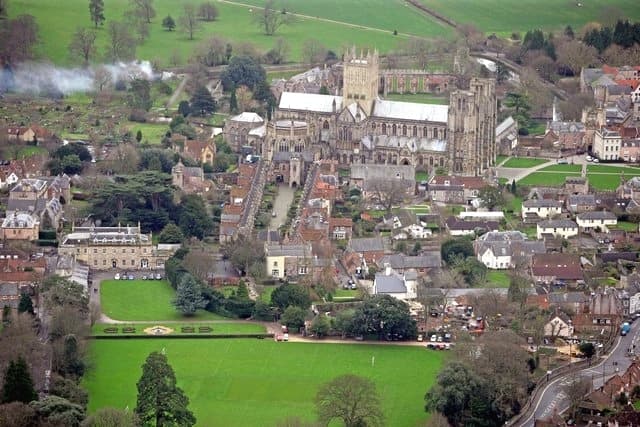
Wells, Somerset
Wells, Somerset, is a historic cathedral city in England, renowned for its magnificent cathedral and its status as one of the country's smallest cities. It holds significant historical importance, tracing its origins to a Roman settlement and later becoming a key center under the Anglo-Saxons, with its growth deeply intertwined with the presence of its cathedral and bishopric.

Glastonbury Abbey
Glastonbury Abbey was a prominent Benedictine monastery in Glastonbury, Somerset, England, with ruins that are now a visitor attraction. Founded in the 8th century and significantly rebuilt after a fire in 1184, it became one of England's wealthiest and most powerful abbeys by the 14th century, playing a key role in land management and drainage projects. The abbey was dissolved by King Henry VIII in 1539, with its last abbot executed.