
Saint-Denis Cathedral
The Basilica of Saint-Denis, now formally the Basilica Cathedral of Saint-Denis, is a Roman Catholic cathedral in Saint-Denis, France, renowned as the birthplace of Gothic architecture. Its choir, completed in 1144, is considered the first structure to fully embody Gothic architectural principles. Historically, it served as a significant pilgrimage site and the royal necropolis for French monarchs, housing nearly every king from the 10th to the 19th century.
Key Facts
- ›Considered the first structure to employ all elements of Gothic architecture in its choir, completed in 1144.
- ›Served as the necropolis for French kings, with nearly every monarch from the 10th to the 19th century buried there.
- ›Abbot Suger initiated major rebuilding efforts in the 12th century, laying the foundation for Gothic style.
- ›The nave was rebuilt in the Rayonnant Gothic style in the 13th century, with large rose windows in the transepts.
- ›Royal tombs were desecrated during the French Revolution and later restored in the 19th century.
- ›Became a cathedral in 1966 with the formation of the Diocese of Saint-Denis.

Birthplace of Gothic Architecture, Royal Necropolis of France, Abbot Suger's Choir, Rayonnant Gothic Nave, Large Rose Windows In Transepts, Royal Tombs With Effigies
Abbot Suger, Pierre De Montreuil
About Saint-Denis Cathedral
Saint-Denis Cathedral: The Cradle of Gothic Architecture and Royal Necropolis
The Basilica of Saint-Denis, formally known as the Basilica Cathedral of Saint-Denis, stands as a monumental edifice in Saint-Denis, a northern suburb of Paris, France. It is globally recognized as the site where Gothic architecture first fully emerged, with its choir, completed in 1144, widely regarded as the seminal structure of this revolutionary style. Beyond its architectural significance, Saint-Denis holds profound historical importance as the principal royal necropolis of France, having served as the burial place for nearly every French monarch from the 10th century until the 19th century.
History and Architectural Evolution
The site's origins trace back to a Gallo-Roman cemetery, with early Christian burials and a martyrium erected around 313 AD to honor Saint Denis, the first bishop of Paris. In 632, King Dagobert I transformed the existing church into the Abbey of Saint Denis, a Benedictine monastery, and commissioned a new shrine for the saint's relics. The first significant church structure mentioned in chronicles was begun in 754 and completed in 775 under Charlemagne.
The transformative period occurred in the 12th century under Abbot Suger, a close advisor to Kings Louis VI and VII. Driven by the decrepit state of the older church and the growing number of pilgrims, Suger initiated an ambitious rebuilding program. His work on the west front, completed around 1140, and especially his construction of the new choir between 1140 and 1144, are considered the foundational elements of Gothic architecture. Suger masterfully integrated rib vaults with pointed arches, slender columns, and large stained-glass windows, creating an unprecedented sense of lightness and luminosity. The new choir's dedication on June 11, 1144, marked a pivotal moment in architectural history.
In the 13th century, under Abbot Odo Clement and later Abbot Matthew of Vendôme, the Carolingian nave was rebuilt in the Rayonnant Gothic style, a more refined evolution of the earlier Gothic. This reconstruction aimed to further enhance the cathedral's role as the French royal necropolis, with the remains of sixteen former kings and queens relocated to new tombs around the crossing in 1264.
Royal Necropolis and Pilgrimage Site
Saint-Denis Cathedral was not only a center of religious devotion but also a powerful symbol of French monarchy. It housed the coronation regalia, and French kings often carried the oriflamme, the battle flag of Saint Denis, into war for protection. The cathedral became a major pilgrimage destination, drawing visitors to the shrine of Saint Denis and to venerate the tombs of the monarchy.
The French Revolution and Restoration
During the French Revolution, Saint-Denis suffered greatly. Its connection to royalty made it a target for vandalism. The monastic buildings were demolished, the treasury confiscated, and the royal tombs were desecrated and opened in 1793. The church itself was profaned and used for storage. Following the Bourbon Restoration, efforts were made to recover and reinter the royal remains, and the tombs were restored by Viollet le Duc in the 1860s. Napoleon reconsecrated the church in 1806, designating it as a potential burial site for his own dynasty.
Modern Era
The abbey church officially became a cathedral in 1966 with the establishment of the Diocese of Saint-Denis. While known as the Basilica of Saint-Denis, it has not been formally granted the title of Minor Basilica by the Holy See. A significant project is currently underway to rebuild the cathedral's 86-meter-tall spire, which was dismantled in the 19th century, with completion anticipated by 2029.
Source: Wikipedia ↗
Frequently Asked Questions
What is the architectural significance of Saint-Denis Cathedral?
Saint-Denis Cathedral is historically significant as the site where Gothic architecture is widely considered to have originated. Its choir, completed in 1144 under Abbot Suger, first incorporated all the key elements of this revolutionary style.
Why is Saint-Denis Cathedral a royal necropolis?
From the 10th century onwards, Saint-Denis Cathedral became the principal burial place for the kings of France. Nearly every monarch, from the 10th century up to Louis XVIII in the 19th century, was interred within its walls.
What role did Abbot Suger play in the cathedral's history?
Abbot Suger, a highly influential figure, initiated the extensive rebuilding of the abbey church in the 12th century. He is credited with creating the first truly Gothic building by integrating innovative structural and decorative features.
What happened to the royal tombs during the French Revolution?
During the French Revolution, the royal tombs were desecrated. The remains of kings and queens were exhumed, stripped of funerary objects, and deposited in mass graves, while many tomb sculptures were damaged or destroyed.
When did Saint-Denis become a cathedral?
Saint-Denis became a cathedral in 1966, following the establishment of the Diocese of Saint-Denis. It is now the seat of the Bishop of Saint-Denis.
Is there a project to rebuild the spire?
Yes, there is an ongoing project to rebuild the 86-meter-tall spire. The project was decided in 2018, with initial restoration work beginning in 2022 and the main construction planned to commence in 2025, aiming for completion by 2029.
Related Cathedrals
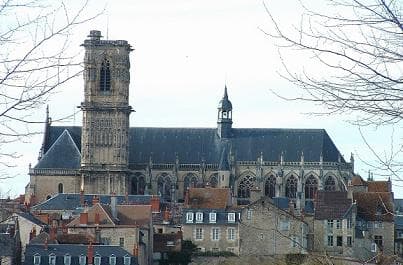
Nevers Cathedral
Nevers Cathedral, officially Cathédrale Saint-Cyr-et-Sainte-Julitte de Nevers, is a Roman Catholic cathedral in Nevers, France, serving as the seat of the Bishop of Nevers. It is a significant national monument with origins dating back to the Roman period, and its history showcases a blend of Romanesque and Gothic architectural styles shaped by numerous reconstructions and restorations.
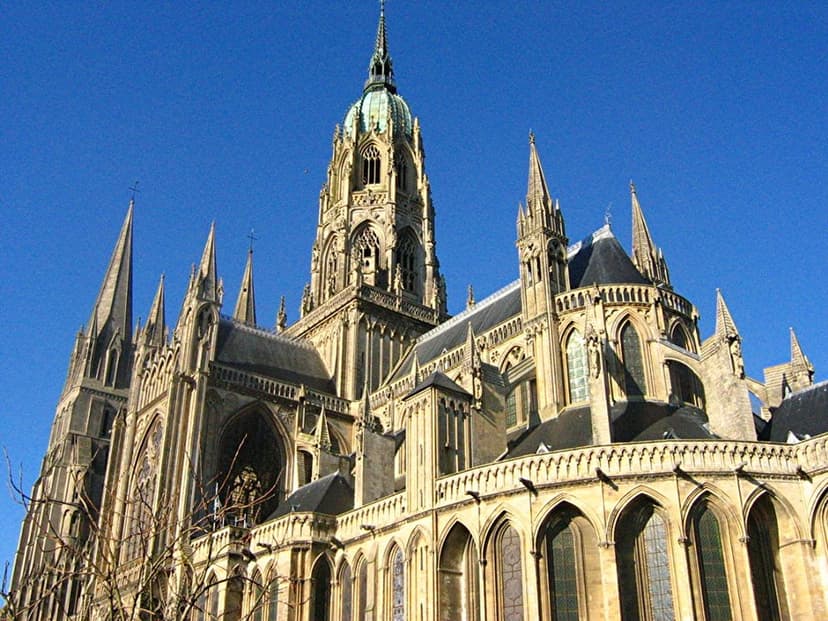
Bayeux Cathedral
Bayeux Cathedral, officially the Cathedral of Our Lady of Bayeux, is a significant Roman Catholic cathedral located in Bayeux, Normandy, France. It stands as a prime example of European Norman-Romanesque and Gothic architecture and was the original home of the renowned Bayeux Tapestry. The cathedral's history is marked by multiple reconstructions and modifications, reflecting evolving architectural styles and enduring historical events.
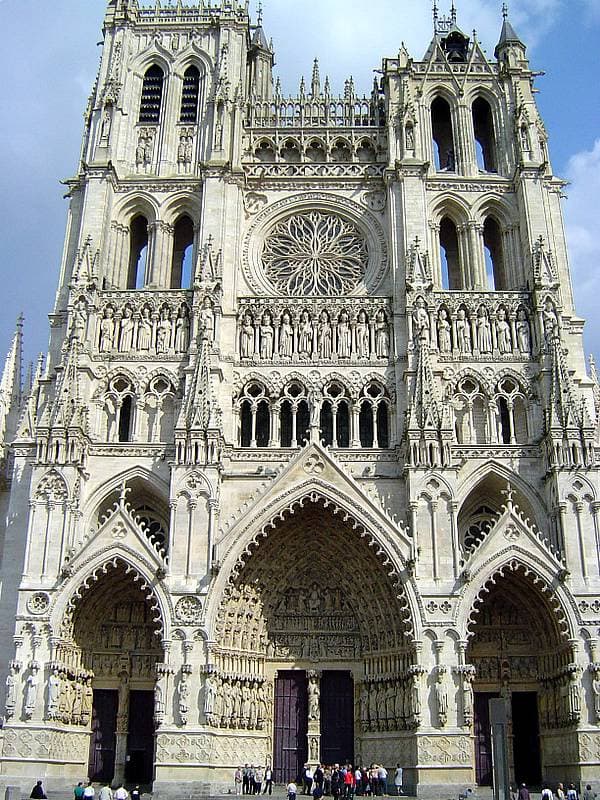
Amiens Cathedral
Amiens Cathedral, officially the Cathedral of Our Lady of Amiens, is a preeminent example of Gothic architecture and a significant religious site in France. It is renowned for its immense scale, being the largest cathedral by volume in France, and for its remarkably unified High Gothic and Rayonnant style, achieved through a swift construction period. The cathedral is also celebrated for its extensive collection of early Gothic sculpture, particularly on its west facade, and holds a UNESCO World Heritage designation.