
Rodez Cathedral
Rodez Cathedral, officially Cathédrale Notre-Dame de Rodez, is a Roman Catholic cathedral in Rodez, Aveyron, Southern France. It is a national monument and the seat of the Bishopric of Rodez, notable for its military-style west front, its impressive Flamboyant Gothic and Renaissance tower, and its significant influence on other European Gothic cathedrals.
Key Facts
- ›The site of Rodez Cathedral has a history of religious structures dating back to the 4th century, built on the grounds of a Roman pagan temple.
- ›The current Gothic structure's construction began in 1277, led by architect Jean Deschamps, and was influenced by Clermont-Ferrand and Limoges cathedrals.
- ›The cathedral features a distinctive west front with a military appearance, lacking a large portal and formerly integrated into the city wall.
- ›A prominent 87-meter high north bell tower showcases Flamboyant Gothic and Renaissance architectural elements, completed in the 16th century.
- ›Notable interior features include a 15th-century rood screen and choir stalls with intricate carvings, and a significant Great Organ.
- ›Rodez Cathedral was used as a central surveying point for the calculation of the Earth's circumference in the late 18th century.

- Military-Style West Front
- Flamboyant Gothic and Renaissance North Bell Tower
- Renaissance Rood Screen and Choir Stalls
- Great Organ
- Influence On Other European Gothic Cathedrals
Jean Deschamps, Antoine Salvanh, Jean Salvanh
About Rodez Cathedral
Rodez Cathedral, officially known as Cathédrale Notre-Dame de Rodez, stands as a prominent Roman Catholic cathedral in the city of Rodez, located in the Aveyron department of Southern France's Occitanie region. It serves as the seat of the Bishopric of Rodez and is recognized as a national monument.
History and Construction
The site of Rodez Cathedral has a long history of religious significance, with evidence of a basilica dating back to the Merovingian period (around the 4th century), built upon the foundations of a Roman pagan temple. Following periods of destruction and rebuilding, including a Romanesque basilica constructed around 1000 AD, a major collapse in 1276 necessitated the construction of the current Gothic structure. Work on this new cathedral commenced in 1277 under the direction of architect Jean Deschamps, who had previously contributed to Clermont-Ferrand Cathedral. The design adopted a Rayonnant Gothic style, characterized by a strong sense of verticality and elements like blind arcades in the triforium.
Construction progressed through the 14th century, reaching the transept and nave, though it was hampered by events such as the Black Death and the Hundred Years' War. Significant funding and renewed efforts in the 16th century, led by Bishops Francois D'Estaing and Georges d'Armagnac, allowed for the completion of the nave vaults and the construction of a new tower. This tower, incorporating Flamboyant Gothic and Renaissance features, was built between 1501 and 1529 by master mason Antoine Salvanh.
Architectural Features
Rodez Cathedral is distinguished by its unique west front, which presents a military appearance and was historically part of the city's defensive walls, featuring narrow slit windows rather than a large portal. The cathedral boasts an impressive 87-meter high north bell tower, a striking example of Flamboyant Gothic and Renaissance architecture, completed in the early 16th century.
Internally, the cathedral measures 101.57 meters in length and 36.89 meters in width at the transept, with a nave height of 30 meters. It follows a three-level design common in Ile-de-France cathedrals, with massive pillars, a narrow triforium, and upper walls filled with windows. Among its notable interior elements are a preserved jubé (rood screen) installed in 1478, a rare survival in French Gothic churches, and elaborately carved choir stalls from the same period. The cathedral also houses a significant Great Organ, with its buffet dating from 1628.
Scientific and Historical Significance
Beyond its religious and architectural importance, Rodez Cathedral played a crucial role in scientific history. Between 1792 and 1798, surveyors Pierre Méchain and Jean-Baptiste Delambre utilized the cathedral as a central surveying point for their ambitious project to measure the Earth's circumference. This endeavor was instrumental in the establishment of the metric system and the definition of the meter.
Remarkably, Rodez Cathedral escaped significant damage during both World War I and World War II, a contrast to many other historic structures in France. The cathedral continues to stand as an active place of worship and a testament to centuries of architectural evolution and historical events.
Source: Wikipedia ↗
Frequently Asked Questions
What is the history of Rodez Cathedral?
The site has been used for Christian worship since the 4th century, with a Romanesque basilica built in 1000 AD. The current Gothic cathedral's construction began in 1277 after the collapse of an earlier structure, with significant work continuing into the 16th century.
What are the notable architectural features of Rodez Cathedral?
The cathedral is recognized for its imposing west front, which has a military appearance and was integrated into the old city walls. Its 87-meter high north bell tower is a striking example of Flamboyant Gothic and Renaissance styles, and the interior contains a preserved rood screen and choir stalls.
When was Rodez Cathedral constructed?
The reconstruction of the current Gothic cathedral began on May 25, 1277. Work progressed over several centuries, with significant additions and completions occurring in the 16th century.
What is the significance of Rodez Cathedral in scientific history?
Between 1792 and 1798, surveyors Pierre Méchain and Jean-Baptiste Delambre used Rodez Cathedral as a central point for their geodetic measurements to calculate the Earth's circumference. This work was crucial for establishing the metric system, including the definition of the meter.
Does Rodez Cathedral have any famous artworks or artifacts?
Yes, the cathedral houses a 15th-century rood screen and choir stalls, which are notable for their rich carved decorations, including biblical figures and scenes. It also possesses a historically significant Great Organ.
Has Rodez Cathedral been damaged in wars?
Unlike many structures in northern France, Rodez Cathedral remained untouched by aerial bombing and artillery fire during both World War I and World War II.
Related Cathedrals

Meaux Cathedral
Meaux Cathedral, officially Cathédrale Saint-Étienne de Meaux, is a Roman Catholic cathedral in Meaux, France, serving as the seat of the Bishop of Meaux. Its construction spanned several centuries, resulting in a blend of Gothic architectural styles, and it holds historical significance as a monument of France.

Orléans Cathedral
Orléans Cathedral, officially the Basilique Cathédrale Sainte-Croix d'Orléans, is a significant Roman Catholic cathedral in Orléans, France. It holds historical importance, having been visited by Joan of Arc during the Siege of Orléans, and stands as one of the largest and last Gothic cathedrals constructed in France. The cathedral has undergone multiple reconstructions and renovations throughout its history.
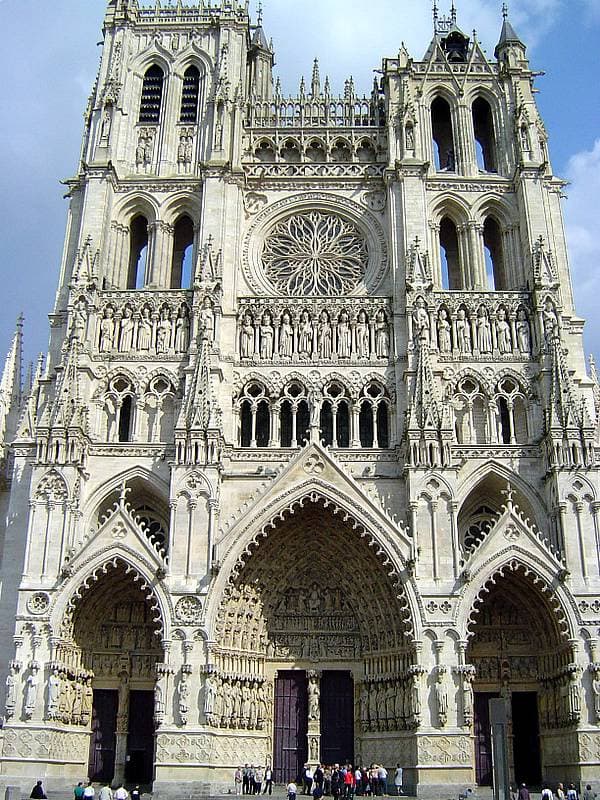
Amiens Cathedral
Amiens Cathedral, officially the Cathedral of Our Lady of Amiens, is a preeminent example of Gothic architecture and a significant religious site in France. It is renowned for its immense scale, being the largest cathedral by volume in France, and for its remarkably unified High Gothic and Rayonnant style, achieved through a swift construction period. The cathedral is also celebrated for its extensive collection of early Gothic sculpture, particularly on its west facade, and holds a UNESCO World Heritage designation.