
Portsmouth Cathedral
Portsmouth Cathedral, officially the Cathedral Church of St Thomas of Canterbury, is the Anglican cathedral for the Diocese of Portsmouth, England. Originally a medieval chapel founded in the late 12th century, it evolved into a parish church before becoming a pro-cathedral in 1927 and a full cathedral in 1935. It is notable for its blend of architectural styles, reflecting centuries of rebuilding and expansion.
Key Facts
- ›Founded as a chapel dedicated to St Thomas of Canterbury around 1180 by Jean de Gisors.
- ›The medieval building, dedicated in 1188, had its chancel and transepts survive later destruction.
- ›Suffered significant damage during the English CIVIL War, leading to a rebuilding of the nave and tower in the classical style from 1683-1693.
- ›Became the pro-cathedral of the new Diocese of Portsmouth in 1927 and a full cathedral in 1935.
- ›Architect Charles Nicholson designed extensions in a Neo-Byzantine style, though work was interrupted by World War II.
- ›The cathedral features modern additions, including bronze west doors based on the tree of life and a nave organ case with significant artistic panels.

Classical, Neo-Byzantine, Gothic Revival
- Bronze West Doors Depicting the Tree of Life
- Sculpture 'Christus' By Peter Eugene Ball
- Nave Organ Case With Panels By Patrick Caulfield
- Ceramic Plaque of the Virgin and Child By Andrea Della Robbia
- 1631 Memorial To George Villiers, 1st Duke of Buckingham
12th Century, 17th Century, 18th Century, 19th Century, 20th Century
Charles Nicholson, Seely & Paget
About Portsmouth Cathedral
The Cathedral Church of St Thomas of Canterbury, more commonly known as Portsmouth Cathedral, stands as the principal Anglican place of worship for the Diocese of Portsmouth in England. Its history traces back to a humble chapel established around 1180 by Jean de Gisors, a Norman merchant, on land designated for the Augustinian canons of Southwick Priory. This chapel was dedicated to St Thomas of Canterbury, a significant martyr of the era.
Medieval Origins and Early History
The original medieval building, consecrated in 1188, was cruciform in design and featured a central tower that served a dual purpose as a lookout and a lighthouse. While the chancel and transepts of this early structure endure, much of the original building was lost over time. The church survived a French raid in 1337 but faced a period of closure and excommunication in 1449 following the murder of Adam Moleyns, Bishop of Chichester, by local sailors. The church was eventually reopened in 1508.
Civil War Damage and Restoration
During the English Civil War, the church's tower was targeted by Parliamentary gunners, resulting in severe damage that led to the ruin of the medieval tower and nave. Following the Restoration of the monarchy in 1660, Charles II authorized a national collection to fund the rebuilding. The nave was reconstructed in the classical style between 1683 and 1693, with galleries added in subsequent decades to accommodate growing congregations. A wooden cupola with a lantern was placed atop the tower in 1703.
Transition to Cathedral Status and Modern Expansion
A significant shift occurred in 1927 with the establishment of the Diocese of Portsmouth, drawing territory from the Diocese of Winchester. St Thomas's Church became the pro-cathedral of this new diocese. Architect Charles Nicholson was commissioned to extend the church to appropriately reflect its new status, with work commencing in a Neo-Byzantine style. However, extensions were halted by the outbreak of World War II in 1940 and faced further funding challenges in the post-war decades.
By the mid-1980s, the need to address structural issues with a "temporary" wall from the wartime period made completion urgent. Although plans by Seely & Paget in the 1960s had envisaged a large western extension, the final construction in the late 20th century resulted in a foreshortened nave, reflecting the evolving needs of the diocese. Work began in 1990, and the completed building, smaller than initially planned, was consecrated in 1991.
Architectural and Artistic Significance
Portsmouth Cathedral showcases a diverse architectural palette, blending classical elements from its 17th-century rebuilding with Nicholson's Neo-Byzantine additions. The formal entrance is through bronze west doors designed by Bryan Kneale, symbolizing the tree of life. The nave, designed as a flexible space, can accommodate concerts and exhibitions alongside religious services. Notable artworks within the cathedral include the sculpture 'Christus' by Peter Eugene Ball, the nave organ case with panels by Patrick Caulfield, and a ceramic plaque of the Virgin and Child by Andrea della Robbia. The cathedral also houses a significant 1631 memorial to George Villiers, 1st Duke of Buckingham.
Source: Wikipedia ↗
Frequently Asked Questions
When was Portsmouth Cathedral founded?
Portsmouth Cathedral was founded as a chapel around the year 1180 by Jean de Gisors. It was dedicated to the honour of St Thomas of Canterbury.
What happened to the original medieval building?
Of the original medieval building, only the chancel and the transepts remain. The central tower and nave were largely destroyed during the English Civil War.
When did Portsmouth become a cathedral?
The parish church of St Thomas of Canterbury became the pro-cathedral of the new Diocese of Portsmouth on May 1, 1927. The 'provisional' nature of its title was dropped by 1935, establishing it as a cathedral.
What architectural styles are present in Portsmouth Cathedral?
Portsmouth Cathedral exhibits a mix of styles. The rebuilding after the Civil War resulted in a nave in the classical style. Later extensions by Charles Nicholson introduced a Neo-Byzantine style, echoing the earlier classical quire. Modern additions also incorporate contemporary artistic elements.
What are some notable artistic features of the cathedral?
Notable artistic features include bronze west doors designed by Bryan Kneale based on the tree of life, a sculpture called Christus by Peter Eugene Ball, and a nave organ case with panels painted by Patrick Caulfield depicting day and night. There is also a ceramic plaque of the Virgin and Child by Andrea della Robbia.
Related Cathedrals
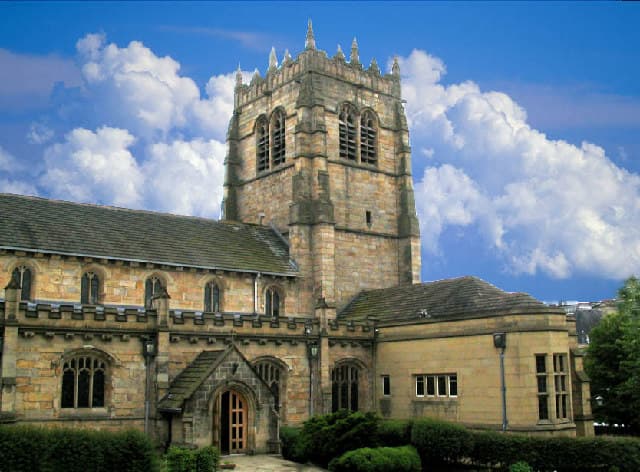
Bradford Cathedral
Bradford Cathedral, officially the Cathedral Church of St Peter, is an Anglican cathedral in Bradford, West Yorkshire, England. Its site has been a place of Christian worship since the 7th century, and it served as a parish church for many centuries before achieving cathedral status in 1919. It is now one of three co-equal cathedrals within the Diocese of Leeds.

Carlisle Cathedral
Carlisle Cathedral, formally the Cathedral Church of the Holy and Undivided Trinity in Carlisle, is an Anglican cathedral in Carlisle, Cumbria, England. Founded as an Augustinian priory in 1122 and elevated to cathedral status in 1133, it is the seat of the Bishop of Carlisle and is notable as one of England's ancient cathedrals, characterized by its mix of Norman and Gothic architecture and significant medieval features.

Chelmsford Cathedral
Chelmsford Cathedral, officially the Cathedral Church of St Mary the Virgin, St Peter and St Cedd, is an Anglican cathedral in Chelmsford, Essex, England. It became a cathedral in 1914 upon the creation of the Diocese of Chelmsford and serves as the seat of the Bishop of Chelmsford. The building has a history dating back to around 1200 as a parish church, with significant rebuilding in the 15th and 16th centuries, and further modifications in the 19th and 20th centuries to adapt it to its cathedral status.