
Bradford Cathedral
Bradford Cathedral, officially the Cathedral Church of St Peter, is an Anglican cathedral in Bradford, West Yorkshire, England. Its site has been a place of Christian worship since the 7th century, and it served as a parish church for many centuries before achieving cathedral status in 1919. It is now one of three co-equal cathedrals within the Diocese of Leeds.
Key Facts
- ›The site has a history of Christian worship dating back to the 7th century.
- ›It was rebuilt multiple times, with significant reconstruction in the 14th century and completion of the third church in 1458.
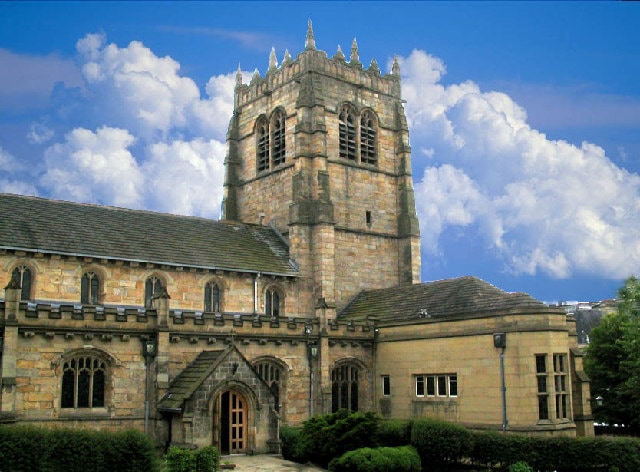
- ›The Perpendicular style tower was added in the early 16th century, completed in 1508.
- ›Bradford Cathedral achieved cathedral status in 1919 when the Diocese of Bradford was created.
- ›The building underwent extensions in the 1950s and 1960s by architect Edward Maufe.
- ›It is a Grade I listed building, signifying its architectural and historical importance.
Perpendicular Gothic, Victorian, Arts and Crafts
- Grade I Listed Building
- 7th-Century Christian Worship Site
- Victorian Stained Glass
- Arts and Crafts Stained Glass
- Sculpture By John Flaxman
- Monument By Peter Scheemakers
- Bradford City Football Ground Fire Disaster Memorial
7th Century, 12th Century, 14th Century, 15th Century, 16th Century, 20th Century
Edward Maufe
About Bradford Cathedral
Bradford Cathedral: A Rich History of Christian Worship
Bradford Cathedral, formally known as the Cathedral Church of St Peter, is a significant Anglican cathedral located in Bradford, West Yorkshire, England. Its history is deeply rooted in the region, with the site having been used for Christian worship since the 7th century. Initially, it served as a parish church for centuries before being elevated to cathedral status in 1919. Today, it stands as one of three co-equal cathedrals within the Diocese of Leeds, reflecting its enduring importance in the ecclesiastical landscape.
Architectural Evolution
The architectural journey of Bradford Cathedral spans several centuries, showcasing a blend of styles. The earliest church on the site is thought to date from Anglo-Saxon times. Following the Norman Conquest, a second church was constructed around 1200, which was later significantly damaged by Scottish raiders in the 14th century. The church was rebuilt during the 14th century, with the third iteration completed in 1458. A notable addition was the Perpendicular style tower, finished in 1508, and a clerestory was added by the close of the 15th century. Later, in the 1950s and 1960s, architect Edward Maufe undertook substantial extensions, including work on the east end and the construction of west wings housing the Song Room and cathedral offices. The building is recognized for its architectural merit and is designated as a Grade I listed building.
Notable Features and Modern Adaptations
Bradford Cathedral houses several points of interest, including Victorian stained glass windows, one of which depicts women of the Bible, and Arts and Crafts stained glass designed by Archibald John Davies. The cathedral also features a sculpture by the renowned artist John Flaxman and a monument by Peter Scheemakers. For modern use, the nave and west end were re-ordered in 1987 to better accommodate visitors, involving the replacement of traditional pews with chairs and the installation of new lighting. The cathedral's musical tradition is also a significant aspect, with regular choral services sung by boy and girl choirs, an adult choir, and a chamber choir known as the Cathedral Consort. The cathedral choir has been involved in numerous recordings and broadcasts, further highlighting its vibrant musical life.
Source: Wikipedia ↗
Frequently Asked Questions
What is the history of Bradford Cathedral's site?
The site has been used for Christian worship since the 7th century, when missionaries evangelized the area. The first church on the site is believed to have been built in Anglo-Saxon times. This was followed by a second church built around 1200, which was largely destroyed by Scottish raiders around 1327.
When did Bradford Cathedral become a cathedral?
Bradford Cathedral achieved cathedral status in 1919. Prior to this, it had served as the parish church of St Peter for many centuries. It became one of three co-equal cathedrals in the new Diocese of Leeds in 2014.
What significant architectural additions have been made to Bradford Cathedral?
The tower in the Perpendicular style was added to the west end and finished in 1508, and a clerestory was added by the end of the 15th century. Major extensions and modifications were carried out in the 1950s and 1960s by architect Edward Maufe, who designed the east end and west wings.
What notable artworks or features can be found in Bradford Cathedral?
The cathedral contains Victorian stained glass, including a window depicting women of the Bible, and Arts and Crafts style stained glass in a World War I memorial window. It also features a sculpture by John Flaxman and a monument by Peter Scheemakers.
How has Bradford Cathedral been adapted for modern use?
In 1987, the nave and west end were re-ordered to accommodate more visitors, with Victorian pews being replaced by chairs. The nave organ was removed to create more space, and a computer organ was installed. The roof panelling was cleaned and restored, and new lighting was installed.
Related Cathedrals

Ripon Cathedral
Ripon Cathedral, officially the Cathedral Church of St Peter and St Wilfrid, is a significant religious and architectural landmark in Ripon, North Yorkshire, England. Originally founded as a monastery in the 660s and refounded by St Wilfrid in 672, it became a collegiate church and served as a mother church for the Diocese of York. The present structure, built between the 13th and 16th centuries, became the cathedral for the Diocese of Ripon in 1836 and is now one of three co-equal cathedrals for the Diocese of Leeds.

Carlisle Cathedral
Carlisle Cathedral, formally the Cathedral Church of the Holy and Undivided Trinity in Carlisle, is an Anglican cathedral in Carlisle, Cumbria, England. Founded as an Augustinian priory in 1122 and elevated to cathedral status in 1133, it is the seat of the Bishop of Carlisle and is notable as one of England's ancient cathedrals, characterized by its mix of Norman and Gothic architecture and significant medieval features.

Chelmsford Cathedral
Chelmsford Cathedral, officially the Cathedral Church of St Mary the Virgin, St Peter and St Cedd, is an Anglican cathedral in Chelmsford, Essex, England. It became a cathedral in 1914 upon the creation of the Diocese of Chelmsford and serves as the seat of the Bishop of Chelmsford. The building has a history dating back to around 1200 as a parish church, with significant rebuilding in the 15th and 16th centuries, and further modifications in the 19th and 20th centuries to adapt it to its cathedral status.