
Ripon Cathedral
Ripon Cathedral, officially the Cathedral Church of St Peter and St Wilfrid, is a significant religious and architectural landmark in Ripon, North Yorkshire, England. Originally founded as a monastery in the 660s and refounded by St Wilfrid in 672, it became a collegiate church and served as a mother church for the Diocese of York. The present structure, built between the 13th and 16th centuries, became the cathedral for the Diocese of Ripon in 1836 and is now one of three co-equal cathedrals for the Diocese of Leeds.
Key Facts
- ›The site has had a stone church since 672 when St Wilfrid replaced a timber church with one in the Roman style, featuring a crypt that still survives from this period.
- ›The current cathedral is the fourth church to stand on the site, with significant construction phases occurring between the 13th and 16th centuries.
- ›Architectural highlights include the Gothic west front in the Early English style and the Geometric east window.
- ›The seventh-century crypt of St Wilfrid's church is a notable example of early Christian architecture in England.
- ›It became the cathedral for the newly created Diocese of Ripon in 1836.
- ›In 2014, the Diocese of Ripon was incorporated into the Diocese of Leeds, making Ripon Cathedral one of three co-equal cathedrals.

Gothic, Early English Gothic, Decorated Gothic, Romanesque
7th-Century Crypt of St Wilfrid's Church, Gothic West Front In Early English Style, Geometric East Window, Thirty-Four Misericords Carved 1489-1494, 18 Portraits of Tudor Royalty
7th Century, 12th Century, 13th Century, 14th Century, 15th Century, 16th Century
About Ripon Cathedral
What is Ripon Cathedral?
The Cathedral Church of St Peter and St Wilfrid, commonly known as Ripon Cathedral, is a prominent religious edifice located in Ripon, North Yorkshire, England. It holds a significant place in English ecclesiastical history, having evolved from an early monastery founded in the 660s and refounded by Saint Wilfrid in 672. For much of its history, it served as a collegiate church and the mother church of the vast Diocese of York before becoming the cathedral for the Diocese of Ripon in 1836. Today, it is one of three co-equal cathedrals within the modern Diocese of Leeds.
Historical Development and Architecture
The current cathedral is the fourth church to occupy the site, with its construction spanning from the 13th to the 16th centuries. The site boasts a much earlier history, with a stone church established by Saint Wilfrid in 672, which included a crypt that remains a significant example of early Christian architecture in England. Architecturally, Ripon Cathedral is celebrated for its Early English Gothic west front, considered one of the finest of its type, and its Geometric east window. Major rebuilding phases in the later medieval period saw the addition of aisles and the raising of nave walls, though construction was sometimes interrupted by events like the Wars of the Roses and an earthquake that necessitated the rebuilding of the crossing tower.
Significance and Modern Role
Ripon Cathedral's history is deeply intertwined with figures like Saint Wilfrid, who is buried near the high altar of his original church. The cathedral has endured destruction and rebuilding throughout the centuries, including damage during the Civil War. Its elevation to cathedral status in 1836 marked a new chapter, establishing it as the seat of a bishop. The incorporation of the Diocese of Ripon into the new Diocese of Leeds in 2014 has further shaped its contemporary role as part of a larger ecclesiastical structure, while retaining its rich historical and architectural heritage.
Source: Wikipedia ↗
Frequently Asked Questions
When was Ripon Cathedral founded?
Ripon Cathedral was initially founded as a monastery by monks of the Irish tradition in the 660s. It was subsequently refounded as a Benedictine monastery by Saint Wilfrid in 672.
What is the architectural style of Ripon Cathedral?
Ripon Cathedral is notable for its Gothic architecture, particularly its west front, which is in the Early English style and is considered one of the finest examples of its kind. The east window is a splendid example of Decorated Gothic.
What is the significance of the crypt at Ripon Cathedral?
The crypt dates back to the 7th century and is part of the church built by Saint Wilfrid. It is a significant example of early Christian architecture in England and is the only surviving part of Wilfrid's original church.
When did Ripon Minster become a cathedral?
Ripon Minster officially became a cathedral in 1836, serving as the principal church for the newly established Anglican Diocese of Ripon. Before this, it had been a collegiate church acting as a mother church for the Diocese of York.
What are some notable features of Ripon Cathedral?
Notable features include the crypt of St Wilfrid's 7th-century church, the Early English west front, the Geometric east window, and the thirty-four misericords carved between 1489 and 1494. The cathedral also houses 18 portraits of Tudor royalty.
Related Cathedrals
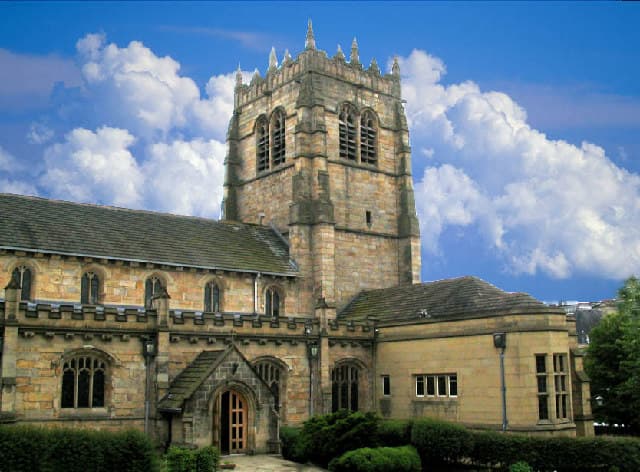
Bradford Cathedral
Bradford Cathedral, officially the Cathedral Church of St Peter, is an Anglican cathedral in Bradford, West Yorkshire, England. Its site has been a place of Christian worship since the 7th century, and it served as a parish church for many centuries before achieving cathedral status in 1919. It is now one of three co-equal cathedrals within the Diocese of Leeds.

Bath Abbey
Bath Abbey, officially the Abbey Church of Saint Peter and Saint Paul, is a significant parish church and former Benedictine monastery in Bath, Somerset, England. Originally founded in the 7th century, it has undergone numerous rebuildings and restorations, most notably in the 12th and 16th centuries, with major renovations by Sir George Gilbert Scott in the 1860s. It stands as a prime example of Perpendicular Gothic architecture and once served as a cathedral for the Diocese of Bath and Wells before its consolidation at Wells.

Bishop's Tawton
Bishop's Tawton is a village and civil parish in North Devon, England, situated in the valley of the River Taw. Its historical significance is linked to a potential early bishopric in the 10th century, though this is conjectural, with the extant Church of St John the Baptist featuring a 14th-century spire and Norman font.