
Chelmsford Cathedral
Chelmsford Cathedral, officially the Cathedral Church of St Mary the Virgin, St Peter and St Cedd, is an Anglican cathedral in Chelmsford, Essex, England. It became a cathedral in 1914 upon the creation of the Diocese of Chelmsford and serves as the seat of the Bishop of Chelmsford. The building has a history dating back to around 1200 as a parish church, with significant rebuilding in the 15th and 16th centuries, and further modifications in the 19th and 20th centuries to adapt it to its cathedral status.
Key Facts
- ›The original parish church of St Mary the Virgin was likely built around 1200, with major rebuilding in the 15th and early 16th centuries.
- ›Chelmsford became a cathedral in 1914 when the Diocese of Chelmsford was established.
- ›The cathedral is additionally dedicated to Saints Peter and Cedd, with this dedication occurring in 1954.
- ›Notable artworks include 'Christ in Glory' by Peter Eugene Ball (2000) and Mark Cazelet's 'Tree of Life' painting (2004).
- ›The cathedral boasts two pipe organs, a four-manual instrument in the nave (1994) and a two-manual instrument in the chancel (1995), both built by Mander Organs.
- ›Thomas Hooker, a significant figure in early American history who founded Hartford, Connecticut, served as Chelmsford Town Lecturer from 1626 to 1629, and a blue plaque commemorates him at the cathedral gates.

Perpendicular Gothic
- Tower With Spire
- Ring of Thirteen Bells
- Coade Stone Piers and Tracery
- Sculpture 'Christ In Glory' By Peter Eugene Ball
- Painting 'Tree of Life' By Mark Cazelet
- Altar Frontal By Philip Sanderson
- Two Mander Pipe Organs
- Blue Plaque Commemorating Thomas Hooker
13th Century, 15th Century, 16th Century, 19th Century, 20th Century
John Johnson
About Chelmsford Cathedral
Chelmsford Cathedral, formally known as the Cathedral Church of St Mary the Virgin, St Peter and St Cedd, is the principal Anglican place of worship in Chelmsford, Essex, England. Its establishment as a cathedral dates to 1914, coinciding with the creation of the Diocese of Chelmsford, and it now serves as the seat of the Bishop of Chelmsford.
History and Development
The origins of the cathedral trace back to the parish church of St Mary the Virgin, which was likely established around 1200. The church underwent significant rebuilding between the 15th and early 16th centuries, utilizing materials such as flint rubble, stone, and brick. A notable event in its history was the partial collapse of the nave in 1800, followed by its rebuilding by County architect John Johnson, who maintained the Perpendicular design while incorporating Coade stone piers and a plaster ceiling. The upper section of the chancel was rebuilt in 1878.
Upon becoming a cathedral in 1914, the building has seen further enhancements. The south porch was extended in 1953 to commemorate Anglo-American friendship post-World War II. In 1954, the cathedral's dedication was expanded to include Saints Peter and Cedd. Extensive interior refurbishment occurred in 1983, introducing a new floor, seating, altar, bishop's throne, font, and artwork. The installation of two pipe organs by Mander Organs in 1994 and 1995 significantly enhanced its musical capabilities. The stained-glass windows are predominantly from the 19th and 20th centuries.
Art and Heritage
Chelmsford Cathedral is home to several significant works of art. In 2000, the sculpture "Christ in Glory" by Peter Eugene Ball was installed above the chancel arch. More recently, in 2004, two major commissions were added: Mark Cazelet's "Tree of Life" painting in the North Transept and Philip Sanderson's altar frontal in the Mildmay Chapel. The cathedral also holds a historical connection to Thomas Hooker, an influential Puritan minister who lectured in Chelmsford between 1626 and 1629 before fleeing to the New World to found Hartford, Connecticut, and contribute to the foundations of American democracy. A blue plaque at the cathedral gates memorializes his presence.
Music and Organs
The cathedral maintains a vibrant music department. The Cathedral Choir comprises boys, girls, choral scholars, lay clerks, and volunteer singers, performing Evensong and Choral Eucharist services. The Cathedral Singers, formerly the Voluntary Choir, provide music during choir term breaks. The cathedral is equipped with two notable pipe organs: the Nave Organ, a four-manual instrument built by Mander Organs in 1994, and the Chancel Organ, a two-manual instrument from 1995 also by Mander, which incorporates 19th-century pipework. The cathedral has a documented list of Directors and Assistant Directors of Music dating back to the early 19th century.
Source: Wikipedia ↗
Frequently Asked Questions
When did Chelmsford become a cathedral?
Chelmsford became a cathedral in 1914. This was in conjunction with the creation of the Anglican Diocese of Chelmsford.
What is the history of the building before it was a cathedral?
The building began as the parish church of St Mary the Virgin, likely constructed around 1200. It underwent significant rebuilding in the 15th and early 16th centuries. The nave partially collapsed in 1800 and was subsequently rebuilt.
What are some notable artworks in Chelmsford Cathedral?
Key artworks include 'Christ in Glory,' a sculpture by Peter Eugene Ball placed above the chancel arch in 2000. Additionally, Mark Cazelet's 'Tree of Life' painting is located in the North Transept, and Philip Sanderson's altar frontal is in the Mildmay Chapel, both commissioned in 2004.
What is the significance of Thomas Hooker to Chelmsford Cathedral?
Thomas Hooker, a prominent figure in the founding of American democracy, was the Chelmsford Town Lecturer between 1626 and 1629. A blue plaque commemorating him is situated at the cathedral gates, highlighting his historical connection to the city.
What are the main architectural styles of Chelmsford Cathedral?
The primary architectural style of the church during its 15th and 16th-century rebuilding was Perpendicular Gothic. While the nave was rebuilt in the early 19th century retaining this design, it incorporated elements like Coade stone piers and tracery.
Related Cathedrals
Bradford Cathedral
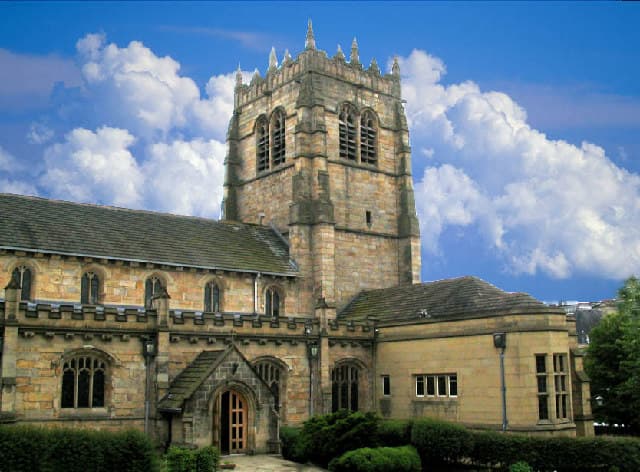
Bradford Cathedral, officially the Cathedral Church of St Peter, is an Anglican cathedral in Bradford, West Yorkshire, England. Its site has been a place of Christian worship since the 7th century, and it served as a parish church for many centuries before achieving cathedral status in 1919. It is now one of three co-equal cathedrals within the Diocese of Leeds.

Carlisle Cathedral
Carlisle Cathedral, formally the Cathedral Church of the Holy and Undivided Trinity in Carlisle, is an Anglican cathedral in Carlisle, Cumbria, England. Founded as an Augustinian priory in 1122 and elevated to cathedral status in 1133, it is the seat of the Bishop of Carlisle and is notable as one of England's ancient cathedrals, characterized by its mix of Norman and Gothic architecture and significant medieval features.

Chichester Cathedral
Chichester Cathedral, officially the Cathedral Church of the Holy Trinity, is the seat of the Anglican Bishop of Chichester in West Sussex, England. Founded in 1075, it is renowned for its blend of Norman and Gothic architecture, featuring unique elements like a free-standing medieval bell tower and double aisles. The cathedral also houses notable medieval sculptures and modern artworks.