
Carlisle Cathedral
Carlisle Cathedral, formally the Cathedral Church of the Holy and Undivided Trinity in Carlisle, is an Anglican cathedral in Carlisle, Cumbria, England. Founded as an Augustinian priory in 1122 and elevated to cathedral status in 1133, it is the seat of the Bishop of Carlisle and is notable as one of England's ancient cathedrals, characterized by its mix of Norman and Gothic architecture and significant medieval features.
Key Facts
- ›Founded in 1122 as an Augustinian priory, it became a cathedral in 1133.
- ›Features a MIX of Norman architecture in its earliest sections and Gothic styles in its rebuilt choir.
- ›Houses England's largest window in the Flowing Decorated Gothic style, measuring 51 feet high and 26 feet wide.
- ›Contains a set of 46 carved medieval choir stalls with misericords, dating from the early 15th century.
- ›A portion of its nave was demolished in 1646 during the English CIVIL War by the Scottish Presbyterian Army.
- ›Restored between 1853 and 1870 by Ewan Christian.

Norman, Gothic, Flowing Decorated Gothic
- Figurative Stone Carving
- Medieval Choir Stalls With Misericords
- Largest Window In the Flowing Decorated Gothic Style In England
- Barrel Ceiling In the Choir
- Remains of Monastic Buildings Including the Fratry and Chapter House Ruins
12th Century, 13th Century, 14th Century, 15th Century, 19th Century
Athelwold, John Lewen, Ewan Christian, Robert William Billings, Owen Jones, Sir Charles Nicholson, Feilden Fowles
About Carlisle Cathedral
Carlisle Cathedral, officially named the Cathedral Church of the Holy and Undivided Trinity in Carlisle, is a significant Anglican cathedral located in the city of Carlisle, Cumbria, England. It holds the distinction of being the second smallest of England's ancient cathedrals and serves as the seat of the Bishop of Carlisle. Its history stretches back to its founding in 1122 as an Augustinian priory, and it was elevated to cathedral status in 1133.
Architectural Evolution
The cathedral's architecture is a testament to centuries of development, showcasing a blend of styles. Its earliest parts, begun around 1123, exhibit Norman characteristics, with solid masonry, round piers, and round arches, elements still visible in the south transept and the remaining nave bays. The 13th century saw the rebuilding of the choir in the Gothic style, which, after suffering damage from a fire in 1292, was recommenced and completed by the early 14th century with elaborate tracery. The upper stages of the walls were finished by the late 14th century, likely under the guidance of architect John Lewen. The choir is capped by a notable 14th-century wooden barrel ceiling, which was restored and repainted in the 19th century.
Notable Features
Carlisle Cathedral is renowned for several distinctive features. Its East Window stands out as the largest and most complex example of Flowing Decorated Gothic tracery in England, measuring an impressive 51 feet in height and 26 feet in width. The cathedral also houses a complete set of 46 carved wooden choir stalls with misericords, dating from the early 15th century. These intricately carved seats depict a variety of figures, creatures, and narrative scenes, including themes from the Bestiary and the 'inverted world' motif of a woman beating a man. The building has also experienced historical damage, notably in 1646 when a part of the nave was demolished by the Scottish Presbyterian Army during the English Civil War, reducing the nave to just two bays.
Historical Context and Later Developments
Founded during the reign of King Henry I, the priory followed the strict canonical life influenced by Cistercian practices. The cathedral's history also includes the integration of Dominican and Franciscan friaries in 1233. Following the Dissolution of the Monasteries, Carlisle Cathedral adopted a secular chapter structure, similar to those in Lincoln and York. The building underwent significant restoration between 1853 and 1870 under Ewan Christian. The monastic buildings surrounding the cloister, including the refectory (now the Fratry), have also seen rebuilding and modern extensions. The cathedral precinct includes several Grade I listed buildings, remnants of the original monastic complex, such as the abbey gate and the Prior's Tower.
Source: Wikipedia ↗
Frequently Asked Questions
When was Carlisle Cathedral founded?
Carlisle Cathedral was founded in 1122 as an Augustinian priory. It was raised to the status of a cathedral in 1133.
What architectural styles are present at Carlisle Cathedral?
The cathedral exhibits Norman architecture in its original sections, such as the south transept and nave bays. Later additions and rebuilds, particularly the choir, feature Gothic styles, including the Flowing Decorated Gothic style of its famous East Window.
What is significant about the East Window of Carlisle Cathedral?
The East Window is the largest and most complex window in the Flowing Decorated Gothic style in England. It is 51 feet high and 26 feet wide and contains much of its original medieval glass.
Are there any notable features within the choir of Carlisle Cathedral?
Yes, the choir contains a fine set of 46 carved wooden choir stalls with misericords, installed in the early 15th century. These stalls are decorated with religious, mythical, and narrative scenes.
Has Carlisle Cathedral always been this size?
No, a portion of the nave was demolished in 1646 by the Scottish Presbyterian Army to reinforce Carlisle Castle. This reduced the nave to only two bays in length.
Related Cathedrals
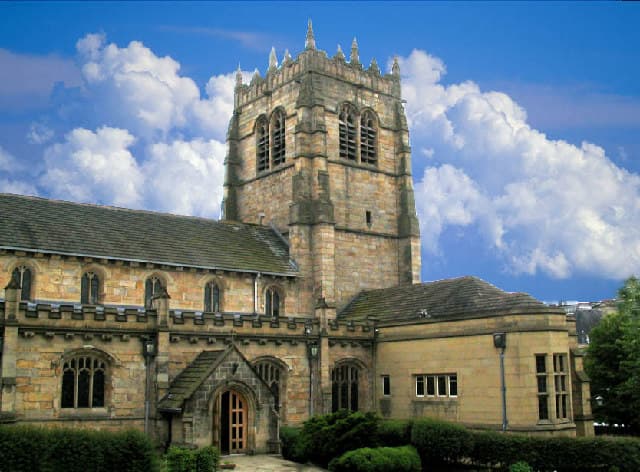
Bradford Cathedral
Bradford Cathedral, officially the Cathedral Church of St Peter, is an Anglican cathedral in Bradford, West Yorkshire, England. Its site has been a place of Christian worship since the 7th century, and it served as a parish church for many centuries before achieving cathedral status in 1919. It is now one of three co-equal cathedrals within the Diocese of Leeds.

Chelmsford Cathedral
Chelmsford Cathedral, officially the Cathedral Church of St Mary the Virgin, St Peter and St Cedd, is an Anglican cathedral in Chelmsford, Essex, England. It became a cathedral in 1914 upon the creation of the Diocese of Chelmsford and serves as the seat of the Bishop of Chelmsford. The building has a history dating back to around 1200 as a parish church, with significant rebuilding in the 15th and 16th centuries, and further modifications in the 19th and 20th centuries to adapt it to its cathedral status.

Chichester Cathedral
Chichester Cathedral, officially the Cathedral Church of the Holy Trinity, is the seat of the Anglican Bishop of Chichester in West Sussex, England. Founded in 1075, it is renowned for its blend of Norman and Gothic architecture, featuring unique elements like a free-standing medieval bell tower and double aisles. The cathedral also houses notable medieval sculptures and modern artworks.