
Northampton Cathedral
Diocese of Northampton·Roman Catholic·England
Northampton Cathedral, officially the Cathedral Church of St Mary and St Thomas, is the seat of the Roman Catholic Bishop of Northampton and the mother church for the Diocese of Northampton. Situated in the north of Northampton, England, it serves as a significant center for Catholic worship and community life in the region.
Key Facts
- ›The current cathedral's origins date back to 1840 with designs by Augustus Welby Northmore Pugin.
- ›The nave extension, designed by Edward Welby Pugin, was completed in 1864, transforming the building into a cathedral.
- ›A significant westward extension, designed by Albert Herbert, was completed in 1955, adding transepts and a crossing tower.
- ›The sanctuary underwent a reordering in 1998, including a new window in the Blessed Sacrament Chapel.
- ›The cathedral possesses a historical tracker-action pipe organ built in 1976 and a digital Viscount organ installed in 2008.
- ›It operates as a parish church, hosting various voluntary organizations, including the Society of Saint Vincent de Paul.

Gothic Revival
- Stained Glass Windows By John Hardman of Birmingham
- New Window In the Blessed Sacrament Chapel By Joseph Nuttgens
- Cathedra Carved By Stephen Foster
- Historical Tracker-Action Pipe Organ
- Digital Viscount Organ
19th Century, 20th Century
Augustus Welby Northmore Pugin, Edward Welby Pugin, Albert Herbert
About Northampton Cathedral
The Cathedral Church of St Mary and St Thomas, commonly known as Northampton Cathedral, is a significant Roman Catholic place of worship located in Northampton, England. It serves as the episcopal see for the Bishop of Northampton and is the principal church of the Diocese of Northampton, which encompasses Northamptonshire, Bedfordshire, Buckinghamshire, and a portion of Berkshire north of the River Thames.
History and Construction
The establishment of a permanent Roman Catholic presence in Northampton began in 1823 with the arrival of Fr William Foley, who was sent by Bishop John Milner. Initially, services were held in a small rented house that included a chapel. Fr Foley acquired land on the site of the original St Andrew's Priory and commissioned a purpose-built chapel dedicated to Saint Andrew, which was opened on 25 October 1825.
The foundations of the current cathedral structure were laid in 1840 when Augustus Welby Northmore Pugin was engaged by Bishop William Wareing to design a collegiate chapel of St Felix. This new chapel was constructed in 1844, replacing the earlier St Andrew's chapel which had become insufficient for the growing congregation. To accommodate the expanding number of worshippers, Bishop Wareing's successor, Francis Amherst, selected Pugin's son, Edward Welby Pugin, to design an extension. This project resulted in the creation of the current nave, which was opened in 1864 and dedicated to Our Lady Immaculate and St Thomas of Canterbury.
In 1948, Bishop Leo Parker initiated a further extension at the west end of the cathedral, a project that necessitated the demolition of a portion of the original St Andrew's chapel. The surviving elements of the older chapel, including its altar, were relocated to the cathedral's sacristy and chapter room. This extensive building work, designed by architect Albert Herbert, was completed in 1955 and included the replacement of the original west end with a straight facade, along with the construction of transepts and a crossing tower.
Architectural and Artistic Features
The stained glass windows, dating from the 1860s, were crafted by John Hardman of Birmingham and depict figures such as St Peter, St Edward the Confessor, and St Thomas Becket. In 1998, a significant reordering of the sanctuary took place. This included the installation of a new window, designed by Joseph Nuttgens, in the Blessed Sacrament Chapel. The original choir stalls were moved to the chapter room, and the bishop's throne, the cathedra, was replaced with a new carving by Stephen Foster, designed to complement the triptych of the Holy Spirit positioned behind it.
Music and Parish Life
Northampton Cathedral is home to two organs: a historical tracker-action pipe organ built in 1976, inspired by the work of Metzler Orgelbau, and a custom-made digital Viscount organ installed in May 2008. The cathedral also maintains a regular choir that participates in the 11:00 Sunday Mass and other significant liturgical events. Beyond its role as a cathedral, it functions as an active parish church, supporting various voluntary organizations, most notably the Society of Saint Vincent de Paul, which organizes outreach to the local poor and disadvantaged.
Source: Wikipedia ↗
Frequently Asked Questions
When was Northampton Cathedral first established?
The origins of a permanent Roman Catholic presence in Northampton date back to 1823 when a priest was sent to establish a base. A purpose-built chapel dedicated to Saint Andrew was opened on October 25, 1825.
Who designed the current Northampton Cathedral?
The initial design for the collegiate chapel of St Felix, which forms part of the current cathedral, was commissioned from Augustus Welby Northmore Pugin in 1840. His son, Edward Welby Pugin, later designed the extension that created the nave.
What significant extensions has Northampton Cathedral undergone?
The building was extended in the 1860s with the addition of the nave. A major westward extension, including transepts and a crossing tower, was completed in 1955 under architect Albert Herbert.
What is notable about the music at Northampton Cathedral?
The cathedral is equipped with two organs: a historical tracker-action pipe organ built in 1976 and a digital Viscount organ installed in 2008. It also features a regular choir that sings during Sunday Masses and other major liturgies.
What is the significance of the Society of Saint Vincent de Paul at the cathedral?
The Society of Saint Vincent de Paul meets at Northampton Cathedral to organize efforts in serving the poor and disadvantaged within the local area, highlighting the cathedral's role as an active parish church.
Related Cathedrals
Aldershot Cathedral
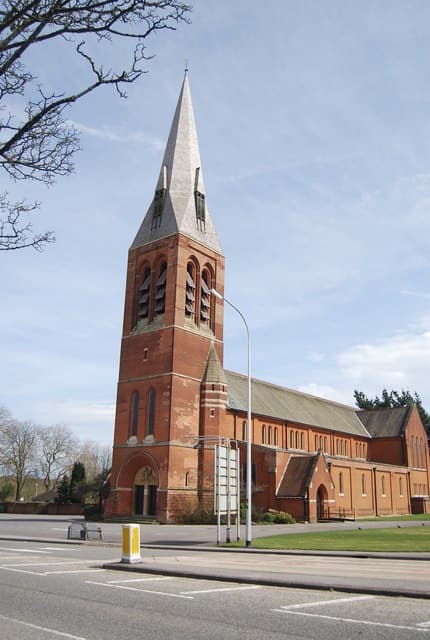
The Cathedral Church of St Michael and St George is the Roman Catholic cathedral for the Bishopric of the Forces, located in Aldershot, England. Originally built as an Anglican church for the British Army, it was consecrated in 1893 and later repurposed in 1973 to become the seat of the Roman Catholic Bishop of the Forces. It is a significant landmark due to its Gothic Revival architecture and its close association with military history.

Arundel Cathedral
The Cathedral Church of Our Lady and St Philip Howard in Arundel, West Sussex, England, was dedicated in 1873 as a Catholic parish church and became a cathedral in 1965 with the foundation of the Diocese of Arundel and Brighton. It serves as the seat of the Bishop of Arundel and Brighton and is recognized as a Grade I listed building, notable for its French Gothic Revival architecture.
Brentwood Cathedral
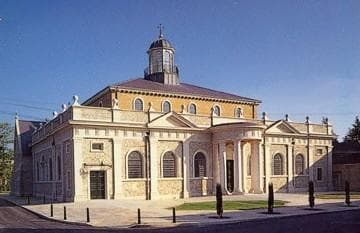
Brentwood Cathedral, officially the Cathedral of St Mary and St Helen, is the seat of the Roman Catholic Diocese of Brentwood in England. Originally a parish church built in 1861, it was elevated to cathedral status in 1917 and significantly enlarged and redesigned in an Italianate classical style between 1989 and 1991. Its architecture draws inspiration from the Italian Renaissance and English Baroque, creating a space focused on liturgy and flooded with light.