
Milan Cathedral
Archdiocese of Milan·Roman Catholic·Italy
Milan Cathedral, also known as the Duomo di Milano, is the seat of the Archbishop of Milan and took nearly six centuries to complete, from 1386 to 1965. It is the largest church in Italy and one of the largest in the world, renowned for its Gothic architecture and intricate marble facade.
Key Facts
- ›Construction began in 1386 under Archbishop Antonio da Saluzzo and was largely completed by 1965.
- ›It is the largest church in Italy and one of the largest globally.
- ›The cathedral is primarily built of brick and faced with marble from the Candoglia quarry.
- ›Key architectural influences include Lombard Gothic, Rayonnant Gothic, and Renaissance elements.
- ›Notable artworks include Marco D'Agrate's statue of Saint Bartholomew Flayed and the Trivulzio Candelabrum.
- ›The Madonnina statue, a gilded copper figure, crowns the main spire at a height of 108.5 meters.

Gothic, Lombard Gothic, Rayonnant Gothic, Renaissance
Saint Bartholomew Flayed Statue, Trivulzio Candelabrum, Madonnina Spire, Intricate Marble Facade, Forest of Pinnacles and Spires On the Roof, Holy Nail Relic
Simone Da Orsenigo, Nicolas De Bonaventure, Jean Mignot, Amadeo, Pellegrino Pellegrini, Carlo Buzzi, Carlo Pellicani, Francesco Maria Richini, Fabio Mangone, Filippo Juvarra, Luigi Vanvitelli
About Milan Cathedral
Milan Cathedral, officially the Metropolitan Cathedral-Basilica of the Nativity of Saint Mary and commonly known as the Duomo di Milano, stands as the ecclesiastical seat of the Archbishop of Milan. Its construction represents one of the longest and most ambitious building projects in European history, commencing in 1386 and reaching its final completion in 1965, spanning nearly six centuries.
History and Construction
The Duomo occupies a historically significant site in Milan, central since Roman times. The current structure replaced earlier basilicas, with its origins tracing back to the 4th century. The ambitious undertaking began under Archbishop Antonio da Saluzzo and was significantly influenced by Gian Galeazzo Visconti, who sought to elevate Milan's prominence. The project involved demolishing existing buildings and quarrying vast quantities of marble from Candoglia.
Architectural direction evolved over centuries, incorporating influences from Lombard Gothic to Rayonnant Gothic, with French engineers playing a key role in its early stages. Despite periods of financial and ideological challenges, construction progressed intermittently. The Renaissance period saw contributions from artists like Leonardo da Vinci and Donato Bramante in design competitions, and the octagonal cupola was completed. The Spanish domination saw further work, though the interior remained unfinished for a long time.
Significant interventions occurred under Archbishops Carlo and Federico Borromeo, who aimed to imbue the cathedral with a Renaissance and distinctly Italian character, sometimes clashing with the prevailing Gothic style. Despite various designs proposed for the façade, its completion was significantly accelerated by Napoleon Bonaparte in 1805, who ordered its finishing in neo-Gothic style. The final details, including the last portal, were not inaugurated until 1965. The cathedral also suffered some damage during World War II, necessitating repairs.
Architecture and Artistry
Milan Cathedral is characterized by its immense scale and intricate detail. It features a nave with four side aisles, a transept, choir, and apse, with nave columns reaching 24.5 meters in height. The roof is famous for its "forest" of openwork pinnacles and spires, accessible to tourists. The building is faced with marble, giving it a distinctive appearance.
Internally, the Duomo houses a wealth of artistic treasures. Among the most celebrated is Marco d'Agrate's striking statue of Saint Bartholomew Flayed, depicting the saint carrying his own skin. Other notable works include the sarcophagi of various archbishops and notable figures such as Marco Carelli, who greatly funded the construction. The presbytery is a late Renaissance masterpiece, featuring a choir, pulpits, and large organs. The Trivulzio Candelabrum, with its detailed base and mid-16th-century stem, is another significant artifact. A sacred relic, one of the nails reputedly from the Crucifixion, is housed above the apse, marked by a small red light.
Significance and Legacy
Milan Cathedral is not only a monument of religious importance but also a symbol of the city's enduring artistic and engineering prowess. Its vast size, intricate decoration, and prolonged construction period have inspired awe and critical commentary from figures like Mark Twain and Oscar Wilde. The cathedral continues to be an active place of worship and a major tourist attraction, with ongoing efforts to preserve its magnificent structure, including campaigns to fund the maintenance of its numerous spires.
Source: Wikipedia ↗
Frequently Asked Questions
When was Milan Cathedral built?
Construction of Milan Cathedral began in 1386 and its final details were completed in 1965, meaning it took nearly six centuries to finish.
What is the architectural style of Milan Cathedral?
Milan Cathedral exhibits a blend of architectural styles, primarily Gothic, influenced by Lombard Gothic and Rayonnant Gothic. Renaissance elements are also present, particularly in later additions and decorations.
What are the most famous features inside Milan Cathedral?
Inside, visitors can see famous artworks such as Marco d'Agrate's statue of Saint Bartholomew Flayed, the Trivulzio Candelabrum, and various sarcophagi of archbishops and notable figures. The presbytery is also a significant Renaissance masterpiece.
Is Milan Cathedral an active place of worship?
Yes, Milan Cathedral is the cathedral church of Milan and the seat of the Archbishop of Milan, serving as an active place of worship.
What is the significance of the Madonnina statue?
The Madonnina, a gilded copper statue of the Virgin Mary, is a beloved symbol of Milan. It is perched atop the cathedral's highest spire and is considered a representation of the city's spirit.
Can visitors go to the roof of Milan Cathedral?
Yes, the roof of Milan Cathedral is open to tourists, offering close-up views of its intricate sculptures, pinnacles, and spires, as well as panoramic views of the city.
Related Cathedrals

Rodez Cathedral
Rodez Cathedral, officially Cathédrale Notre-Dame de Rodez, is a Roman Catholic cathedral in Rodez, Aveyron, Southern France. It is a national monument and the seat of the Bishopric of Rodez, notable for its military-style west front, its impressive Flamboyant Gothic and Renaissance tower, and its significant influence on other European Gothic cathedrals.

Orléans Cathedral
Orléans Cathedral, officially the Basilique Cathédrale Sainte-Croix d'Orléans, is a significant Roman Catholic cathedral in Orléans, France. It holds historical importance, having been visited by Joan of Arc during the Siege of Orléans, and stands as one of the largest and last Gothic cathedrals constructed in France. The cathedral has undergone multiple reconstructions and renovations throughout its history.
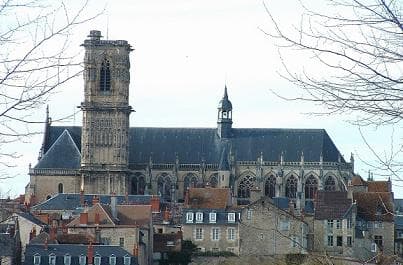
Nevers Cathedral
Nevers Cathedral, officially Cathédrale Saint-Cyr-et-Sainte-Julitte de Nevers, is a Roman Catholic cathedral in Nevers, France, serving as the seat of the Bishop of Nevers. It is a significant national monument with origins dating back to the Roman period, and its history showcases a blend of Romanesque and Gothic architectural styles shaped by numerous reconstructions and restorations.