
Manchester Cathedral
Manchester Cathedral, officially the Cathedral and Collegiate Church of St Mary, St Denys and St George, is the principal church of the Anglican Diocese of Manchester and the parish church of the city. It is a Grade I listed building with origins that may date back to Anglo-Saxon times, though its current Perpendicular Gothic structure was significantly developed from the 15th century onwards.
Key Facts
- ›The cathedral's origins are obscure, with evidence suggesting an earlier church dating possibly to around 700 AD.
- ›It was rebuilt in the Perpendicular Gothic style following the foundation of a collegiate body in 1421.
- ›Significant rebuilding of the nave and choir occurred in the late 15th century under James Stanley II, who commissioned medieval wooden furnishings.
- ›The church became the cathedral of the new Diocese of Manchester in 1847.
- ›The building has undergone extensive restoration and extensions, including after bomb damage during World War II and an IRA bombing in 1996.
- ›It is known for its late-medieval wooden internal furnishings, including choir stalls and angel minstrel roof brackets, and fine 16th-century misericords.

Perpendicular Gothic
- Late-Medieval Wooden Internal Furnishings
- Angel Minstrels Supporting the Nave Roof
- 16th-Century Misericords, Including One Depicting Backgammon
- Angel Stone Carving
- Hanging Bridge
15th Century, 19th Century, 20th Century
John Wastell, J. S. Crowther, J. P. Holden, Basil Champneys, Percy Worthington, Hubert Worthington
About Manchester Cathedral
Mancunians have worshipped on the site of Manchester Cathedral for over a thousand years, though the current structure, formally known as the Cathedral and Collegiate Church of St Mary, St Denys and St George, is largely a testament to late medieval and Victorian rebuilding. It stands as the mother church of the Anglican Diocese of Manchester and serves as the city's parish church.
Origins and Early History
The earliest evidence of a church on the site is the Angel Stone, a fragment possibly dating to around 700 AD, suggesting an Anglo-Saxon predecessor. Historical records mention a church dedicated to St Mary in the Domesday Book of 1086. The construction of a parish church began in 1215. This church, which had a nave, chancel, and west tower in the late-medieval perpendicular style, was significantly developed when Thomas de la Warre established a collegiate church in 1421.
Collegiate Church and Architectural Development
Under the patronage of Thomas de la Warre, the eastern arm of the parish church was rebuilt to accommodate the collegiate choir. The nave and choir were substantially reconstructed in the late 15th century by James Stanley II, who was responsible for raising the clerestory and commissioning the richly decorated timber roofs and choir stalls. Stylistic similarities suggest the involvement of John Wastell, architect of King's College Chapel, Cambridge. The cathedral is noted for its wide nave, created by the addition of chantry chapels along its sides in the early 16th century.
From Collegiate Church to Cathedral and Modern History
The collegiate church's status changed when it became the cathedral of the new Diocese of Manchester in 1847. The building has undergone extensive restoration and modification, particularly in the Victorian period. It suffered severe damage during the Manchester Blitz in 1940, losing its Lady Chapel and chantry chapels, and again in an IRA bombing in 1996. Repairs and rebuilding have continued, with the Lady Chapel being reconstructed and the St John the Baptist Chapel refitted as a regimental chapel. The cathedral houses extensive archives dating back to its foundation.
Notable Features
Mancaster Cathedral is renowned for its exceptional late-medieval wooden furnishings. Fourteen angel sculptures, depicted playing various instruments, support the nave roof. The cathedral also boasts thirty 16th-century misericords, considered among the finest in Europe, with one notable example being the earliest known depiction of backgammon in the UK. The stained glass has been significantly replaced following wartime destruction, with modern schemes installed in the western windows and a healing window commemorating the 1996 bombing.
Source: Wikipedia ↗
Frequently Asked Questions
What is the official name of Manchester Cathedral?
The official name of Manchester Cathedral is the Cathedral and Collegiate Church of St Mary, St Denys and St George.
What is the architectural style of Manchester Cathedral?
The cathedral is primarily built in the Perpendicular Gothic style. It has also seen extensive restoration and additions in the Victorian period.
When was Manchester Cathedral established as a cathedral?
The collegiate church officially became the cathedral of the new Diocese of Manchester in 1847.
What are some notable features of Manchester Cathedral?
Notable features include the late-medieval wooden internal furnishings like the choir stalls and angel minstrel carvings, as well as fine 16th-century misericords, some depicting early forms of games like backgammon.
Has Manchester Cathedral suffered damage from bombing?
Yes, the cathedral sustained significant damage during the Manchester Blitz in 1940, which destroyed the medieval Lady Chapel and James Stanley's chantry chapel. It was also damaged in an IRA bombing in 1996.
Related Cathedrals
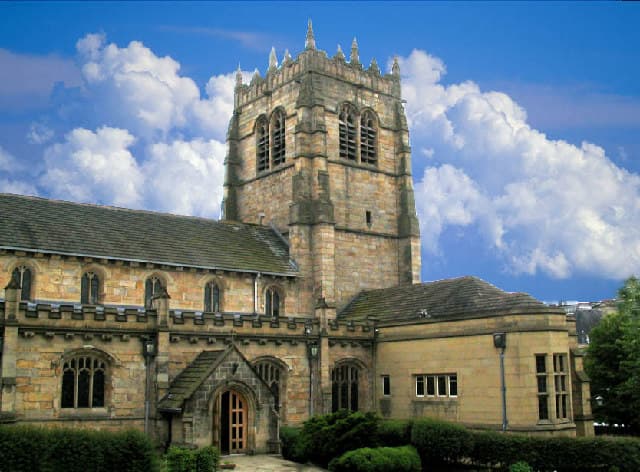
Bradford Cathedral
Bradford Cathedral, officially the Cathedral Church of St Peter, is an Anglican cathedral in Bradford, West Yorkshire, England. Its site has been a place of Christian worship since the 7th century, and it served as a parish church for many centuries before achieving cathedral status in 1919. It is now one of three co-equal cathedrals within the Diocese of Leeds.

Carlisle Cathedral
Carlisle Cathedral, formally the Cathedral Church of the Holy and Undivided Trinity in Carlisle, is an Anglican cathedral in Carlisle, Cumbria, England. Founded as an Augustinian priory in 1122 and elevated to cathedral status in 1133, it is the seat of the Bishop of Carlisle and is notable as one of England's ancient cathedrals, characterized by its mix of Norman and Gothic architecture and significant medieval features.

Chelmsford Cathedral
Chelmsford Cathedral, officially the Cathedral Church of St Mary the Virgin, St Peter and St Cedd, is an Anglican cathedral in Chelmsford, Essex, England. It became a cathedral in 1914 upon the creation of the Diocese of Chelmsford and serves as the seat of the Bishop of Chelmsford. The building has a history dating back to around 1200 as a parish church, with significant rebuilding in the 15th and 16th centuries, and further modifications in the 19th and 20th centuries to adapt it to its cathedral status.