
Holy Trinity Cathedral
Orthodox Church in America Diocese of the Midwest·Orthodox Christianity·Usa
Holy Trinity Orthodox Cathedral is a significant religious and architectural landmark in Chicago, Illinois, serving as the cathedral church for the Orthodox Church in America Diocese of the Midwest. It is notable as one of only two churches designed by the influential American architect Louis Sullivan, blending traditional Russian provincial design with his distinctive decorative style.
Key Facts
- ›Designed by renowned architect Louis Sullivan, it is one of only two churches he designed.
- ›Commissioned by an Orthodox community of immigrants from Eastern Europe, it reflects a blend of Russian provincial architecture and Sullivan's unique decorative elements.
- ›Construction was partly financed by a donation from Tsar Nicholas II of Russia.
- ›It was consecrated by St. Tikhon of Moscow and was under the spiritual guidance of St. John of Chicago (Kochurov) in its early years.
- ›Elevated to a cathedral in 1923, it serves as the seat of the Orthodox Church in America Diocese of the Midwest.
- ›It is listed on the us National Register of Historic Places and designated a Chicago Landmark.

Russian Provincial, Art Nouveau, Arts and Crafts
Octagonal Dome, Frontal Belltower, Decorative Elements By Louis Sullivan, Influence of Russian Provincial Architecture
Louis Sullivan
About Holy Trinity Cathedral
Holy Trinity Orthodox Cathedral
Holy Trinity Orthodox Cathedral stands as a significant religious and architectural landmark in Chicago, Illinois, serving as the principal church for the Orthodox Church in America Diocese of the Midwest. Its importance is amplified by its designation as one of only two churches designed by Louis Sullivan, a pivotal figure in American architecture known for his innovative approaches to design and ornamentation.
History and Design
The cathedral's origins trace back to a growing Orthodox community composed of immigrants from diverse backgrounds, including Rusyns, Ukrainians, Russians, Serbs, and Greeks, many of whom hailed from Carpathian Rus', Galicia, and the Balkans. The founders envisioned a church that would be "remindful of the small, intimate, rural buildings they left behind in the Old World." This vision led to a design that incorporates features of traditional Russian provincial architecture, such as an octagonal dome and a frontal belltower. Archival evidence suggests a particular inspiration from a small wooden church in the Siberian village of Tatarskaya.
To this traditional foundation, Louis Sullivan applied his distinctive aesthetic sensibilities, influenced by the Art Nouveau and Arts and Crafts movements. These elements are evident in the decorative work over the western entrance, the framing of windows and roofs, and the design of the bell tower and cupolas. The construction received partial financial support from a donation of 4,000 rubles from Tsar Nicholas II of Russia. Louis Sullivan himself contributed by donating a portion of his fee and an elaborate chandelier manufactured by Healy & Millet.
Significance and Recognition
The church was consecrated by St. Tikhon of Moscow and benefited from the spiritual guidance of St. John of Chicago (Kochurov) during its formative years. In 1923, the church was elevated to the status of a cathedral, solidifying its role as the seat of the Orthodox Church in America Diocese of the Midwest. Its architectural merit and historical importance have been recognized through its listing on the US National Register of Historic Places and its designation as a Chicago Landmark. It continues to serve the Orthodox Christian community in Chicago's Ukrainian Village neighborhood, remaining one of only two Orthodox churches in that area.
Source: Wikipedia ↗
Frequently Asked Questions
Who designed Holy Trinity Orthodox Cathedral?
Holy Trinity Orthodox Cathedral was designed by Louis Sullivan, a highly influential American architect of the late 19th and early 20th centuries. It is one of only two churches he ever designed.
What is the architectural style of Holy Trinity Orthodox Cathedral?
The cathedral combines traditional Russian provincial architecture, featuring an octagonal dome and frontal belltower reminiscent of rural buildings from Eastern Europe, with decorative elements characteristic of Louis Sullivan's work, influenced by Art Nouveau and Arts and Crafts movements.
When was Holy Trinity Orthodox Cathedral built?
Construction of Holy Trinity Orthodox Cathedral took place in the early 20th century, with the church being elevated to a cathedral in 1923. Specific start and completion dates for the initial construction are not detailed but align with the early 1900s.
What is the significance of Holy Trinity Orthodox Cathedral?
Its significance lies in its unique architectural design by Louis Sullivan, its representation of the immigrant Orthodox community's heritage, and its role as the cathedral church for the Orthodox Church in America Diocese of the Midwest. It is also recognized on the US National Register of Historic Places and as a Chicago Landmark.
What is Holy Trinity Orthodox Cathedral's connection to Russian history?
The church was commissioned by immigrants from regions historically associated with Russia and was partly financed by a donation from Tsar Nicholas II of Russia. Its design intentionally evokes the small, intimate, rural buildings found in the Old World, particularly a wooden church in the Siberian village of Tatarskaya.
What services are held at Holy Trinity Orthodox Cathedral?
The cathedral celebrates the Divine Liturgy on Sundays at 9:30 am, preceded by the singing of the Hours from 9:10 am. The Divine Liturgy is also celebrated at 9:30 am on Feast days, and Vigil is held on Saturdays at 5:00 pm.
Related Cathedrals
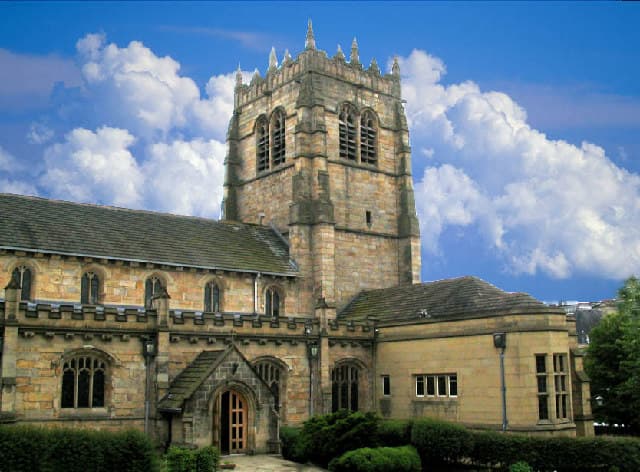
Bradford Cathedral
Bradford Cathedral, officially the Cathedral Church of St Peter, is an Anglican cathedral in Bradford, West Yorkshire, England. Its site has been a place of Christian worship since the 7th century, and it served as a parish church for many centuries before achieving cathedral status in 1919. It is now one of three co-equal cathedrals within the Diocese of Leeds.

Leeds Cathedral
Leeds Cathedral, officially the Cathedral Church of St Anne, is the principal Roman Catholic cathedral in Leeds, West Yorkshire, United Kingdom. It serves as the seat of the Roman Catholic Bishop of Leeds. While the city lacks a Church of England cathedral, Leeds Cathedral stands as a significant religious and architectural landmark for the Catholic community.

St. Michael the Archangel Cathedral
St. Michael the Archangel Cathedral, also known as the Cathedral of St. Michael the Archangel, is a significant Orthodox cathedral in Sitka, Alaska, holding the distinction of being the earliest Orthodox cathedral in the New World. Although the original 19th-century structure was destroyed by fire in 1966, it was faithfully rebuilt, preserving its historical and architectural importance as a legacy of Russian influence in North America. The current building features green domes and golden crosses, serving as a prominent landmark.