
Ely Cathedral
Ely Cathedral, also known as the Cathedral Church of the Holy and Undivided Trinity of Ely, is an Anglican cathedral located in Ely, Cambridgeshire, England. Its origins trace back to an abbey founded in 672 by St Æthelthryth, with the present building's earliest sections dating to 1083. It is a significant architectural landmark, renowned for its monumental Romanesque style complemented by later Decorated Gothic additions, and is a major tourist destination.
Key Facts
- ›Founded as an abbey in 672 by St Æthelthryth, it became a cathedral in 1109.
- ›The cathedral showcases a blend of Romanesque and Decorated Gothic architectural styles.
- ›Its most distinctive feature is the central octagonal Lantern Tower, a unique architectural achievement.
- ›The nave is one of the longest in Britain, measuring over 75 meters.
- ›It is known locally as 'the ship of the Fens' due to its prominent position.
- ›The cathedral is a major tourist attraction, drawing approximately 250,000 visitors annually.

Romanesque, Decorated Gothic, Early English Gothic
Octagon Lantern Tower, Galilee Porch, Lady Chapel With Carved Relief Sculptures, West Tower, Long Nave
8th Century, 11th Century, 12th Century, 13th Century, 14th Century, 15th Century, 16th Century
Alan of Walsingham, William Hurley
About Ely Cathedral
Ely Cathedral, officially the Cathedral Church of the Holy and Undivided Trinity of Ely, stands as a prominent Anglican cathedral in the city of Ely, Cambridgeshire, England. Its historical roots reach back to 672 with the founding of an abbey by St Æthelthryth (also known as Etheldreda). The earliest surviving sections of the current structure date to 1083, and it officially gained cathedral status in 1109. Historically dedicated to St Etheldreda and St Peter, it was refounded as the Cathedral Church of the Holy and Undivided Trinity of Ely following the Reformation.
Architectural Significance
Architecturally, Ely Cathedral is remarkable for both its scale and stylistic details. It was originally constructed in a monumental Romanesque style. Significant portions, including the Galilee porch, lady chapel, and choir, were later rebuilt in an exuberant Decorated Gothic style. One of its most celebrated and unique architectural achievements is the central octagonal tower, known as the Lantern Tower, which creates a vast internal space and, along with the West Tower, forms a striking silhouette against the surrounding landscape. The cathedral is often referred to locally as "the ship of the Fens" because of its commanding presence in the flat fenland region.
History and Development
The site of Ely has a long history of religious importance, beginning with the Anglo-Saxon abbey founded by St Æthelthryth. After periods of Viking raids and monastic continuity, the Norman rebuilding commenced in 1083 under Abbot Simeon. The construction was a complex and lengthy process, marked by interruptions and adaptations. The nave, one of the longest in Britain, was built in phases, with work on the West Tower and western transepts occurring later. The present-day presbytery and east end were significantly expanded in the 13th century by Bishop Hugh of Northwold, dedicated in 1252 in the presence of King Henry III. A major disaster in 1322, when the central crossing tower collapsed, led to the ambitious creation of the unique octagonal Lantern Tower, overseen by Alan of Walsingham. Later centuries saw the addition of elaborate chantry chapels for bishops John Alcock and Nicholas West.
Present Day
Ely Cathedral continues to be an active place of worship, sustaining a daily pattern of morning and evening services. It is also a major tourist destination, attracting approximately 250,000 visitors each year, drawn by its rich history, impressive architecture, and prominent position in the Cambridgeshire landscape. The cathedral serves as the seat for the Bishop of Ely and is part of the Diocese of Ely, which covers much of Cambridgeshire and western Norfolk.
Source: Wikipedia ↗
Frequently Asked Questions
When was Ely Cathedral founded?
Ely Cathedral's origins date back to an abbey founded in 672 by St Æthelthryth. The present building's earliest parts were constructed starting in 1083, and it was granted cathedral status in 1109.
What are the main architectural styles of Ely Cathedral?
Ely Cathedral was initially built in a monumental Romanesque style. Later additions, such as the Galilee porch, lady chapel, and choir, were rebuilt in an exuberant Decorated Gothic style.
What is the most notable feature of Ely Cathedral?
The most notable feature of Ely Cathedral is its central octagonal tower, known as the Lantern Tower, which provides a unique internal space and dominates the surrounding landscape along with the West Tower.
What is the significance of St Æthelthryth to Ely Cathedral?
St Æthelthryth, also known as Etheldreda, founded the original abbey in 672. Her relics were a major driving force for the success of the refounded abbey, and her cult was re-affirmed during the construction of the Norman church.
What is the nickname of Ely Cathedral and why?
Ely Cathedral is known locally as 'the ship of the Fens'. This nickname comes from its prominent position above the surrounding flat landscape, making it highly visible for miles.
Related Cathedrals
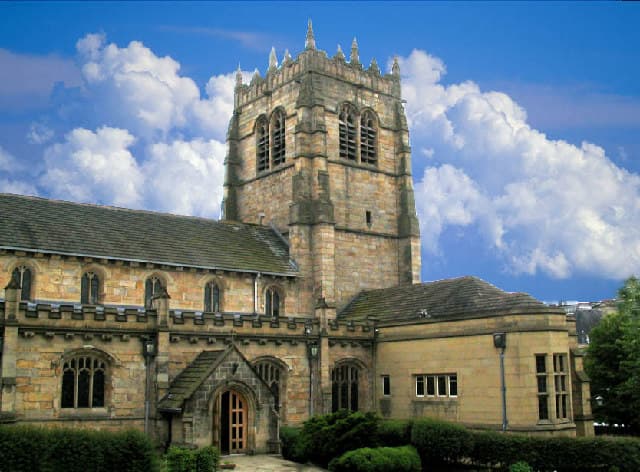
Bradford Cathedral
Bradford Cathedral, officially the Cathedral Church of St Peter, is an Anglican cathedral in Bradford, West Yorkshire, England. Its site has been a place of Christian worship since the 7th century, and it served as a parish church for many centuries before achieving cathedral status in 1919. It is now one of three co-equal cathedrals within the Diocese of Leeds.

Carlisle Cathedral
Carlisle Cathedral, formally the Cathedral Church of the Holy and Undivided Trinity in Carlisle, is an Anglican cathedral in Carlisle, Cumbria, England. Founded as an Augustinian priory in 1122 and elevated to cathedral status in 1133, it is the seat of the Bishop of Carlisle and is notable as one of England's ancient cathedrals, characterized by its mix of Norman and Gothic architecture and significant medieval features.

Chelmsford Cathedral
Chelmsford Cathedral, officially the Cathedral Church of St Mary the Virgin, St Peter and St Cedd, is an Anglican cathedral in Chelmsford, Essex, England. It became a cathedral in 1914 upon the creation of the Diocese of Chelmsford and serves as the seat of the Bishop of Chelmsford. The building has a history dating back to around 1200 as a parish church, with significant rebuilding in the 15th and 16th centuries, and further modifications in the 19th and 20th centuries to adapt it to its cathedral status.