
Derby Cathedral
Derby Cathedral, originally All Saints' Church, achieved cathedral status in 1927, becoming the seat for the Bishop of Derby. While its origins trace back to a 10th-century royal collegiate church, its present form is largely a Georgian rebuilding, notable for its 16th-century tower and a 20th-century retroquire. It stands as a significant religious and historical landmark in Derby, England.
Key Facts
- ›The original church of all Saints was founded around 943 as a royal collegiate church.
- ›The current main body of the cathedral is a Georgian rebuilding by James Gibbs, completed in 1725.
- ›The 212-foot (65 M) tower, built in the Perpendicular Gothic style, dates from 1510–1532.
- ›In 1927, all Saints' Church was promoted to cathedral status, creating the Diocese of Derby.
- ›Notable furnishings include an 18th-century wrought iron rood screen by Robert Bakewell and a monument to Bess of Hardwick.
- ›The cathedral houses the oldest ring of ten bells in the world, with most dating from 1678.

Georgian, Neo-Classical, Perpendicular Gothic
- 16th-Century Tower
- Georgian Rebuilding By James Gibbs
- 18th-Century Wrought Iron Chancel Screen By Robert Bakewell
- Monument To Bess of Hardwick
- Oldest Ring of Ten Bells In the World
- 20th-Century Retroquire By Sebastian Comper
10th Century, 14th Century, 16th Century, 18th Century, 20th Century
James Gibbs, Sebastian Comper
About Derby Cathedral
Derby Cathedral, officially known as the Cathedral Church of All Saints, Derby, is a prominent Anglican cathedral located in the city of Derby, England. Its history is long and multifaceted, evolving from a 10th-century royal collegiate church to its current status as the seat of the Bishop of Derby, a role it assumed in 1927 when it was elevated from parish church status.
History and Architecture
The origins of All Saints' Church can be traced back to approximately 943, when it was likely established by King Edmund I as a royal collegiate church. While no trace of this original Anglo-Saxon building remains, the church underwent significant transformations over the centuries. A new building was constructed in the 14th century, and between 1510 and 1532, the imposing 212-foot (65 m) tower was erected in the Perpendicular Gothic style, featuring twelve sculpted grotesque animal figures and a Green Man carving at the west door. The fabric of the church deteriorated significantly by the early 18th century, leading to its demolition and a comprehensive rebuilding. The main body of the church as seen today is a Georgian construction, largely a Neo-Classical design by architect James Gibbs, completed in 1725. The original 1530s tower was retained, and a retroquire was added to the east end between 1967 and 1972, designed by Sebastian Comper.
Notable Features and Significance
Derby Cathedral is distinguished by several notable features. Its tower is a significant example of late Gothic architecture. Inside, the cathedral boasts an 18th-century wrought iron chancel screen, a masterpiece by local iron-smith Robert Bakewell. Among its treasures is a monument with an effigy of Bess of Hardwick, a celebrated Elizabethan noblewoman, alongside monumental brasses of her descendants from the Cavendish family. The cathedral is also home to the oldest ring of ten bells in the world, with most dating from 1678. The cathedral's clock mechanism incorporates gun barrels from the 1745 Jacobite uprising, a unique historical artifact. In recent years, the cathedral has also gained attention for the peregrine falcons that have taken up residence on its tower, with nesting platforms and webcams installed to monitor them.
Modern Role
Since its consecration as a cathedral in 1927, Derby Cathedral has served as the spiritual heart of the Diocese of Derby. It continues to be an active place of worship and a significant cultural and historical site, hosting events, educational programs, and maintaining its role as a landmark in the city of Derby. The Cathedral Centre, located opposite the west doors, provides administrative offices and meeting rooms, and has previously housed a café and bookshop.
Source: Wikipedia ↗
Frequently Asked Questions
When did All Saints' Church become Derby Cathedral?
All Saints' Church officially became Derby Cathedral by Order in Council on July 1, 1927. This promotion coincided with the creation of the new Episcopal see of Derby.
Who designed the main body of Derby Cathedral?
The main body of Derby Cathedral as it stands today was rebuilt to a Neo-Classical design by the architect James Gibbs. This rebuilding was completed in 1725.
What is significant about Derby Cathedral's tower?
The tower of Derby Cathedral, standing 212 feet (65 m) tall, was built between 1510 and 1532 in the Perpendicular Gothic style. It is adorned with twelve large sculpted grotesque animal figures and features a sculpted Green Man head at the base of the West Door.
What are some notable furnishings or artworks within Derby Cathedral?
Derby Cathedral features an 18th-century wrought iron rood screen crafted by Robert Bakewell, a monument with an effigy of Bess of Hardwick, and monumental brasses of her descendants. The cathedral also has stained-glass windows designed by Ceri Richards and a bronze crucifix by Ronald Pope.
What is unique about the bells at Derby Cathedral?
Derby Cathedral possesses the oldest ring of ten bells in the world, with most of them dating back to 1678 when the number of bells was increased. The largest bell is over 500 years old and is believed to have come from Dale Abbey.
Related Cathedrals
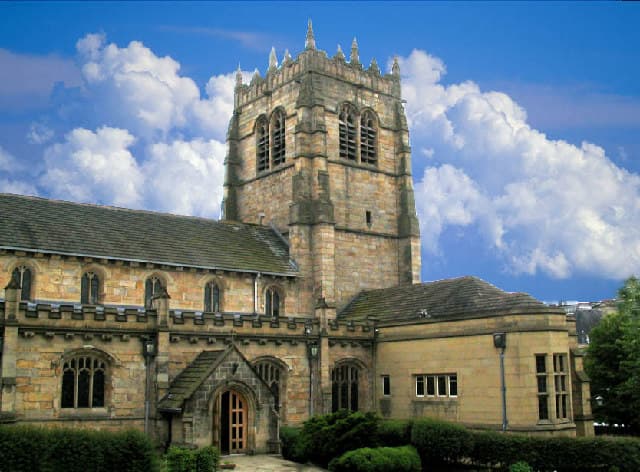
Bradford Cathedral
Bradford Cathedral, officially the Cathedral Church of St Peter, is an Anglican cathedral in Bradford, West Yorkshire, England. Its site has been a place of Christian worship since the 7th century, and it served as a parish church for many centuries before achieving cathedral status in 1919. It is now one of three co-equal cathedrals within the Diocese of Leeds.

Carlisle Cathedral
Carlisle Cathedral, formally the Cathedral Church of the Holy and Undivided Trinity in Carlisle, is an Anglican cathedral in Carlisle, Cumbria, England. Founded as an Augustinian priory in 1122 and elevated to cathedral status in 1133, it is the seat of the Bishop of Carlisle and is notable as one of England's ancient cathedrals, characterized by its mix of Norman and Gothic architecture and significant medieval features.

Chelmsford Cathedral
Chelmsford Cathedral, officially the Cathedral Church of St Mary the Virgin, St Peter and St Cedd, is an Anglican cathedral in Chelmsford, Essex, England. It became a cathedral in 1914 upon the creation of the Diocese of Chelmsford and serves as the seat of the Bishop of Chelmsford. The building has a history dating back to around 1200 as a parish church, with significant rebuilding in the 15th and 16th centuries, and further modifications in the 19th and 20th centuries to adapt it to its cathedral status.