
Cahors Cathedral
Cahors Cathedral, officially known as the Cathedral of Saint-Étienne de Cahors, is a significant Roman Catholic church in Occitanie, France. It is recognized as a national monument and stands as an important example of the architectural transition from late Romanesque to Gothic styles. The cathedral holds a precious relic, the Holy Cap, believed to have been worn by Christ.
Key Facts
- ›Built by Bishop Gerard de Cardaillac in the 11th century over a 7th-century church, and consecrated in 1119.
- ›Features massive Byzantine-style domes in the nave, supported by pilasters, with one dome decorated with 14th-century frescoes.
- ›The apse exhibits Gothic style on a Romanesque base, featuring chapels with sculptures and contrasting with colorful stained glass and choir paintings.
- ›Contains the relic of the Holy Cap, brought from the Holy Land by Bishop Gerard de Cardaillac in 1113.
- ›Includes a Flamboyant Gothic-style cloister built in 1504, which now houses a museum of Religious Art.
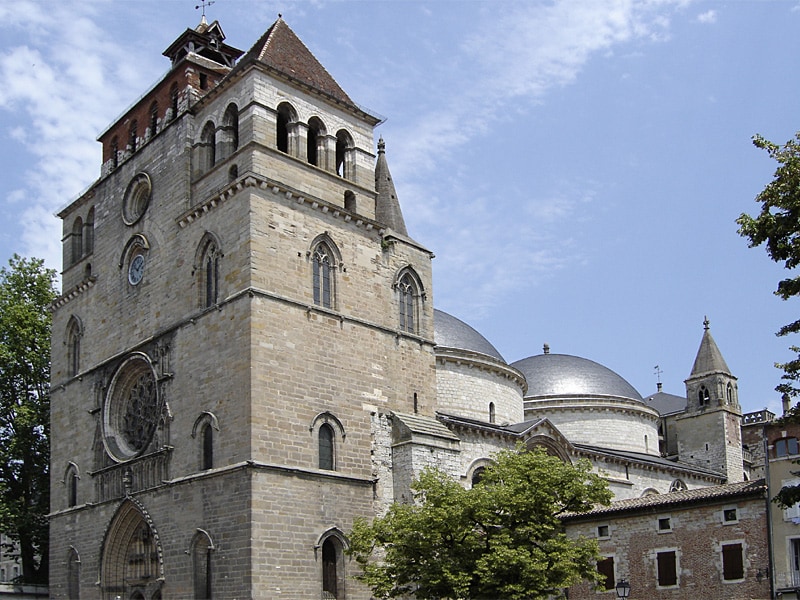
Byzantine-Style Domes In the Nave, 14th-Century Frescoes In One Dome, Relic of the Holy Cap, Flamboyant Gothic Cloister, Fortified FaçAde Resembling A Castle Wall
Gerard De Cardaillac, Guillaume De Labroue, Anthony of Luzech
About Cahors Cathedral
Cahors Cathedral, officially known as the Cathedral of Saint-Étienne de Cahors, is a significant Roman Catholic church situated in the town of Cahors in the Occitanie region of France. Recognized as a national monument, it stands as a notable example of the architectural transition between the late Romanesque and Gothic styles.
History and Construction
The initial construction of Cahors Cathedral was undertaken by Bishop Gerard de Cardaillac in the 11th century, built upon the foundations of a church established in the 7th century by St. Didier of Cahors. The cathedral was officially consecrated by Pope Calixtus II on September 10, 1119, with its main construction completed around 1135. Its location in the city center contributes to its imposing presence, reflecting the historical power of the bishops, who also served as feudal lords of Cahors. The façade underwent a significant renovation between 1316 and 1324 under Guillaume de Labroue, cousin of Pope John XXII, which further enhanced its fortified appearance, resembling a robust castle wall.
Architectural Features
The cathedral's nave is well-lit and measures 44 by 20 meters. It is characterized by two massive, 32-meter-high domes in the Byzantine style, supported by pendentives and large pilasters, with the notable absence of a transept. One of these domes is adorned with 14th-century frescoes depicting the stoning of St. Stephen and eight prophets. The apse, while built on a Romanesque base with columns featuring decorated capitals, is in the Gothic style. It comprises three chapels adorned with sculptures, creating a visual contrast with the white apse, colorful stained glass, and the paintings in the choir.
Notable Relics and Artworks
Cahors Cathedral is the repository for the precious relic of the Holy Cap, which is believed to have been worn by Christ. This relic was brought to France by Bishop Gerard de Cardillac following his pilgrimage to the Holy Land in 1113. The church also houses several tombs, including that of Alain de Solminihac. The northern side of the cathedral features a secondary façade in the Romanesque style, also possessing a fortified character.
Cloister and Museum
Access to the cloister is gained through a door to the right of the choir. This cloister, built in the Flamboyant Gothic style in 1504 by Bishop Anthony of Luzech, displays scenes of everyday life and a depiction of the Madonna. On the western side of the cloister is the St. Gaubert Chapel, whose vault is decorated with Italian Renaissance paintings, and whose walls feature 15th-century frescoes of the Last Judgment. This area now serves as a museum of Religious Art.
Source: Wikipedia ↗
Frequently Asked Questions
What is the history of Cahors Cathedral?
Cahors Cathedral was initiated by Bishop Gerard de Cardaillac in the 11th century, built over an earlier 7th-century church. It was consecrated in 1119 and completed around 1135. The façade underwent significant renovation between 1316 and 1324.
What are the main architectural styles found at Cahors Cathedral?
The cathedral showcases a blend of late Romanesque and Gothic architectural traditions. The nave features Byzantine-style domes, while the apse is Gothic on a Romanesque foundation. The cloister is in the Flamboyant Gothic style.
What notable relics or artworks are housed in Cahors Cathedral?
The cathedral is home to the precious relic of the Holy Cap, said to have been worn by Christ. One of the nave domes is adorned with 14th-century frescoes depicting the stoning of St. Stephen and prophets, and the walls contain numerous other medieval paintings.
Does Cahors Cathedral have a cloister?
Yes, Cahors Cathedral has a cloister built in the Flamboyant Gothic style in 1504. It features scenes of daily life, a Madonna, and the St. Gaubert Chapel with Renaissance paintings and 15th-century frescoes.
What is the significance of the cathedral's fortified appearance?
The cathedral's sturdy, fortified appearance reflects the historical role of local bishops as powerful feudal lords, acting as counts and barons of Cahors. This is evident in the heavy castle-wall-like façade and the fortified northern façade.
Related Cathedrals
Altamura Cathedral
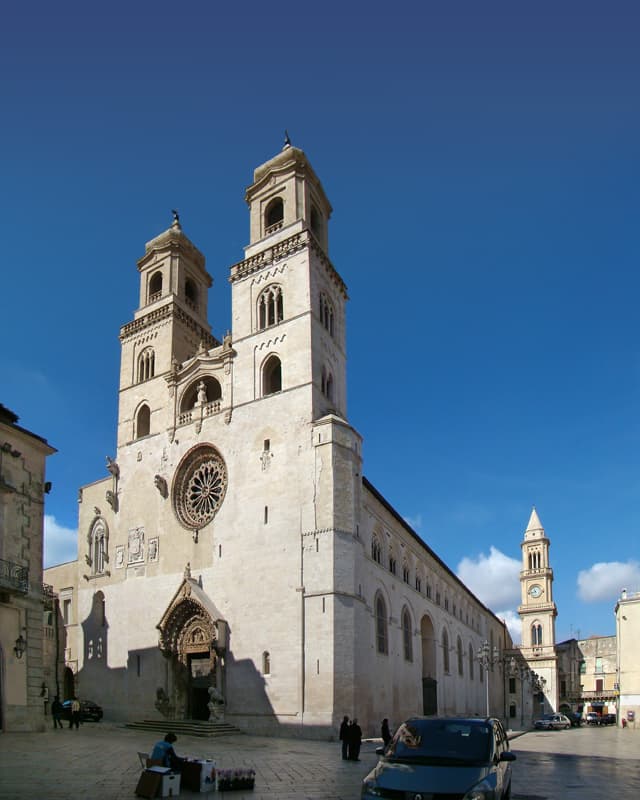
Altamura Cathedral, officially dedicated to the Assumption of the Blessed Virgin Mary, is a significant Roman Catholic cathedral located in Altamura, Apulia, southern Italy. Originally commissioned by Emperor Frederick II, it has undergone numerous expansions and alterations throughout its history, reflecting various architectural styles and historical periods. It currently serves as the seat of the Bishop of Altamura-Gravina-Acquaviva delle Fonti.
Canosa Cathedral
Canosa Cathedral, officially the Cathedral of San Sabino, is a Romanesque-Byzantine architectural masterpiece located in Canosa di Puglia, Italy. Originally founded in the 8th century and consecrated in 1101, it stands as a significant religious and historical site, showcasing a rich blend of architectural styles and ancient influences. The cathedral holds the relics of Saint Sabinus, the town's patron saint, and is a testament to the enduring history of this ancient Apulian city.

Annunciation Melkite Catholic Cathedral
The Annunciation Melkite Catholic Cathedral, located in the West Roxbury neighborhood of Boston, Massachusetts, serves as the principal church for the Melkite Greek Catholic Eparchy of Newton, which covers the entire United States. Its current structure and status as a cathedral were established in 1966, replacing a previous parish church that served the growing Melkite community in Boston.