
Annunciation Melkite Catholic Cathedral
Melkite Greek Catholic Eparchy of Newton·Melkite Greek Catholic·United States
The Annunciation Melkite Catholic Cathedral, located in the West Roxbury neighborhood of Boston, Massachusetts, serves as the principal church for the Melkite Greek Catholic Eparchy of Newton, which covers the entire United States. Its current structure and status as a cathedral were established in 1966, replacing a previous parish church that served the growing Melkite community in Boston.
Key Facts
- ›Established as a cathedral in 1966, having previously been a parish church since 1908.
- ›The Melkite community in Boston originated from immigrants from Syria and the Levant in the late 19th century.
- ›The current site was acquired in the 1960s due to the dispersion of the Melkite population and the inadequacy of previous locations.
- ›The cathedral's design is inspired by Byzantine architecture.
- ›It is the seat of the Melkite Greek Catholic Eparchy of Newton and its hierarch, Bishop Francois Beyrouti.
- ›The cathedral was consecrated on April 23, 1966.

- Modern Design Inspired By Byzantine Architecture
Lawrence J. Cuneo
About Annunciation Melkite Catholic Cathedral
The Annunciation Melkite Catholic Cathedral, situated in the West Roxbury neighborhood of Boston, Massachusetts, stands as a significant edifice for the Melkite Greek Catholic Church in the United States. Its current incarnation as a cathedral was established in 1966, though the Melkite community's presence and worship in Boston dates back to the early 20th century.
History and Community
The roots of the Melkite community in Boston trace back to the late 19th century, with the arrival of Christian immigrants from Syria and the Levant seeking better economic prospects. These immigrants, predominantly from the region around Zahlé, settled in northeastern cities like Boston, drawn by opportunities in the garment industry. Initially, the community relied on visiting priests, but their desire for a permanent church and pastor led to petitions to the Archbishop of Boston. After initial reluctance, a parish church was established in 1908 at 178 Harrison Avenue in the South End, initially named Our Lady of the Annunciation Syrian Catholic Church.
Over the decades, the parish outgrew its South End locations. By the 1930s, a larger church on Warren Avenue was acquired, but the congregation continued to disperse throughout Boston and its surrounding suburbs. By the late 1950s and early 1960s, the need for a more centrally located and accessible church for the widely dispersed faithful became apparent. This led to the identification of a 4.2-acre property in West Roxbury, a location that offered better access for the majority of parishioners.
Transition to Cathedral Status
The construction of the current church in West Roxbury was a significant undertaking, initiated in the early 1960s. A building committee was formed, and Lawrence J. Cuneo was engaged as the principal architect. Cardinal Cushing of Boston provided considerable support for the project, including a substantial pledge to a building fund drive. The new church was consecrated on April 23, 1966.
In January 1966, the Holy See established the Melkite Exarchate for the United States, and the Church of the Annunciation was chosen as its cathedral. On March 25, 1966, the Feast of the Annunciation, the inaugural Divine Liturgy was celebrated, marking its official designation as a cathedral. In 1976, the exarchate was elevated to the status of an eparchy, and on May 8, 1977, the Melkite Greek Catholic Eparchy of Newton was canonically erected, with the Annunciation Melkite Catholic Cathedral serving as its principal church and the seat of its eparch, currently Bishop Francois Beyrouti.
Source: Wikipedia ↗
Frequently Asked Questions
When was the Annunciation Melkite Catholic Cathedral established?
The present structure and its status as a cathedral date to 1966. Prior to this, the Melkite community worshipped in a parish church established in 1908.
Where did the Melkite community in Boston originate from?
The Melkite community in Boston began with Christian immigrants from Syria and the Levant (modern-day Lebanon) who arrived in the United States in the 1890s seeking economic opportunities.
Why did the Melkite church relocate to West Roxbury?
The relocation was necessitated by the dispersion of the Melkite faithful to various Boston neighborhoods and suburbs, the increasing travel demands, a shortage of parking, and the need for extensive repairs to previous church buildings.
What architectural style is the Annunciation Melkite Catholic Cathedral inspired by?
The cathedral is modern and inspired by Byzantine architecture.
What is the significance of the Eparchy of Newton?
The Eparchy of Newton encompasses the entire United States and is the principal eparchy for Melkite Greek Catholics in the country. The Annunciation Melkite Catholic Cathedral serves as its principal church and the seat of its hierarch.
Related Cathedrals
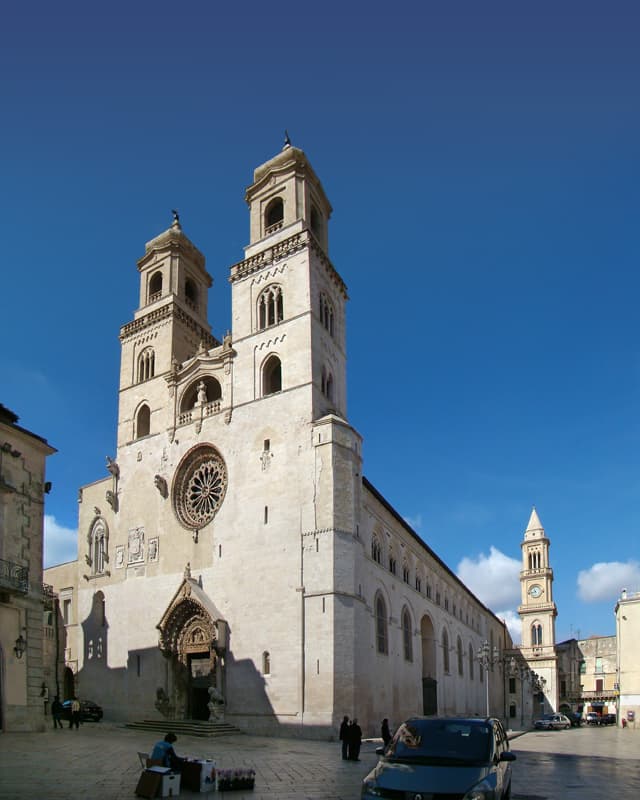
Altamura Cathedral
Altamura Cathedral, officially dedicated to the Assumption of the Blessed Virgin Mary, is a significant Roman Catholic cathedral located in Altamura, Apulia, southern Italy. Originally commissioned by Emperor Frederick II, it has undergone numerous expansions and alterations throughout its history, reflecting various architectural styles and historical periods. It currently serves as the seat of the Bishop of Altamura-Gravina-Acquaviva delle Fonti.
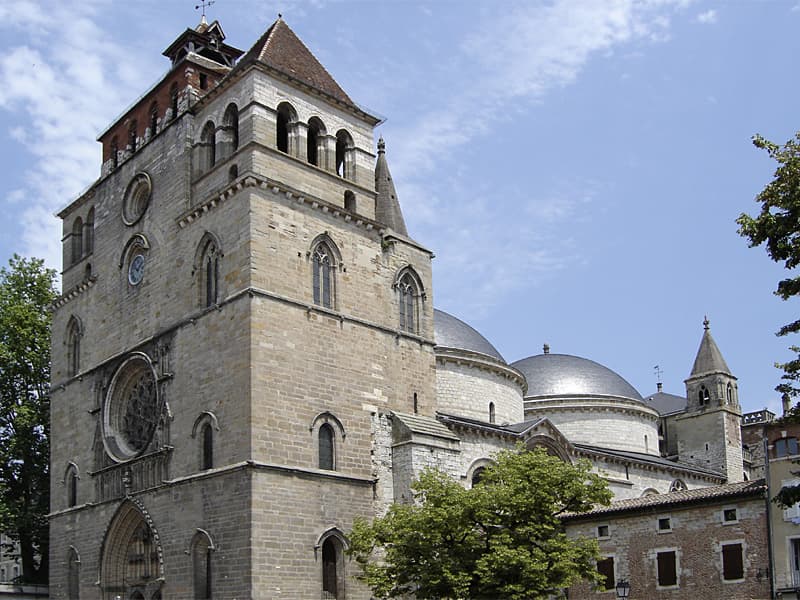
Cahors Cathedral
Cahors Cathedral, officially known as the Cathedral of Saint-Étienne de Cahors, is a significant Roman Catholic church in Occitanie, France. It is recognized as a national monument and stands as an important example of the architectural transition from late Romanesque to Gothic styles. The cathedral holds a precious relic, the Holy Cap, believed to have been worn by Christ.
Canosa Cathedral
Canosa Cathedral, officially the Cathedral of San Sabino, is a Romanesque-Byzantine architectural masterpiece located in Canosa di Puglia, Italy. Originally founded in the 8th century and consecrated in 1101, it stands as a significant religious and historical site, showcasing a rich blend of architectural styles and ancient influences. The cathedral holds the relics of Saint Sabinus, the town's patron saint, and is a testament to the enduring history of this ancient Apulian city.