
Bergamo Cathedral
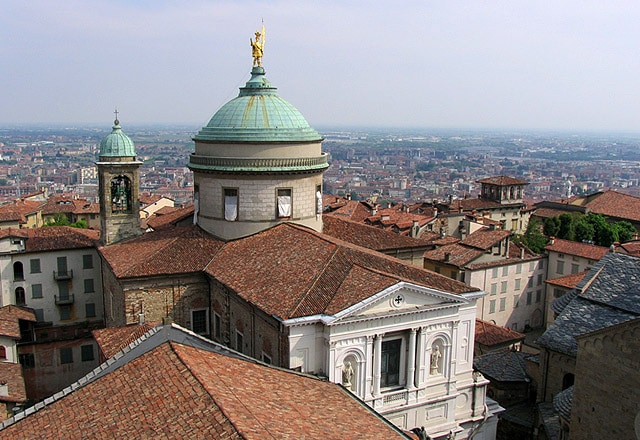
Bergamo Cathedral, officially the Cathedral of Saint Alexander, is the principal Roman Catholic cathedral in Bergamo, Italy. It serves as the seat of the Bishop of Bergamo and is dedicated to the city's patron saint. The cathedral's history involves the unification of two earlier religious sites, with its current form resulting from various renovations and rebuildings over centuries.
Key Facts
- ›The cathedral is dedicated to Saint Alexander of Bergamo, the city's patron saint.
- ›It was formed by the unification of two earlier cathedrals, St. Alexander and St. Vincent.
- ›Filarete is credited with plans for the rebuilding of St. Vincent's cathedral in the MID-15th century.
- ›The structure underwent significant renovations in 1689 by Carlo Fontana and a major 19th-century renovation.
- ›The interior features notable artworks, including pieces by Andrea Previtali, Giovan Battista Moroni, and Giovanni Battista Tiepolo.
- ›The nearby octagonal baptistery, originally built for Santa Maria Maggiore in 1340, was reassembled in its current location in 1889.
- Works By Andrea Previtali and Giovan Battista Moroni
- Martyrdom of Bishop Saint John of Bergamo By Giovanni Battista Tiepolo
- Main Altar Designed By Filippo Juvarra
- Wooden Intaglio Panels By Johann Karl Sanz
- Nearby Octagonal Baptistery
- Neo-Classical West Front
Filarete, Carlo Fontana
About Bergamo Cathedral
Bergamo Cathedral, officially known as the Cattedrale di Sant'Alessandro, is the principal Roman Catholic cathedral in the city of Bergamo, Italy. It holds significant importance as the seat of the Bishop of Bergamo and is dedicated to Saint Alexander of Bergamo, the city's revered patron saint. The cathedral's history is marked by the evolution and eventual unification of two earlier religious structures, with its present form shaped by centuries of architectural development and renovation.
History and Development
Prior to the current cathedral, Bergamo housed two cathedrals: the Basilica of Saint Alexander, believed to be located on the site of his martyrdom, and the Cathedral of Saint Vincent. Construction of the latter likely began during the Lombard era. In the mid-15th century, Bishop Giovanni Barozzi initiated a rebuilding of the Cathedral of St. Vincent, with plans attributed to the renowned architect Filarete. A pivotal moment in the cathedral's history occurred in 1561 when the Venetian authorities demolished the Cathedral of St. Alexander for military purposes, leaving St. Vincent's as the sole surviving cathedral.
Further consolidation took place in the early 17th century when Bishop Giovanni Emo unified the canons of both former cathedrals. The final step in establishing a single cathedral occurred when Bishop Gregorio Barbarigo secured a papal bull from Pope Innocent XI in 1697, which officially unified the diocese's chapter and designated the surviving cathedral the sole cathedral, changing its dedication to Saint Alexander.
The structure underwent significant refurbishment in 1689, following designs by Carlo Fontana. A more extensive renovation in the 19th century culminated in the completion of the Neo-classical west front in 1889, shaping the cathedral's appearance into the modern era.
Architectural and Artistic Significance
Bergamo Cathedral features a Latin cross ground plan with a single nave. The interior is adorned with a collection of significant artworks spanning various periods. The first side-chapel to the right showcases 'St. Benedict and Saints' by Andrea Previtali (1524), while the first chapel to the left contains 'Madonna and child with saints' by Giovan Battista Moroni (1576). Other notable pieces include 'Madonna with child with two doves' by Giovanni Cariani, canvases attributed to Giambettino Cignaroli and Sebastiano Ricci, and in the apse, 'The Martyrdom of Bishop Saint John of Bergamo' (1731-1743) by Giovanni Battista Tiepolo and a 'Saint Alexander' by Carlo Innocenzo Carloni.
The main altar was designed by the celebrated architect Filippo Juvarra, and the choir area is distinguished by wooden intaglio panels crafted by Johann Karl Sanz.
The Baptistery
Adjacent to the cathedral stands its octagonal baptistery, a significant structure originally constructed in 1340 by Giovanni da Campione for the Basilica of Santa Maria Maggiore. During substantial building works in 1650, the baptistery was dismantled but preserved. It was later reassembled in the canons' courtyard in 1856 and finally moved to its present location in 1889. The baptistery's interior features bas-reliefs depicting episodes from the Life of Christ, a statue of John the Baptist, and a font from 1340, also by Giovanni da Campione. The upper level is encircled by a colonnade topped with eight 14th-century statues representing the Virtues.
Source: Wikipedia ↗
Frequently Asked Questions
What is Bergamo Cathedral dedicated to?
Bergamo Cathedral is dedicated to Saint Alexander of Bergamo, who is the patron saint of the city. The cathedral also bears the full name Cattedrale di Sant'Alessandro.
What is the history of Bergamo Cathedral?
The site of the present cathedral was once occupied by the Basilica of Saint Vincent. In the mid-15th century, Bishop Giovanni Barozzi commissioned its rebuilding, with Filarete claiming credit for the plans. The cathedral of Saint Alexander was demolished in 1561 for military reasons. The two cathedrals' canons were unified in the early 17th century, and the surviving cathedral was eventually rededicated to Saint Alexander.
What notable artworks are found inside Bergamo Cathedral?
The cathedral's interior houses several significant artworks. These include 'St. Benedict and Saints' by Andrea Previtali, 'Madonna and child with saints' by Giovan Battista Moroni, and 'The Martyrdom of Bishop Saint John of Bergamo' by Giovanni Battista Tiepolo. It also contains works attributed to Giovan Battista Moroni and Sebastiano Ricci.
Where is the baptistery of Bergamo Cathedral located?
The octagonal baptistery is located nearby Bergamo Cathedral. It was originally constructed in 1340 for the Basilica of Santa Maria Maggiore and has been moved several times, ultimately being reassembled in its present site in 1889.
Who designed the main altar of Bergamo Cathedral?
The main altar within Bergamo Cathedral was designed by Filippo Juvarra. The choir area features wooden intaglio panels created by Johann Karl Sanz.
Related Cathedrals
Alghero Cathedral
Alghero Cathedral, officially the Cathedral of St. Mary the Immaculate, is a Roman Catholic cathedral located in the historic center of Alghero, Sardinia, Italy. It served as the seat of the Bishop of Alghero from 1503 to 1986 and has been the seat of the Bishop of Alghero-Bosa since then. The cathedral is notable for its blend of architectural styles, reflecting its long construction and restoration history.
Alessandria Cathedral
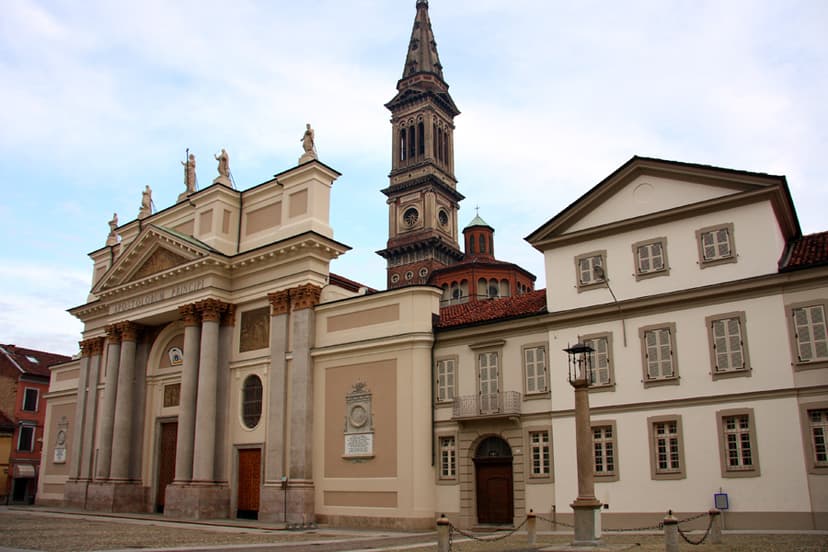
Alessandria Cathedral, officially the Cathedral of Saints Peter and Mark, serves as the episcopal see for the Roman Catholic Diocese of Alessandria in Piedmont, Italy. Its history is marked by multiple constructions and demolitions, with the current Neo-classical structure dating from the early 19th century after the previous cathedral was ordered destroyed by Napoleon.

Derby Cathedral
Derby Cathedral, originally All Saints' Church, achieved cathedral status in 1927, becoming the seat for the Bishop of Derby. While its origins trace back to a 10th-century royal collegiate church, its present form is largely a Georgian rebuilding, notable for its 16th-century tower and a 20th-century retroquire. It stands as a significant religious and historical landmark in Derby, England.