
Alghero Cathedral
Alghero-Bosa·Roman Catholic·Italy
Alghero Cathedral, officially the Cathedral of St. Mary the Immaculate, is a Roman Catholic cathedral located in the historic center of Alghero, Sardinia, Italy. It served as the seat of the Bishop of Alghero from 1503 to 1986 and has been the seat of the Bishop of Alghero-Bosa since then. The cathedral is notable for its blend of architectural styles, reflecting its long construction and restoration history.
Key Facts
- ›Construction began in 1567 and the cathedral was inaugurated in 1593, though not fully completed until later.
- ›It was consecrated in 1730 after several restorations.
- ›The original structure featured Catalan-Gothic elements, with later additions in Late Renaissance and Neo-Classical styles.
- ›The main altar was designed by Giuseppe Massetti in 1727, depicting Mary the Immaculate.
- ›It is the burial site of the Duke of Montferrat and his brother, who died of malaria in Sardinia.
- ›The cathedral is the seat of the Bishop of Alghero-Bosa.
Catalan-Gothic, Late Renaissance, Neo-Classical
- Catalan-Gothic Presbytery With Ambulatory and Octagonal Bell Tower Base
- Late Renaissance Nave and Aisles
- Main Altar Depicting Mary the Immaculate
- Neo-Classical Narthex
- Burial Site of the Duke of Montferrat and His Brother
16th Century, 17th Century, 18th Century
Giuseppe Massetti
About Alghero Cathedral
Alghero Cathedral, also known as the Cathedral of St. Mary the Immaculate (Cattedrale di Santa Maria Immacolata), stands as a significant religious and architectural landmark in the historic center of Alghero, Sardinia, Italy. Designated as a diocesan seat in 1503, it has been the primary church for the Bishops of Alghero and, since 1986, the Bishops of Alghero-Bosa.
History and Construction
The construction of the cathedral commenced in 1567, with its inauguration taking place in 1593, though it remained unfinished for some time. Following a series of restorations, it was officially consecrated in 1730. The church's architectural evolution is marked by a blend of styles. Its original design featured elements of Catalan-Gothic architecture, particularly noticeable in the five chapels and the ambulatory of the presbytery, as well as the octagonal base of the bell tower. The nave and aisles, however, were constructed in the Late Renaissance style.
In 1862, a Neo-Classical narthex was added to the façade, significantly altering its appearance. The first chapel on the right side is dedicated to the Blessed Sacrament and boasts an imposing marble altar inaugurated in 1824, designed within a circular temple reminiscent of the Temple of Vesta in Rome. The main altar itself, a notable artistic work, was designed by the Genovese artist Giuseppe Massetti in 1727, featuring a sculpture of Mary the Immaculate flanked by angels. Massetti also contributed to the design of the ambulatory and the pulpit.
Notable Features and Burials
Beyond its architectural complexity, Alghero Cathedral holds historical significance as the burial site for the Italian-born Duke of Montferrat (1762-1799) and his brother, the Count of Asti (1766-1802). Both met their end on the island due to contracting malaria. Their marble mausoleum, a poignant memorial, was sculpted by Felice Festa in the early 19th century.
As an active place of worship and the seat of a bishopric, Alghero Cathedral continues to be a central spiritual and historical site for the city and the wider region.
Source: Wikipedia ↗
Frequently Asked Questions
When was Alghero Cathedral built?
Construction work on Alghero Cathedral began in 1567 and it was inaugurated in 1593. However, it was not finished at that time and underwent several restorations before being consecrated in 1730.
What is the architectural style of Alghero Cathedral?
The cathedral exhibits a mix of styles. It was originally in Catalan-Gothic style, evident in parts of the presbytery. The nave and aisles are in Late Renaissance style, and a Neo-Classical narthex was added to the façade in 1862.
Who is buried in Alghero Cathedral?
Alghero Cathedral is the burial site of the Italian-born Duke of Montferrat and his brother, the Count of Asti. They died on the island from malaria in the early 19th century.
What is the significance of the main altar?
The main altar was designed by the Genovese artist Giuseppe Massetti in 1727. The sculpture depicts Mary the Immaculate flanked by angels and is a notable artistic feature of the cathedral.
What is the history of Alghero Cathedral's role as a diocesan seat?
Alghero was designated as a diocesan seat in 1503. It served as the seat of the Bishop of Alghero until 1986, after which it became the seat of the Bishop of Alghero-Bosa.
Related Cathedrals
Acquaviva Cathedral
Acquaviva delle Fonti Cathedral, also known as the Concattedrale di Sant'Eustachio, is the principal church of Acquaviva delle Fonti and serves as a co-cathedral within the Diocese of Altamura-Gravina-Acquaviva delle Fonti. Originally a Romanesque structure from the 12th century, it was significantly rebuilt in a Renaissance style in the 16th century and consecrated in 1623.

Alatri Cathedral
Alatri Cathedral, officially the Basilica of Saint Paul, is a Roman Catholic cathedral in Alatri, Lazio, Italy. Originally the cathedral of the Diocese of Alatri, it is now a co-cathedral of the Diocese of Anagni-Alatri. It holds significant relics, including those of Saint Sixtus I and the Ostia incarnata from the Eucharistic miracle of Alatri, making it a site of considerable religious importance.
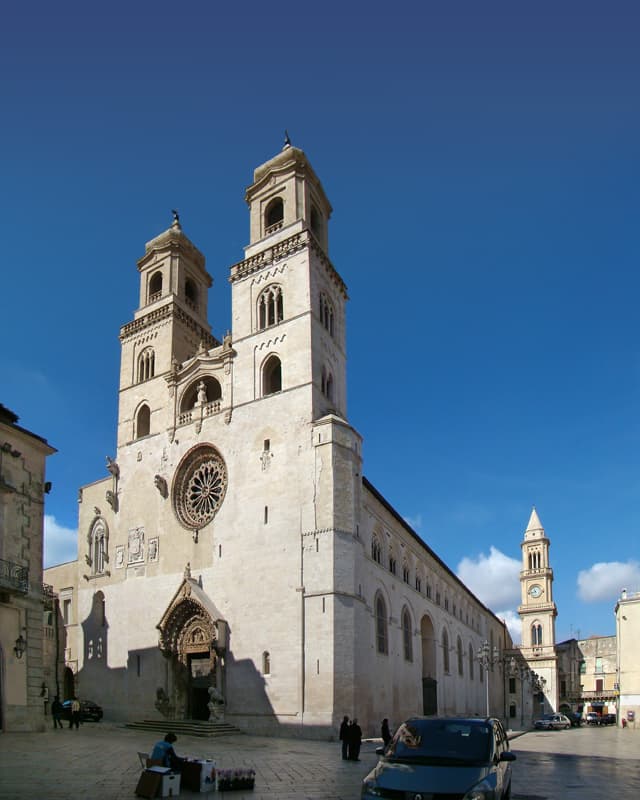
Altamura Cathedral
Altamura Cathedral, officially dedicated to the Assumption of the Blessed Virgin Mary, is a significant Roman Catholic cathedral located in Altamura, Apulia, southern Italy. Originally commissioned by Emperor Frederick II, it has undergone numerous expansions and alterations throughout its history, reflecting various architectural styles and historical periods. It currently serves as the seat of the Bishop of Altamura-Gravina-Acquaviva delle Fonti.