
Alatri Cathedral
Alatri Cathedral, officially the Basilica of Saint Paul, is a Roman Catholic cathedral in Alatri, Lazio, Italy. Originally the cathedral of the Diocese of Alatri, it is now a co-cathedral of the Diocese of Anagni-Alatri. It holds significant relics, including those of Saint Sixtus I and the Ostia incarnata from the Eucharistic miracle of Alatri, making it a site of considerable religious importance.
Key Facts
- ›Built on the acropolis of Alatri, over the remains of ancient shrines and a temple.
- ›Relics of Saint Sixtus I were translated here in 1132, leading to significant refurbishments.
- ›Features works by the Cosmati school, including a screen and ambo added in the 13th century.
- ›Underwent major modernizing works in the 17th and 18th centuries, with the current façade and campanile added between 1790 and 1808.
- ›Houses relics of Saint Alexander and the Ostia incarnata, linked to the Eucharistic miracle of Alatri.
- ›Declared a basilica minor by Pope Pius XII in 1950.

Romanesque, Baroque, Neoclassical
- Relics of Saint Sixtus I
- Relics of Saint Alexander
- Ostia Incarnata
- Cosmati Screen and Ambo
- Copy of Guido Reni's Crucifixion
- Chased and Repoussé Silver Face of Saint Sixtus
- Madonna Del Suffragio Wooden Sculpture
- Remains of Blessed Maria Raffaella Cimatti
11th Century, 12th Century, 13th Century, 16th Century, 17th Century, 18th Century, 19th Century, 20th Century
Jacopo Subleyras, Cosmati
About Alatri Cathedral
Alatri Cathedral, officially known as the Basilica of Saint Paul (Italian: Duomo di Alatri; Basilica concattedrale di San Paolo apostolo), stands as a significant Roman Catholic cathedral in the town of Alatri, within the Lazio region of Italy. It was formerly the seat of the Diocese of Alatri and, since September 30, 1986, serves as a co-cathedral within the Diocese of Anagni-Alatri. Its importance was further recognized on September 10, 1950, when Pope Pius XII bestowed upon it the title of basilica minor.
History and Construction
The cathedral's site is historically rich, built upon the acropolis of Alatri, where ancient shrines of the Hernici and a temple dedicated to Saturn once stood. Historical records indicate the presence of a cathedral chapter as early as 930, with references to a cathedral dating to the first half of the 11th century. A pivotal moment in its history occurred around 1132, under Pope Innocent II, when the relics of the martyred Saint Pope Sixtus I were translated to Alatri. This event prompted a significant refurbishment, with the main altar completed in 1156. Further enhancements were made in the 13th century, including the addition of a screen and ambo by the renowned Cosmati artists, fragments of which are still visible today. The internal walls were adorned with frescoes depicting episodes from the translation of Saint Sixtus' relics in the 16th century, though these are now concealed by later renovations. The cathedral's present-day appearance is largely shaped by extensive modernization works undertaken in the 17th and 18th centuries. The contemporary façade and campanile were constructed between 1790 and 1808 by Jacopo Subleyras, with the cornice and tympanum added in 1884. In commemoration of the 800th anniversary of the relics' translation, the Chapel of St. Sixtus was erected in 1932.
Description and Notable Features
The interior of Alatri Cathedral features a Latin cross ground plan, with three naves separated by pilasters and a raised transept. The façade, constructed from stone and opus latericium, dates from the late 18th and early 19th centuries. Beyond the relics of Saint Sixtus I, the cathedral safeguards the remains of Saint Alexander, brought from the Catacombs of Callixtus in 1640, and the Ostia incarnata, a relic associated with the Eucharistic miracle of Alatri in 1228. The cathedral's artistic treasures include a copy of Guido Reni's "Crucifixion," a 1584 silverwork depicting the face of Saint Sixtus, and a 1639 sculpted wooden group known as the "Madonna del suffragio." The remains of Blessed Maria Raffaella Cimatti are also housed in one of the chapels, transferred there in 2010.
Source: Wikipedia ↗
Frequently Asked Questions
What is Alatri Cathedral dedicated to?
Alatri Cathedral is dedicated to Saint Paul the Apostle. It is also known as the Basilica of Saint Paul.
When was Alatri Cathedral first documented?
References to a cathedral in Alatri date back to the first half of the 11th century, with a cathedral chapter documented in 930.
What significant relics are housed in Alatri Cathedral?
The cathedral is home to the relics of the martyred saint Pope Sixtus I, translated in 1132. It also houses the relics of Saint Alexander from the Catacombs of Callixtus and the Ostia incarnata, associated with the Eucharistic miracle of Alatri.
Who designed the present façade and campanile of Alatri Cathedral?
The present façade and campanile of Alatri Cathedral were designed by Jacopo Subleyras and were added between 1790 and 1808.
What is the significance of the Eucharistic miracle of Alatri in relation to the cathedral?
The Ostia incarnata, a relic from the Eucharistic miracle of Alatri in 1228, is housed within the cathedral. This miracle is a significant event in the religious history of Alatri.
When did Alatri Cathedral become a basilica minor?
Pope Pius XII granted Alatri Cathedral the status of basilica minor on September 10, 1950, during his visit to the diocese.
Related Cathedrals

Anagni Cathedral
Anagni Cathedral, an important Catholic cathedral in Anagni, Lazio, Italy, serves as the seat of the Diocese of Anagni-Alatri. Originally built in the Romanesque style, its interior was later refurbished in a Gothic-Lombard style. The cathedral holds historical significance as a former summer residence for Popes and a site for significant religious and political events.
Acquaviva Cathedral
Acquaviva delle Fonti Cathedral, also known as the Concattedrale di Sant'Eustachio, is the principal church of Acquaviva delle Fonti and serves as a co-cathedral within the Diocese of Altamura-Gravina-Acquaviva delle Fonti. Originally a Romanesque structure from the 12th century, it was significantly rebuilt in a Renaissance style in the 16th century and consecrated in 1623.
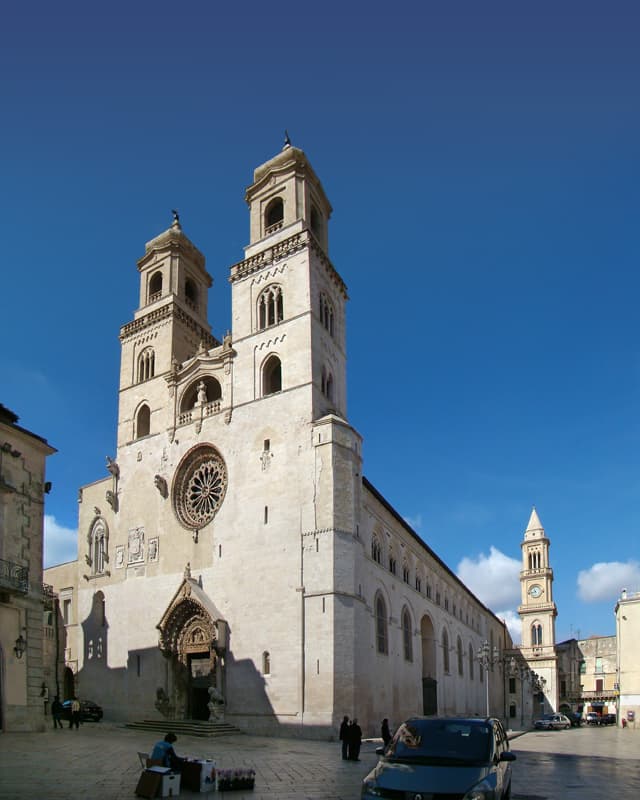
Altamura Cathedral
Altamura Cathedral, officially dedicated to the Assumption of the Blessed Virgin Mary, is a significant Roman Catholic cathedral located in Altamura, Apulia, southern Italy. Originally commissioned by Emperor Frederick II, it has undergone numerous expansions and alterations throughout its history, reflecting various architectural styles and historical periods. It currently serves as the seat of the Bishop of Altamura-Gravina-Acquaviva delle Fonti.