
Acquaviva Cathedral
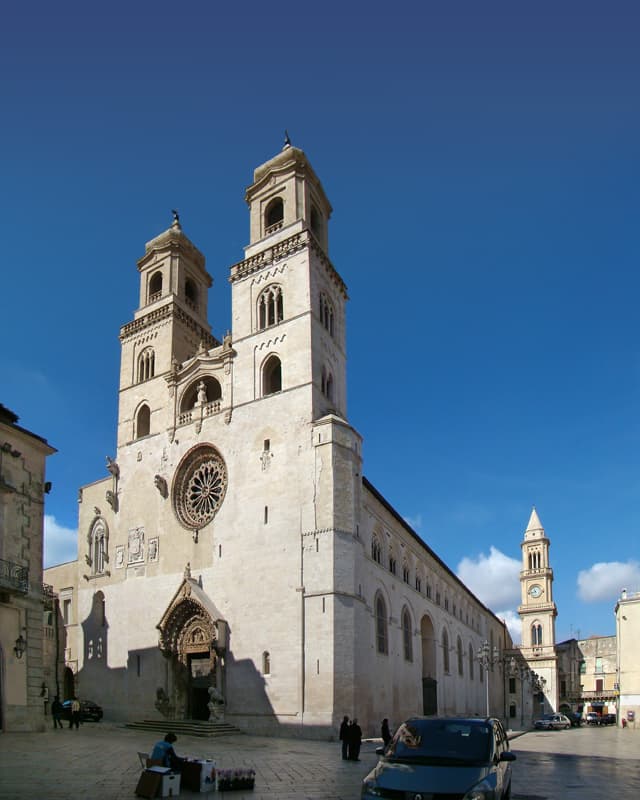
Acquaviva delle Fonti Cathedral, also known as the Concattedrale di Sant'Eustachio, is the principal church of Acquaviva delle Fonti and serves as a co-cathedral within the Diocese of Altamura-Gravina-Acquaviva delle Fonti. Originally a Romanesque structure from the 12th century, it was significantly rebuilt in a Renaissance style in the 16th century and consecrated in 1623.
Key Facts
- ›Originally built in Romanesque style in 1158 by Norman feudal lord Roberto Gurguglione.
- ›Rebuilt in Renaissance style starting in 1529 and completed in 1594.
- ›Consecrated in 1623 in honor of Saint Eustace.
- ›Served as a palatine church, meaning it depended on the king's jurisdiction rather than the ordinary ecclesiastical authority.
- ›The main façade features Renaissance elements, while other façades show Apulian Romanesque influences.
- ›The interior has a Latin cross layout divided into three naves with a vaulted roof.
Renaissance, Apulian Romanesque, Mannerism
- Renaissance Rose Window
- Prothyrum With Columns Resting On Lions
- Bas-Relief Depicting Saint Eustace's Conversion
- Crypt With Twenty-Four Cross Vaults and Fourteen Marble Ionic Columns
- Monumental Organ
12th Century, 16th Century
Giovanni Antonio Donato Acquaviva
About Acquaviva Cathedral
Acquaviva delle Fonti Cathedral
Acquaviva delle Fonti Cathedral, officially known as the Concattedrale di Sant'Eustachio, is the principal church of the town of Acquaviva delle Fonti in Italy. It currently serves as a co-cathedral within the Diocese of Altamura-Gravina-Acquaviva delle Fonti. Historically, it held the status of a palatine church, indicating a direct connection to royal jurisdiction.
History and Construction
The origins of the cathedral trace back to the 12th century, with its initial construction in 1158 in the Romanesque style. This early structure was built by Roberto Gurguglione, a Norman feudal lord, on the site of an older Messapian temple. The church was originally dedicated to the Assumption of the Virgin Mary.
Significant rebuilding efforts commenced in the 16th century. Under the patronage of Giovanni Antonio Donato Acquaviva, the church was reconstructed in the Renaissance style, beginning in 1529. The work was completed and the church reopened for worship in 1594, during the governance of Alberto Acquaviva. The consecration took place in 1623, at which time it was rededicated to Saint Eustace, a martyr.
The designation as a 'palatine' church meant it was likely protected from the authority of the Archbishop of Bari and answered directly to the king. This status was shared with a few other significant churches in the Apulia region.
Architecture and Features
The cathedral presents a fascinating blend of architectural styles. The main façade is characterized by Renaissance elements, including a tripartite design divided by pilasters and organized into two orders with Corinthian and Doric capitals. A prominent Renaissance rose window, tending towards Mannerism, adorns the center of the façade, featuring sixteen columns arranged in a radial pattern.
In contrast, the rest of the façades display architectural characteristics reminiscent of the Apulian Romanesque style. The main portal is distinguished by a finely decorated prothyrum, supported by columns resting on two stylophoric lions. The side portals are topped by niches that once held bas-reliefs depicting the coat of arms of Acquaviva delle Fonti.
The interior of the cathedral follows a Latin cross layout and is divided into three naves, all covered by vaulted ceilings. Large arches supported by stone pillars with half-projecting columns define the structure. The perimeter walls also feature half-extended columns. The vaults, pillars, and columns are embellished with stucco work.
The Crypt
Beneath the main structure lies a crypt, believed to have been built concurrently with the primitive church. This parallelogram-shaped crypt is covered by twenty-four cross vaults, supported by fourteen marble Ionic columns in the central area and smaller pillars along the perimeter walls. The crypt houses three significant altars. One altar features a picture of Saint Eustace, flanked by marble sculptures of his wife, Theopiste, and his sons, Theopistos and Agapios. The central altar, dating from 1693 and dedicated to the Blessed Sacrament, is surrounded by balustrades. The front altar, entirely of silver, is an octagonal temple surmounted by a small dome and contains a large tabernacle. A third altar, dedicated to the Virgin of Constantinople and dating from 1753, is also covered in silver sheets and features a painting attributed to Francesco Palvisino.
Source: Wikipedia ↗
Frequently Asked Questions
When was Acquaviva delle Fonti Cathedral originally built?
The cathedral was originally built in the 12th century, specifically in 1158, in the Romanesque style. It was constructed on the ruins of a small temple with Messapian origins.
What is the architectural style of the cathedral?
The cathedral exhibits a blend of architectural styles. The main façade is predominantly Renaissance, while other parts of the façades are reminiscent of the Apulian Romanesque style. The interior features a Latin cross layout with vaulted ceilings.
What is the history of the cathedral's dedication?
The church was initially dedicated to the Assumption of the Virgin Mary. It was later renamed in honor of the martyr Saint Eustace, to whom it is now dedicated.
What is the significance of its 'palatine' status?
The cathedral was historically known as 'palatine,' meaning it belonged to the king. This status suggested it was preserved from the claims of the archbishop of Bari and that its jurisdiction depended on the king rather than ordinary ecclesiastical authority.
What notable features are found within the cathedral?
The interior includes a 16th-century high altar dedicated to the Virgin of Constantinople and a monumental organ. The crypt contains valuable altars and marble sculptures depicting Saint Eustace and his family.
Related Cathedrals
Altamura Cathedral
Altamura Cathedral, officially dedicated to the Assumption of the Blessed Virgin Mary, is a significant Roman Catholic cathedral located in Altamura, Apulia, southern Italy. Originally commissioned by Emperor Frederick II, it has undergone numerous expansions and alterations throughout its history, reflecting various architectural styles and historical periods. It currently serves as the seat of the Bishop of Altamura-Gravina-Acquaviva delle Fonti.

Alatri Cathedral
Alatri Cathedral, officially the Basilica of Saint Paul, is a Roman Catholic cathedral in Alatri, Lazio, Italy. Originally the cathedral of the Diocese of Alatri, it is now a co-cathedral of the Diocese of Anagni-Alatri. It holds significant relics, including those of Saint Sixtus I and the Ostia incarnata from the Eucharistic miracle of Alatri, making it a site of considerable religious importance.

Ancona Cathedral
Ancona Cathedral, also known as the Basilica Cattedrale Metropolitana di San Ciriaco, is a significant Roman Catholic cathedral in Ancona, Italy, dedicated to Saint Cyriacus. Standing on the site of an ancient Greek acropolis, it showcases a compelling blend of Romanesque-Byzantine and Gothic architectural elements, reflecting centuries of history and reconstruction.