
Bayonne Cathedral
Bayonne, Lescar, and Oloron·Roman Catholic·France
Bayonne Cathedral, officially the Cathedral of Saint Mary of Bayonne, is a significant Roman Catholic church located in Bayonne, France. It stands as a testament to Gothic architecture, built from the 13th century onwards, with notable restorations in the 19th century. The cathedral is an important stop on the Pilgrimage Way of Santiago de Compostela and is recognized as a UNESCO World Heritage Site.
Key Facts
- ›Construction of the present cathedral began in the 13th century and was completed at the beginning of the 17th century.
- ›It was significantly restored and refurbished in the 19th century by Émile Boeswildwald.
- ›The cathedral houses the relics of Saint Leo of Bayonne, a 9th-century bishop.
- ›It is situated on the Pilgrimage Way of Santiago de Compostela.
- ›Bayonne Cathedral was added to the UNESCO World Heritage List in 1998 as part of the Routes of Santiago de Compostela in France.
- ›The north tower features a unique, polychromic bell named Jacques, decorated by Marc-Antoine Orellana.

Relics of Saint Leo of Bayonne, Unesco World Heritage Site Status, Polychromic Bell 'Jacques'
13th, 17th, 19th
éMile Boeswildwald
About Bayonne Cathedral
The Cathedral of Saint Mary of Bayonne, often referred to as Bayonne Cathedral, is a prominent Roman Catholic church located in the town of Bayonne, France. This edifice stands as a significant example of Gothic architecture, with its construction commencing in the 13th century and continuing through to the early 17th century. The building has undergone substantial restoration and refurbishment, most notably in the 19th century under the direction of Émile Boeswildwald, an architect who served the French government.
Historically, the site was previously home to a Romanesque cathedral, which unfortunately succumbed to two destructive fires in 1258 and 1310. The present structure began its construction in the 13th century, with the main body of the cathedral completed by the start of the 17th century. The two distinctive spires were a later addition, only being finished in the 19th century.
Significance and Heritage
Bayonne Cathedral holds spiritual and historical importance, notably housing the relics of Saint Leo of Bayonne, a 9th-century bishop credited with evangelizing the Basque Country. Its location on the Pilgrimage Way of Santiago de Compostela underscores its role as a significant stop for pilgrims. In recognition of this, Bayonne Cathedral was inscribed as a UNESCO World Heritage Site in 1998, as part of the Routes of Santiago de Compostela in France.
Architectural Features
The cathedral is characterized by its Gothic architectural tradition. A notable feature is the north tower, which contains a ring of five bells. Among these is a unique polychromic bell named Jacques, cast in 2003 and artistically decorated by Marc-Antoine Orellana. This bell is distinguished by its painted, symbolic imagery and is considered one of the few polychromic bells found in France. Historical accounts also mention the presence of sundials within the medieval bell tower, remnants of which can still be observed.
Source: Wikipedia ↗
Frequently Asked Questions
What is the history of Bayonne Cathedral?
The site was previously occupied by a Romanesque cathedral that was destroyed by fires in 1258 and 1310. Construction of the current Gothic cathedral began in the 13th century and was largely completed by the early 17th century, with spires added in the 19th century.
What architectural style is Bayonne Cathedral?
Bayonne Cathedral is built in the Gothic architectural tradition. It has undergone significant restoration and refurbishment, particularly in the 19th century.
Is Bayonne Cathedral a UNESCO World Heritage Site?
Yes, Bayonne Cathedral is a UNESCO World Heritage Site. It was added to the list in 1998 as part of the Routes of Santiago de Compostela in France.
What relics are kept at Bayonne Cathedral?
The cathedral contains the relics of Saint Leo of Bayonne, who was a 9th-century Bishop of Bayonne and played a role in the evangelization of the Basque Country.
What is notable about the bells in Bayonne Cathedral?
The north tower houses a ring of five bells, including a unique polychromic bell named Jacques. This bell, cast in 2003, is decorated with symbolic elements and is one of very few polychromic bells in France.
Related Cathedrals

Agen Cathedral
Agen Cathedral, dedicated to Saint Caprasius, is a Roman Catholic cathedral located in Agen, France. Originally built as a collegiate church in the 12th century, it was later elevated to the status of a cathedral and is recognized as a UNESCO World Heritage Site as part of the Routes of Santiago de Compostela in France.

Bordeaux Cathedral
Bordeaux Cathedral, officially the Primatial Cathedral of St Andrew of Bordeaux, is a Roman Catholic cathedral in Bordeaux, France, serving as the seat of the Archbishop of Bordeaux. It is a significant landmark included in the UNESCO World Heritage Site of the Routes of Santiago de Compostela in France. The cathedral showcases a rich architectural history, evolving from Romanesque to Gothic styles and incorporating Renaissance elements, making it a vital historical and religious site.
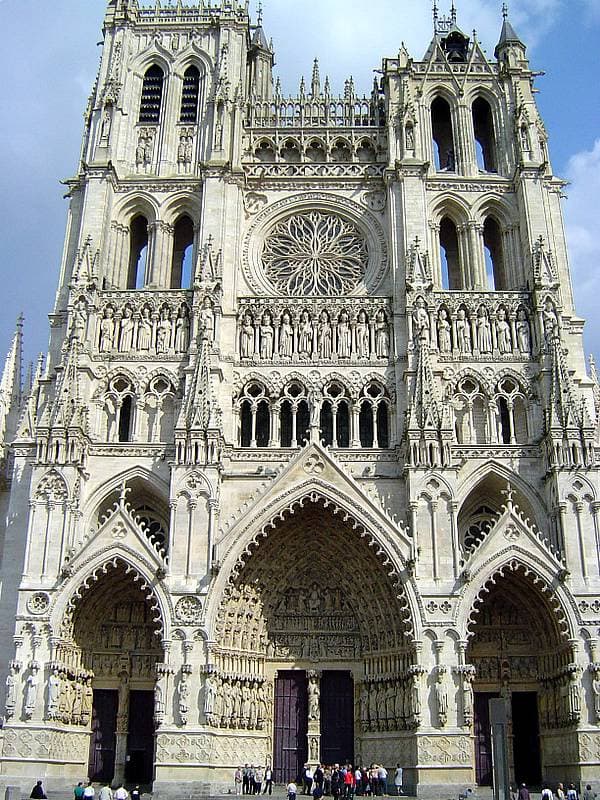
Amiens Cathedral
Amiens Cathedral, officially the Cathedral of Our Lady of Amiens, is a preeminent example of Gothic architecture and a significant religious site in France. It is renowned for its immense scale, being the largest cathedral by volume in France, and for its remarkably unified High Gothic and Rayonnant style, achieved through a swift construction period. The cathedral is also celebrated for its extensive collection of early Gothic sculpture, particularly on its west facade, and holds a UNESCO World Heritage designation.