
Agen Cathedral
Agen Cathedral, dedicated to Saint Caprasius, is a Roman Catholic cathedral located in Agen, France. Originally built as a collegiate church in the 12th century, it was later elevated to the status of a cathedral and is recognized as a UNESCO World Heritage Site as part of the Routes of Santiago de Compostela in France.
Key Facts
- ›The visible structure of Agen Cathedral dates back to the 12th century, initially serving as a collegiate church.
- ›It is a UNESCO World Heritage Site, designated as part of the Routes of Santiago de Compostela in France.
- ›The cathedral was sacked by the Normans in the 9th century and again during the Wars of Religion in the 16th century.
- ›It became the cathedral of the diocese of Agen in 1801, replacing a former cathedral destroyed during the French Revolution.
- ›The main organ, built by Stoltz, was reputedly offered to the cathedral in 1858 and is the largest in the Lot-et-Garonne department.
- ›Architectural features include a Romanesque apse extended by a Gothic frame and a tower built in 1835 incorporating three Gothic styles in reverse chronological order.

Romanesque, Gothic
- Main Organ By Stoltz
- Choir Organ By Magen
- Romanesque Apse With Gothic Extension
- Tower With Three Gothic Styles In Reverse Chronological Order
- Paintings Depicting the History of Christianity and Early Martyrs
12th Century, 13th Century
About Agen Cathedral
Agen Cathedral, officially known as the Cathédrale Saint-Caprais d'Agen, stands as a significant religious and historical landmark in Agen, Lot-et-Garonne, France. Dedicated to Saint Caprasius of Agen, its origins trace back to the 12th century when it was established as a collegiate church. The cathedral's importance is further underscored by its designation as a UNESCO World Heritage Site, recognized for its role along one of the historic pilgrimage routes toward Santiago de Compostela in Spain.
History and Development
The visible fabric of Agen Cathedral largely dates from the 12th century, built upon the site of a basilica that had been sacked by the Normans in the 9th century. The church endured further turmoil, including a significant sacking in 1561 during the Wars of Religion. During the French Revolution, it was repurposed as a fodder store, only to be reopened in 1796. Its status evolved in 1801 when it was elevated to become the cathedral of the diocese of Agen, succeeding Saint Stephen's Cathedral, which was destroyed during the revolutionary period. The cathedral also holds a unique place in photographic history, appearing in one of the earliest color photographs taken by Louis Arthur Ducos du Hauron in 1877.
Architectural Significance
The architectural design of Agen Cathedral reflects a blend of styles, typical of many churches in southern France. Its plan is laid out in the form of a Latin cross, with the nave originating from the 13th century. A notable feature is its Romanesque apse, which is subsequently extended by a Gothic frame. The current bell tower, erected in 1835, is an unusual construction, incorporating three distinct Gothic styles presented in ascending order, a curious reversal of chronological progression. The interior walls and ceilings are adorned with paintings that narrate the advent of Christianity in the region, with a particular focus on the first martyrs of Agen, alongside depictions of the Evangelists, Apostles, patriarchs, and ancient Israelite kings. The nave's relatively short length compared to the chancel is attributed to earlier political and financial constraints encountered during its construction.
Organs and Heritage
Agen Cathedral houses significant musical instruments. The main organ, built by Stoltz, was famously featured in the 1855 Universal Exposition in Paris and is said to have been gifted to the cathedral in 1858. It is the largest organ in the Lot-et-Garonne department, featuring 45 registers across three manuals and a pedal-board. This instrument, along with the choir organ built by Magen in 1885, is recognized as a nationally listed historical monument, further contributing to the cathedral's rich heritage.
Source: Wikipedia ↗
Frequently Asked Questions
What is Agen Cathedral dedicated to?
Agen Cathedral is dedicated to Saint Caprasius of Agen, also known as Saint Caprais. He is the patron saint to whom the cathedral is consecrated.
When was Agen Cathedral built?
The visible structure of Agen Cathedral dates to the 12th century. It was initially constructed as a collegiate church on the foundations of an earlier basilica.
Is Agen Cathedral a UNESCO World Heritage Site?
Yes, Agen Cathedral is a UNESCO World Heritage Site. Its designation falls under the category of Routes of Santiago de Compostela in France, recognizing its significance as a pilgrim route.
What is notable about the organ at Agen Cathedral?
The main organ at Agen Cathedral, built by Stoltz, is a significant feature. It is the largest instrument in the Lot-et-Garonne department, boasting 45 registers spread over three manuals and a pedal-board. It is also a nationally listed historical monument.
What architectural styles can be seen at Agen Cathedral?
Agen Cathedral exhibits a mix of architectural styles. It features a Romanesque apse that is extended by a Gothic frame along a single nave. The tower, built in 1835, is notable for incorporating three Gothic styles presented in ascending reverse chronological order.
Related Cathedrals
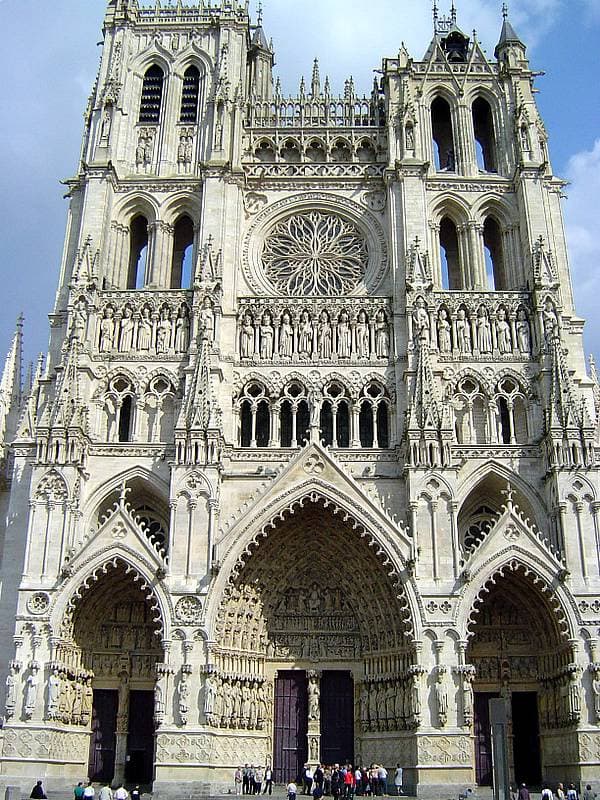
Amiens Cathedral
Amiens Cathedral, officially the Cathedral of Our Lady of Amiens, is a preeminent example of Gothic architecture and a significant religious site in France. It is renowned for its immense scale, being the largest cathedral by volume in France, and for its remarkably unified High Gothic and Rayonnant style, achieved through a swift construction period. The cathedral is also celebrated for its extensive collection of early Gothic sculpture, particularly on its west facade, and holds a UNESCO World Heritage designation.

Avignon Cathedral
Avignon Cathedral, officially Cathédrale Notre-Dame des Doms d'Avignon, is a Romanesque Roman Catholic cathedral located in Avignon, France, adjacent to the Palais des Papes. It serves as the seat of the Archbishop of Avignon and is recognized for its significant architectural history and its inclusion as part of the UNESCO World Heritage site of Avignon.

Durham Cathedral
Durham Cathedral, formally the Cathedral Church of Christ, Blessed Mary the Virgin and St Cuthbert of Durham, is a prominent Church of England cathedral and the seat of the Bishop of Durham. It houses the shrines of Anglo-Saxon saints Cuthbert and Bede and is renowned for its significant Romanesque architecture, particularly its early example of a pointed rib vault in the nave. The cathedral forms part of the Durham Castle and Cathedral World Heritage Site.