
Bayombong Cathedral
Diocese of Bayombong·Roman Catholic·Philippines
Saint Dominic de Guzman Cathedral, commonly known as Bayombong Cathedral, is an 18th-century Baroque Roman Catholic church in the Philippines. It serves as the seat of the Diocese of Bayombong and is dedicated to Saint Dominic. The cathedral has a history of fires and reconstructions, with only its façade and bell tower remaining from the original Spanish era structures.
Key Facts
- ›Originally founded in 1739 by Augustinian Friars, it was rededicated to St. Dominic de Guzman on September 8th of the same year.
- ›The current church structure began construction in 1780 under Father Juan Crespo, OP.
- ›The cathedral has suffered significant damage from fires in 1892 and 1986, and the 1990 Luzon earthquake.
- ›Reconstruction after the 1892 fire in 1895 included galvanized iron roofing, new altarpieces, and a new pulpit.
- ›The façade and bell tower are the only original portions remaining from the Spanish era.
- ›Its façade is described as a close copy of churches in Dupax del Sur and Bambang, Nueva Vizcaya, and shares similarities with the older Tuguegarao Cathedral.

FaçAde, Bell Tower, Octagonal Campanile
Juan Crespo, Op
About Bayombong Cathedral
Saint Dominic de Guzman Cathedral (Bayombong Cathedral)
Saint Dominic de Guzman Cathedral, commonly known as Bayombong Cathedral, is an 18th-century Baroque Roman Catholic church located in Bayombong, Nueva Vizcaya, Philippines. It holds significance as the seat of the Diocese of Bayombong and is dedicated to Saint Dominic de Guzman.
History and Construction
The mission in present-day Bayombong began in the mid-18th century and was formally accepted by the Dominicans. The first Eucharistic Celebration took place on April 23, 1739, with the church initially called the Church of St. Augustine. By September 8 of that year, it was rededicated to St. Dominic de Guzman. The erection of the church structure commenced in 1780 under the supervision of Father Juan Crespo, OP. However, the cathedral has faced considerable damage throughout its history. In 1892, a fire gutted the church and other nearby structures. Father Cerefino Martinez, O.P., led the reconstruction, which was completed in 1895 and included galvanized iron roofing, new altarpieces, and a new pulpit. More recently, another fire in 1986 and the 1990 Luzon earthquake severely damaged the church, destroying its bells and leaving only the façade and bell tower as original portions from the Spanish era.
Architecture
The architectural style of Bayombong Cathedral is characterized by its 18th-century Baroque design. The church façade is notably described as a close imitation of the San Vicente Ferrer Church in Dupax del Sur and the Santa Catalina de Siena Church in Bambang, Nueva Vizcaya. It shares similarities in its doors, windows, oculus, and pediment shape with the older Tuguegarao Cathedral in Cagayan province. A distinguishing feature of Bayombong Cathedral is its slightly detached, octagonal campanile. The façade itself has a squat appearance, divided into four sections by cornices. It is ornamented with two windows on the second level, flanking a saint's niche, and an oculus on the third level. Unlike some other churches, it lacks columns framing the windows.
Source: Wikipedia ↗
Frequently Asked Questions
When was Bayombong Cathedral founded?
Bayombong Cathedral was originally founded in 1739 by the Augustinian Friars. The first Eucharistic Celebration was held on April 23, 1739.
What is the architectural style of Bayombong Cathedral?
The cathedral is described as an 18th-century Baroque Roman Catholic church. Its façade shares similarities with other churches in the Nueva Vizcaya province and the Tuguegarao Cathedral.
Has Bayombong Cathedral always been dedicated to Saint Dominic?
Initially, the church was called the Church of St. Augustine. It was later rededicated to St. Dominic de Guzman on September 8th of its founding year.
What parts of Bayombong Cathedral are original from the Spanish era?
Following significant damage from fires and an earthquake, only the façade and the bell tower remain as original portions from the Spanish era.
What historical events have impacted Bayombong Cathedral?
The cathedral has been affected by several destructive events, including fires in 1892 and 1986, and the 1990 Luzon earthquake, which necessitated reconstructions.
Related Cathedrals

Alatri Cathedral
Alatri Cathedral, officially the Basilica of Saint Paul, is a Roman Catholic cathedral in Alatri, Lazio, Italy. Originally the cathedral of the Diocese of Alatri, it is now a co-cathedral of the Diocese of Anagni-Alatri. It holds significant relics, including those of Saint Sixtus I and the Ostia incarnata from the Eucharistic miracle of Alatri, making it a site of considerable religious importance.
Altamura Cathedral
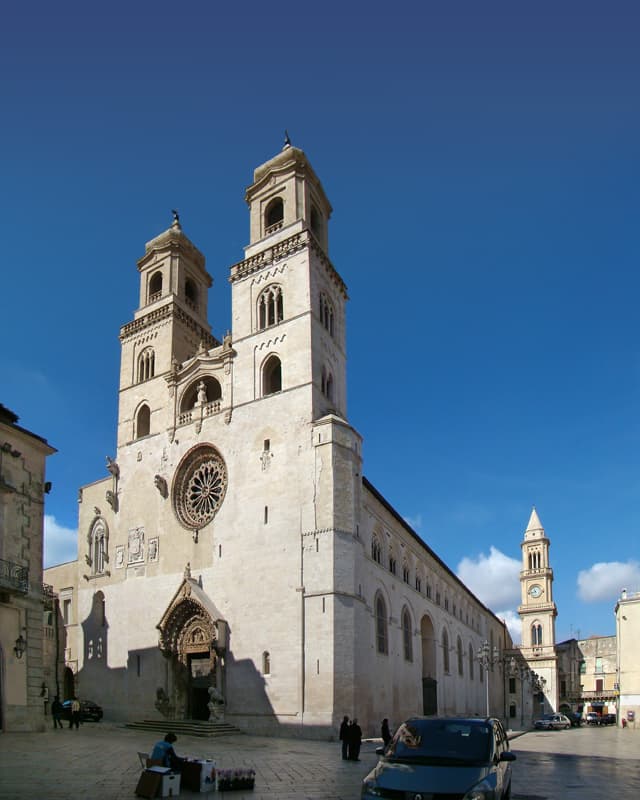
Altamura Cathedral, officially dedicated to the Assumption of the Blessed Virgin Mary, is a significant Roman Catholic cathedral located in Altamura, Apulia, southern Italy. Originally commissioned by Emperor Frederick II, it has undergone numerous expansions and alterations throughout its history, reflecting various architectural styles and historical periods. It currently serves as the seat of the Bishop of Altamura-Gravina-Acquaviva delle Fonti.

Amalfi Cathedral
Amalfi Cathedral, officially the Cathedral of Saint Andrew, is a medieval Roman Catholic cathedral located in Amalfi, Italy. It is renowned for its elaborate architecture, a blend of various historical styles, and for housing the relics of the Apostle Saint Andrew. The cathedral has been an important religious center and a significant landmark of the Amalfi Coast for centuries.